


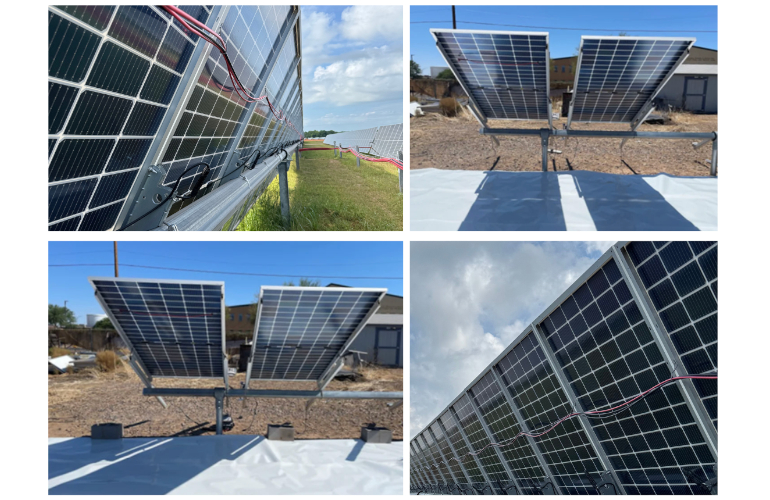

According to a new white paper from Arizona State University (ASU), rear-hanging cables on bifacial solar projects do not contribute enough shading to affect performance or reliability of projects.

Images from the white paper
The white paper, “Impact of Rear-Hanging String-Cable-Bundle Shading on Performance Parameters of Bifacial Photovoltaic Modules,” was written by Dr. GovindaSamy Tamizhmani, a research professor and the director of the Photovoltaic Reliability Laboratory at ASU. Affordable Wire Management (AWM) collaborated on the paper.
“Partnering with Dr. Mani and the team at Arizona State University on this research has been a true honor,” said Dan Smith, chief technology officer and co-founder of AWM. “ASU is my alma mater, which makes this collaboration meaningful on a personal level. Together, we have delivered findings that we believe will fundamentally change cable management design for bifacial PV across the utility-scale industry.”
The study found that rear-side cable bundles — ranging from groups of two to 16 cables and suspended from 3- and 6-in. hangers — have a negligible effect on PV module performance, contributing ≤0.6% impact on Pmax compared to the significantly larger 3 to 30% losses associated with mounting structures. These results are consistent across both single-axis tracker and fixed-tilt systems and with varying surface conditions, including white ground, indicating that the evaluated cable hanger designs are unlikely to cause any meaningful performance loss in real-world applications.
Beyond performance, industry experience and vendor assessments suggest that behind-the-module cable hanger systems can deliver notable efficiency gains, including reducing total cable length by approximately 20 to 30% and installation time by 15 to 20%, while eliminating pinch points near torque tubes and tracker components.
Shading can be detrimental, ultimately resulting in reduced energy yield, improper electrical output and hot spots. The industry has been overly cautious of this and has consistently routed cables along structural components such as torque tubes to prevent rear shading. However, this practice has increased cable lengths and decreased reliability due to the wiring interacting with moving system parts. The results of the research and white paper proved that shading is not a factor for concern, and performance and reliability are not compromised with rear hanging cables.
Additionally, normalized shading ratio (NSR), a novel metric, was developed and subsequently utilized to obtain these results. Up until now, there has not been one single method to quantify rear-side shading impacts in bifacial PV installations. NSR isolates the performance effects of cable bundles from other factors, enabling a precise assessment of real-world power plant energy yield. By establishing a standardized way to measure a previously difficult-to-calculate variable, NSR not only strengthens the study’s conclusions but also provides the industry with a powerful new approach. In the future, NSR may help to inform design decisions and optimize power plant cable management layouts.
AWM produces write management products for ground-mount solar projects. The company uses a “golden row” methodology for string wire management with its Bonsai system, which provides installers with repeatable guidance for routing cable along tracker systems. Building on the findings of this new research, AWM is further refining its designs to support straight-line cable routing across module frames.
The golden row concept standardizes a ‘reference row’ at the outset of construction. This row serves as a blueprint for cable routing, attachment points and overall system layout, enabling crews to replicate best practices efficiently across the entire site. By resolving potential conflicts early and creating a clear installation benchmark, golden row reduces rework, accelerates crew training, and drives greater uniformity and quality across large-scale projects.
“At AWM, we view installation guidance as an extension of product design. Every detail is engineered to deliver consistency and predictability in the field,” said Scott Rand, CEO and co-founder of AWM. “Our golden row methodology exemplifies this philosophy by establishing a clear standard that enables faster, more reliable installations. Coupled with the introduction of the NSR, the industry now has a validated framework for accurately assessing shading impacts, empowering developers and engineers to make more informed design decisions that enhance power plant performance and long-term reliability.”









