

Imagine a farmer in Rajasthan, rising before dawn to water his fields. Not because he has to, but because his solar-powered pump will do it automatically when the sun comes up. Or imagine a small shop owner in rural Odisha operating a flour mill and a refrigerator without the daily stress of 8-hour power cuts.
These are not dreams of far away; these stories are now coming true in villages across the country thanks to the fast-growing solar energy in rural India.
In 2025-26, India achieved a historic milestone: “In January 2025, solar capacity crossed 100 GW for the first time,” and the country is now 3rd worldwide in solar power capacity. This transformation is driven by rural India. But millions of households still suffer from unreliable electricity, frequent blackouts, and high diesel prices
This guide is for people who live in a village, run a farm, or have a small business in a semi-urban area. So, let’s check what you need to know about solar solutions for rural areas in plain, simple language.
One of the tough realities today is, even though India has made progress in electrifying villages, many rural homes get just a few hours of electricity a day. Government data shows rural power supply has improved from 12.5 hours in 2014 to about 22.6 hours per day by 2025. That’s real progress. But it also means millions of homes still go without power for 1-2 hours daily, and it’s worse in remote areas.
The daily costs of poor electricity supply to rural families are:
-
Without candles or expensive kerosene lamps, students can’t study after dark.
-
Farmers are buying diesel for irrigation pumps at the rate of thousands of rupees every month.
-
Small shop owners lose business when their machines break down in the middle of a job.
The answer to all of this is solar energy, and it’s a lasting answer. Sunlight is free once you have a solar system. No monthly fuel bills, no waiting for the electricity department, no power cuts under someone else’s control.
Also, about 2.4 percent of Indian households still remain unelectrified, mostly in remote hilly or forest areas, where it is costly to lay power lines. Off-grid solar systems are the only viable option for these areas.
India is blessed with an abundance of sunshine. Most of the country sees 300+ sunny days annually. So solar energy is not just a good idea for rural India. It’s probably the best idea.
Types of solar solutions available for rural India
Before you buy, it’s important to understand the three main types of solar systems. No problem, we’ll keep it simple.
1. Grid-Connected: On-Grid Solar System
It’s an ordinary electricity connection, only with solar panels installed on your rooftop. Your panels generate power during the day, and you consume it. Any excess electricity flows back into the government grid, and you get credit on your electricity bill; this is called net metering.
Best for: Homes in semi-urban or village areas having a government electricity connection and looking to bring down their monthly bills.
Limitation: This system also stops working if there is a power cut, as it relies on the grid to work. That’s why battery backup is so important.
2. Standalone: Off-Grid Solar System
This system works totally autonomously, not connected to the grid of the government. Your solar panels charge a bank of batteries that you can use at night or when the sun isn’t shining.
Best for: Remote villages not connected to the grid or areas with very long power cuts (6-12 hours per day).
Limitations: Batteries add to the cost and need replacement every 5 to 8 years.
3. Mix of both: Solar Hybrid System
This is the best of both worlds, as the name suggests. It connects to the grid and has a battery back-up. Your home is solar-powered during the day. The battery is oversupplied with power. If the battery is full, it goes to the grid. If the power goes out or it is dark, the battery takes over.
Best for: Families who want the best savings and constant power.
Best solar solution for village, farms and small businesses
-
For rural homes:
A simple rooftop solar system of 1 KW to 3 KW is enough to run 3-4 LED lights, fans, a TV, a mobile charger, and a small fridge. The cost of setting up a 1 kW system will be around Rs 60,000-80,000 before the subsidy. But with the support of government, you can reduce the cost significantly.”
-
For Farmers (Kisan Solar Solutions):
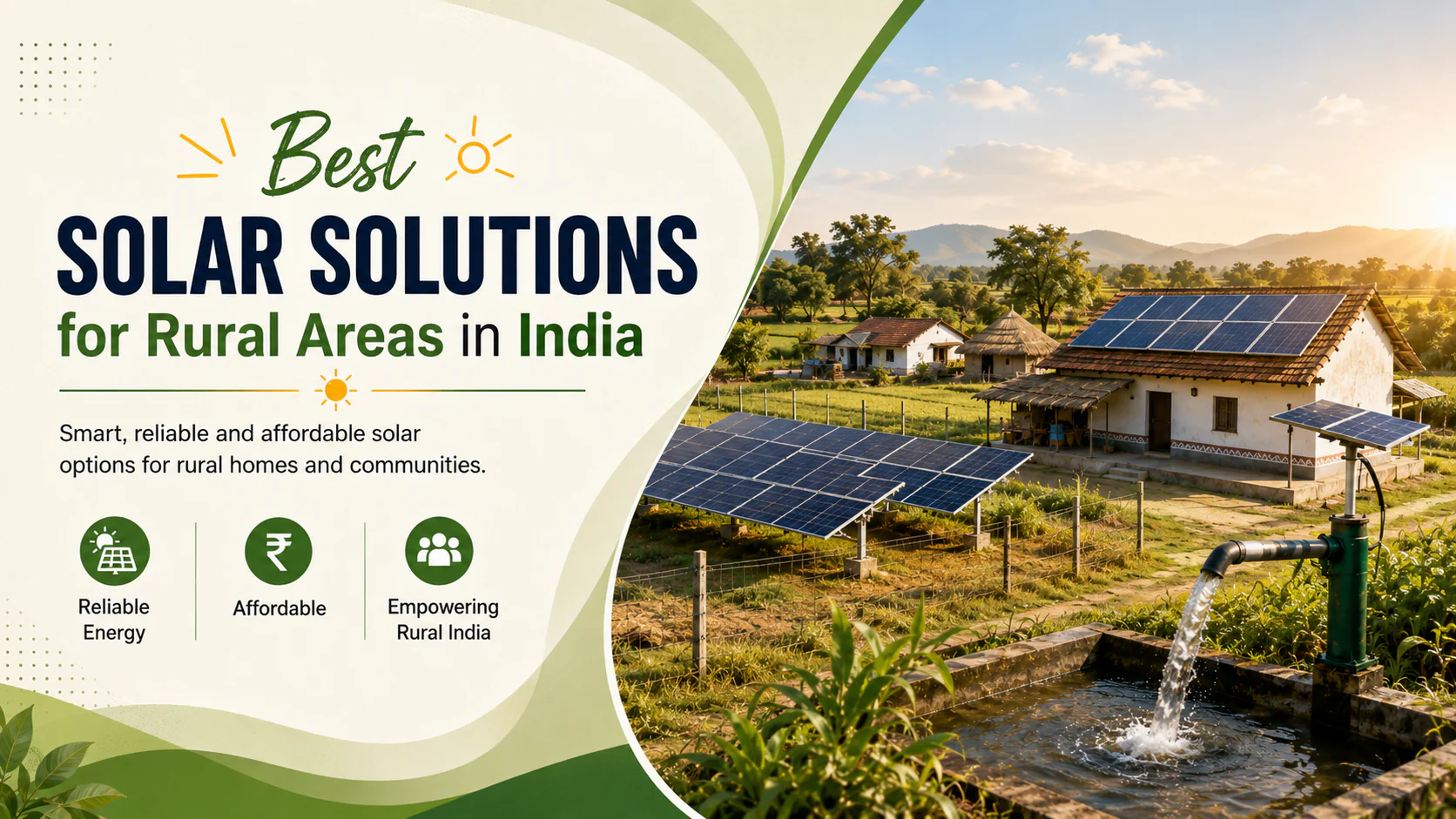
Solar Water Pumping is a very life-changing solar solution for the rural areas Farmers traditionally use diesel pumps for irrigation of their fields, costing ₹8,000–₹15,000 per month on fuel alone. A solar water pump replaces diesel completely; it runs on sunlight and has a near-zero running cost.
Some of the popular ones are:
-
1 HP to 5 HP Solar Pumps for Small & medium-sized farms
-
Deep borewell submersible solar pumps
-
Surface Water Solar Pumps Open Wells, Ponds
Already there are more than 10 lakh solar pumps installed or targeted under government schemes. A farmer using a solar pump can save ₹1-1.5 lakh a year in diesel costs alone.
-
For Schools & Clinics
A 2-5 kW solar system can power a village school’s lights, fans, computers, and projectors without dependence on the unreliable grid power. Solar can power village health clinics to run refrigerators for storing vaccines and basic diagnostic equipment.
-
For Small Businesses and Stores:
A 3-5 kW solar system will help you keep your business running through power cuts, whether you run a kirana store, flour mill, welding shop, or mobile charging center. Many rural entrepreneurs have found that solar is a self-paying investment in 3-5 years through savings on electricity and diesel fuel.
-
For Street Lights:
Standalone solar street lights are a perfect solution for village panchayats and local bodies with low maintenance. They have their own panel and battery, require no wiring, and give light for 10-12 hours every night.
Government subsidies & rural solar schemes
The government of India has launched several schemes to make solar affordable for rural households and farmers. Here are the most important ones:
PM Surya Ghar: Muft Bijili Yojana (For Homeowners):
This scheme is the world’s largest domestic rooftop solar program, launched in February 2024. The aim of the scheme is to establish rooftop solar in 1 crore (10 million) households by 2026-27 with a total government outlay of ₹75,021 crore.
What subsidy do you receive?
-
Up to ₹30,000/kW for the first 2 kW
-
Maximum subsidy up to ₹78,000 per household
-
In addition, net metering will allow you to receive up to 300 units of free electricity every month
Under this scheme, about 23.9 lakh homes had installed rooftop solar by December 2025 and 1.38 crore registrations were received.
To know more about the step-by-step registration process, check out this blog—Haryan solar subsidies 2026 PM Surya Ghar Yojana
PM-KUSUM Yojana (For Farmers):
The Pradhan Mantri Kisan Urja Suraksha evam Utthan Mahabhiyan (PM-KUSUM) scheme is for farmers only. It consists of:
-
30% subsidy on solar water pumps (central government) + 30% subsidy (state government)
-
Farmers pay only 10% of the cost upfront and the balance as a bank loan
-
Subsidies are up to 80% in hilly and north-eastern states
The scheme has a target of installing solar capacity of 34,800 MW and enabling 14 lakh standalone solar pumps by 2026. The total number of solar pumps installed under PM-KUSUM has already crossed 10 lakh.
Things to considered before installing solar in rural India
Installing solar is a big investment, so it’s worth considering some key things before you take the plunge.
1. How Much Power Do You Really Need?
Make a list of all appliances in your home or farm: lights, fans, TV, water pump, mixer, and fridge. Your exact power requirement (in kW) can be calculated from this list by an experienced solar installer. Don’t underbuy or overbuy.
2. Battery Backup is Essential in Rural Areas
A simple on-grid system works well in cities where power cuts are frequent. Power outages are frequent in rural India, due to which a battery backup is a must. That’s why choose a lithium-ion or tubular battery that lasts for 5-8 years.
3. The Quality of the Solar Panels Matters
Every solar panel you see is not built the same. Always look for:
-
Panels with BIS certification and ALMM listing (mandatory for government subsidies)
-
Panels with 25-year manufacturer’s performance guarantee
-
Reliable brands with service centers in your vicinity
4. Pick a Local and Reputable Installer
Check references in your village or district. A bad installation can cut your system’s efficiency by 20 to 30 percent. Make sure your installer will also help with the government subsidy paperwork.
5. Roof Top Condition and Orientation
Solar panels are most effective when installed on a south-facing roof, free from the shade of trees or water tanks. If you have a leaky or damaged roof, repair it before you install panels; maintenance is much more difficult afterward.
6. Cost Up Front vs. Savings Long-Term
A 3 kW solar system can cost around ₹1.5-2 lakh after subsidy. But it can help you save ₹30,000-₹50,000 a year on electricity and diesel bills. That means it pays for itself in 3–5 years and then gives you almost another 20 years of almost free energy.
Conclusion
Rural India is at a crossroads. India is racing towards a cleaner energy future with over 253 GW of total renewable energy capacity installed by the end of 2025, with solar leading the charge. With government schemes such as PM Surya Ghar Yojana and PM-KUSUM, solar has become more affordable than ever for ordinary families and farmers.
If you’re a homeowner who is tired of power cuts, a farmer paying too much for diesel, or a shopkeeper looking to cut costs, there’s a solar solution for you.
The best time to go solar was 5 years ago. Now is the second best time.
Loom Solar is among the most trusted brands in India for rural homes and small businesses looking for reliable and high-quality solar panels and systems. They offer a different variety of technologies like monocrystalline, TOPCon, HJT, bifacial, and back contact panels, as well as lithium batteries and complete solar kits designed for Indian homes, farms, and small businesses.