

by Riko Seibo
Tokyo, Japan (SPX) Apr 16, 2026
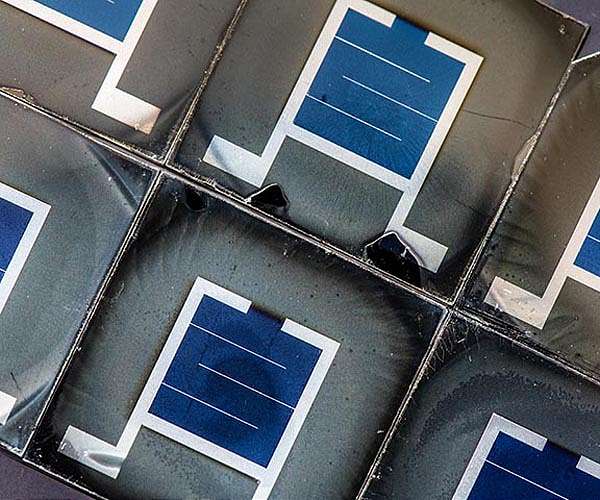
Perovskite solar cells have emerged as one of the most promising next-generation photovoltaic technologies, but their development still depends heavily on time-consuming trial-and-error synthesis and labor-intensive device fabrication. Researchers from the Hong Kong Polytechnic University and collaborating institutions have now reported an agentic robotics system that carries out the full cycle of perovskite solar cell research – from synthesis and fabrication through to characterization and feedback-driven optimization – within a unified AI-robotics framework.
Using the system, the team carried out 50,764 perovskite solar cell device experiments, achieved a champion power conversion efficiency of 27.0 percent with a certified value of 26.5 percent, and generated more than 578 million tokens to strengthen recipe recommendation and mechanistic reasoning.
At the core of the study is the idea that robotic experimentation should do more than automate repeated operations. The researchers designed a seven-layer artificial intelligence architecture covering learning, generating, recipe question-answering, fine-tuning, reasoning, evaluation, and optimization. Within this framework, both numerical and semantic recipes can be continuously learned from literature corpora and robot-generated corpora, enabling iterative refinement of the recipe language model, or RLM.
Formulas and parameters are encoded into machine-readable recipes, translated into robot-executable commands, and returned as structured feedback after fabrication and characterization, establishing a closed-loop workflow linking recommendation, execution, validation, and model improvement.
The hardware system upgrades an earlier robotic synthesis platform into a full-device fabrication system for perovskite solar cells. A digital twin serves as a real-time software-hardware interface, translating model-generated recipes into executable robotic instructions while synchronizing experimental states and feedback.
The 11 robotic boxes form an enclosed and interconnected environment for synthesis, fabrication, and characterization. Altogether, the system includes 101 functional modules, more than 1,500 components, and 4,300 controllable parameters, reconstructing traditionally fragmented glovebox-based manual operations into coupled robotic execution.
The key advance is the integration of three capabilities within one closed-loop framework: controllable fabrication of full perovskite solar cell devices by robotic boxes, robotic characterization that converts high-throughput experimental outputs into structured mechanism-related evidence, and a domain-specific RLM that is trained and continuously improves recipe recommendation, mechanistic reasoning, and subsequent robotic execution.
The significance of the work extends beyond perovskite photovoltaics. By integrating a language agent, an RLM, robotic fabrication, robotic characterization, and feedback-driven optimization into one research framework, the study provides a practical route toward next-generation materials research tools.
The researchers describe the approach as a paradigm shift from manual discovery, offering a scalable architectural foundation for materials intelligence. In the longer term, such AI and robotics systems could be deployed in extreme environments to support on-site materials manufacturing.
Research Report:Agentic Robotic Boxes for Perovskite Solar Cell Fabrication with Recipe Language Model
Related Links
Hong Kong Polytechnic University
All About Solar Energy at SolarDaily.com