

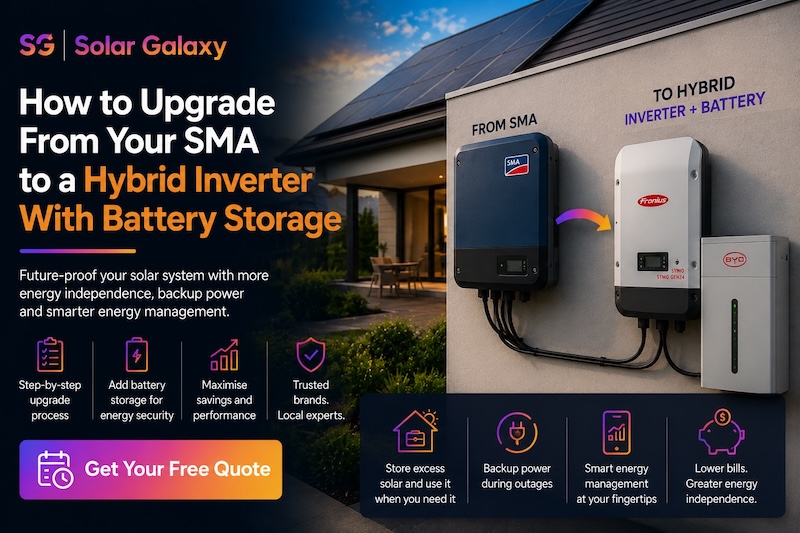
Australian homeowners with SMA inverters face a pressing decision now that SMA is exiting the Australian residential market. Most SMA Sunny Boy models are string inverters without direct battery connection. Two upgrade paths exist: replace the SMA with a DC-coupled hybrid inverter, or add an AC-coupled battery alongside it. Each path carries different efficiency trade-offs, costs, and installation requirements.
What Is DC-Coupled Battery Storage With a Hybrid Inverter?
DC-coupled storage uses a single hybrid inverter to manage solar panels and a battery in one unit, sending energy from panels to battery without converting it to AC first. This approach achieves 95-98% round-trip efficiency because solar energy travels directly from panels to battery as DC power.
A hybrid inverter handles 3 tasks simultaneously. It converts DC power from panels to AC for household appliances like air conditioners, heat pumps, and pool pumps. It routes excess solar energy into the battery with minimal conversion loss. It also discharges stored battery power to the home during evening hours.
Replacing an SMA with a hybrid inverter is the most common upgrade path, particularly when the SMA unit is 8 or more years old. The SMA gets removed entirely. New wiring connects the existing solar panels to the hybrid inverter, which then serves as the single control point for generation, storage, and grid export.
Which Hybrid Inverters Work Best as SMA Replacements?
The Fronius Gen24 Plus, Sungrow SH Series, and GoodWe EH/ES Series are the 3 strongest options for Australian households upgrading from SMA string inverters.
| Brand and Model | Best For | Compatible Batteries |
|---|---|---|
| Fronius Gen24 Plus | Premium quality, backup power | BYD HVS/HVM, Fronius Reserva |
| Sungrow SH Series | Best value, fast switchover | Sungrow SBR range |
| GoodWe EH/ES Series | Wide battery compatibility | BYD, LG Energy Solution, compatible 48V |
Each of these brands holds CEC product approval for the Australian market. The Fronius Gen24 Plus suits homeowners who prioritise build quality and backup power. Sungrow delivers strong performance at a lower price point. GoodWe offers the widest range of compatible battery brands, including BYD, LG Energy Solution, and various 48V lithium options.
How Much Does a Hybrid Inverter Upgrade Cost in Australia?
A hybrid inverter replacement without a battery costs $2,500-$7,200, while a full upgrade with battery ranges from $8,000-$18,000 depending on brand selection and system size.
| Component | Cost Range |
|---|---|
| Hybrid inverter (Fronius, Sungrow, or GoodWe) | $2,000-$5,700 |
| Installation labour | $500-$1,500 |
| Battery (lithium, 5-13.5 kWh) | $4,000-$14,000 |
The hybrid inverter can be installed without a battery on day one. Many homeowners choose this staged approach, locking in the efficient DC-coupled architecture now and adding a battery 6-12 months later when budget allows.
What Are the Advantages and Drawbacks of Replacing Your SMA?
The primary advantage is efficiency: DC-coupled systems retain 95-98% of stored energy compared to AC-coupled setups that lose additional energy through double conversion.
Other benefits include a cleaner single-unit installation, backup power capability during grid outages, and a unified monitoring app from brands like Fronius Solar.web or Sungrow iSolarCloud. The system also becomes future-proof. You avoid reliance on an inverter brand that will no longer supply the Australian residential market.
The drawbacks are real, though. Upfront cost runs higher than an AC-coupled retrofit. Installation requires rewiring from the solar panels, which adds complexity. Your solar system goes offline for 4-8 hours during the swap.
What Is an AC-Coupled Battery and When Does It Make Sense?
An AC-coupled battery has its own built-in inverter and connects to your switchboard independently, allowing your existing SMA to keep operating while the battery handles charging and discharging on the AC side. This makes sense when your SMA inverter is less than 3 years old and still under warranty.
Two AC-coupled batteries dominate the Australian market. The Tesla Powerwall 3 works with virtually any existing inverter and remains the most widely installed AC-coupled option nationally. The Enphase IQ Battery uses a modular design with a 15-year warranty and strong monitoring features.
An AC-coupled battery installed costs $8,000-$16,000 depending on brand and capacity. No inverter replacement is needed, so installation is faster and simpler. However, AC-coupled systems suffer from lower round-trip efficiency because energy converts from DC to AC at the SMA, then from AC to DC when entering the battery, then back from DC to AC when powering your home.
The catch with this approach: you will eventually need to replace the SMA anyway. With SMA leaving Australia, spare parts and warranty support will diminish over time. You end up paying for 2 separate devices now and a third device (a new inverter) later.
How Do DC-Coupled and AC-Coupled Systems Compare Side by Side?
DC-coupled wins on efficiency and long-term value, while AC-coupled wins on upfront simplicity when a working SMA inverter is already in place.
| Factor | DC-Coupled (Hybrid) | AC-Coupled (Keep SMA) |
|---|---|---|
| Round-trip efficiency | 95-98% | Lower (double conversion loss) |
| Upfront cost (with battery) | $8,000-$18,000 | $8,000-$16,000 |
| Installation time | 4-8 hours (full day with battery) | Half day typical |
| Number of devices | 1 inverter + 1 battery | 2 inverters + 1 battery |
| Future SMA replacement needed | No | Yes |
| Backup power | Yes (most models) | Yes (Tesla, Enphase) |
The efficiency gap between DC-coupled and AC-coupled battery storage matters most over time. A DC-coupled hybrid inverter retains 95-98% of the solar energy it stores, because power flows directly from panels to battery as DC current with no intermediate conversion. An AC-coupled system forces energy through 2 extra conversion steps, losing a measurable percentage at each stage. Over a 10-year battery lifespan, that efficiency difference translates to hundreds of additional kilowatt-hours captured each year. For a household generating 20-30 kWh of solar daily, selecting the higher-efficiency path compounds into thousands of dollars in additional savings across the system’s lifetime.
Which Upgrade Path Suits Your Situation?
Homeowners with an SMA inverter older than 5 years should replace it with a hybrid inverter in almost every scenario. The decision becomes less clear-cut only when the SMA is relatively new.
| Your Situation | Recommended Path |
|---|---|
| SMA is 8+ years old or out of warranty | Replace with hybrid inverter |
| SMA is under 3 years old and healthy | AC-coupled battery (keep SMA) |
| SMA has failed or is failing | Replace with hybrid inverter |
| You want maximum efficiency | Replace with hybrid inverter |
| You want lowest upfront cost | AC-coupled battery (keep SMA) |
| You want backup power during outages | Either (both support backup) |
| You are expanding your solar array | Replace with hybrid inverter |
The cost difference between the two paths narrows significantly when you factor in the eventual SMA replacement. A hybrid inverter gives you better efficiency, a cleaner wall-mounted installation, and a single manufacturer for warranty support from brands like Fronius, Sungrow, or GoodWe.
What Does the Hybrid Inverter Upgrade Process Look Like?
The upgrade follows 4 steps: assessment, design and quoting, installation day, and commissioning. Most upgrades complete within a single day from start to finish.
Step 1: System Assessment. A qualified installer inspects your current setup, including panel configuration, wiring gauge, switchboard capacity, and roof layout. This determines which hybrid inverters are compatible and whether any additional electrical work is needed.
Step 2: Design and Quoting. Based on the assessment, your installer recommends the right hybrid inverter size (typically 5 kW, 8 kW, or 10 kW), battery capacity, and any necessary switchboard upgrades. At Solar Galaxy, quotes include all components and labour with no hidden costs.
Step 3: Installation. A typical hybrid inverter replacement takes 4-8 hours. Your solar system goes offline during the swap. Allow a full day when adding a battery at the same time.
Step 4: Commissioning and Monitoring. The new hybrid system is tested, configured for your tariff structure, and connected to the manufacturer’s monitoring app. You can then track solar generation, battery charge levels, and household energy usage in real time from your phone.
Why Is SAA Battery Endorsement Required for This Work?
Australian law requires any battery storage installation to be performed by an SAA-accredited installer with battery endorsement. This is not optional. It is a legal and safety requirement that covers system design, installation standards, and electrical compliance.
The SAA battery endorsement exists because lithium battery installations involve high-voltage DC circuits, specific ventilation requirements, and fire safety protocols that go beyond standard solar panel work. An installer without this endorsement cannot legally connect a battery system in any Australian state or territory. Before signing any contract for a hybrid inverter upgrade or AC-coupled battery addition, verify your installer’s SAA accreditation directly through the Solar Accreditation Australia register. All Solar Galaxy installers hold full SAA accreditation for both solar and battery installations.
Frequently Asked Questions
Can I add a battery directly to my SMA Sunny Boy?
No. Standard SMA Sunny Boy inverters are string inverters without battery connection capability. You need either a hybrid inverter replacement or an AC-coupled battery like the Tesla Powerwall 3 or Enphase IQ Battery to add storage. The SMA Sunny Island was designed for battery use, but with SMA leaving Australia, a modern hybrid inverter from Fronius, Sungrow, or GoodWe is a better long-term option.
Will my existing solar panels work with a new hybrid inverter?
Yes. Your existing solar panels will work with any compatible hybrid inverter. The installer matches the new inverter’s specifications, including voltage range, current limits, and MPPT inputs, to your panel configuration. Panels from manufacturers like Longi, Jinko, and Trina are compatible with all 3 recommended hybrid inverter brands.
How much can Australian households save with battery storage?
Most Australian households save $800-$1,500 per year with a correctly sized battery system. Savings depend on 3 factors: your electricity tariff structure, your daily usage patterns, and your battery capacity. Households on time-of-use tariffs with high evening rates (common in New South Wales, Victoria, and South Australia) tend to see savings at the upper end of that range.
Do I need council approval to upgrade my inverter?
Generally no. Replacing a solar inverter like-for-like or with a similar capacity unit does not require council approval in most local government areas. Your installer handles any necessary network applications through your DNSP (Distribution Network Service Provider) when system size increases.
How long does the full upgrade take?
A straightforward inverter swap takes 4-8 hours. Adding a battery at the same time extends the job to a full day. Your solar system goes offline during installation but returns to operation the same day.
What happens to my SMA monitoring data?
Your historical data on the SMA Sunny Portal will remain accessible for as long as SMA maintains the platform. Your new hybrid inverter uses its own monitoring app, such as Fronius Solar.web, Sungrow iSolarCloud, or GoodWe SEMS. Download or screenshot your SMA generation history before the switchover for your personal records.
Ready to Get Your SMA-to-Hybrid Upgrade Quote?
Solar Galaxy specialises in upgrading SMA systems to modern hybrid inverter and battery setups. We handle everything from initial assessment through to commissioning, using only SAA-accredited installers.
- Free upgrade quote based on your SMA setup, panel configuration, and switchboard requirements
- Battery-ready or battery-included packages so you can install a hybrid now and add the battery whenever you are ready
- SAA-accredited installation for both solar and battery work, covering all Australian compliance requirements
Get your free upgrade quote or call us on 1300 339 596.