


RETC, part of the VDE Group, has released its 2026 PV Module Index (PVMI) Report, which features 19 solar panel manufacturers earning recognition across multiple testing disciplines and award categories. Thirteen manufacturers achieved Overall Highest Achiever status.
 The report provides independent, comparative data on solar PV modules across reliability, performance and quality metrics.
“Certifications require products to meet a minimum baseline standard; however, they do not necessarily address how assets will perform throughout their projected lifetime in the field, specifically in recent years, under increasingly extreme conditions,” said Cherif Kedir, CEO of RETC. “In 2026, solar is now both critical infrastructure and a commoditized product, which makes quality differentiation paramount for long-term reliability, consistency and performance. Stakeholders require more confidence that the products being deployed today will continue performing reliably over decades, especially as new manufacturing scales rapidly and new materials and supply chains hastily enter the market.”
Based on testing conducted between Q2 of 2025 and Q1 of 2026, the 2026 PVMI evaluates PV modules using RETC’s extended real-world testing protocols designed to identify potential long-term reliability and performance risks that may not appear in standard certification testing. The report highlights several emerging trends shaping solar procurement, manufacturing and risk evaluation decisions across the industry.

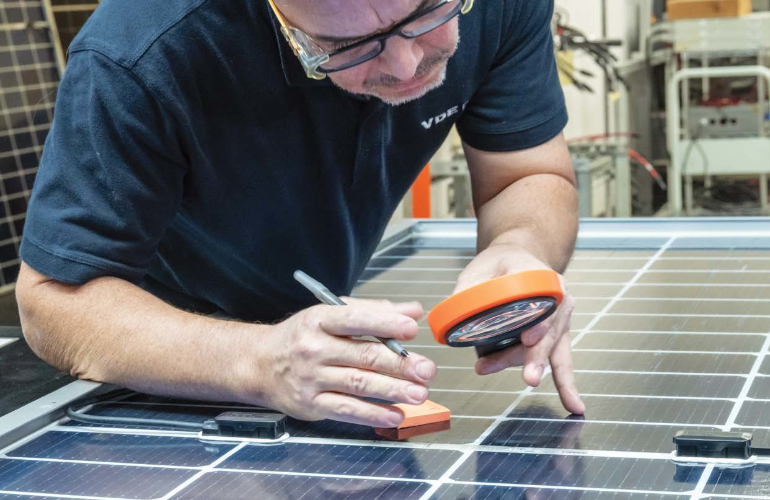
Visual inspection. Credit: Augustin Rajkumar/RETC, VDE Group
“What we are seeing is an industry moving from a deployment story to a performance and risk management story,” Kedir said. “The PVMI gives developers, financiers and asset owners a clearer view of which modules perform under extended stress conditions designed to reflect the realities they will face in the field.”
The 2026 Photovoltaic Module Index Report highlights several reliability and performance trends emerging from RETC’s extended laboratory testing, including:
- More than 10% of module test samples returned failing “red-flag” results in the 2,000-hour damp heat test category.
- For the second consecutive year, approximately 8.3% of module test samples exhibited unacceptable levels of ultraviolet-induced degradation.
- RETC observed year-over-year increases in red-flag results across damp heat, potential-induced degradation, static and dynamic mechanical load, and thermal cycling test categories.
- These laboratory-observed wearout mechanisms and failure modes provide additional context for negative field-performance trends observed by the technical due diligence community
Another independent testing lab, Kiwa PVEL, also highlighted troubling reliability markers in its latest solar panel report.