

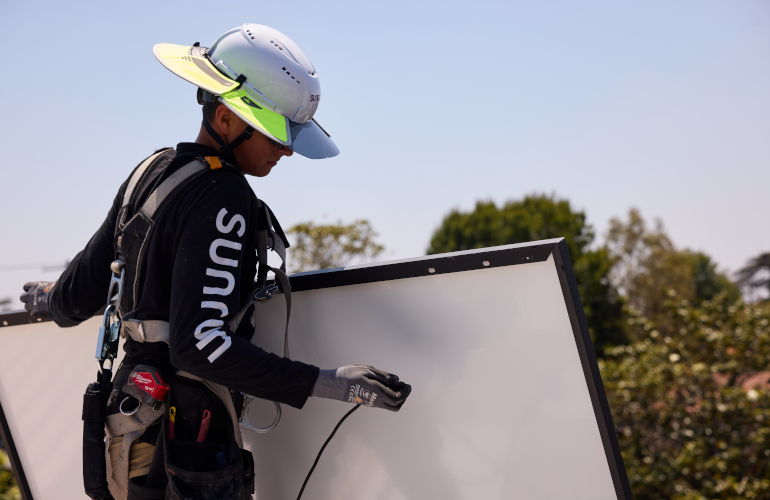

Sunrun has forged a distributed power plant partnership with Pacific Gas and Electric Company (PG&E) using more than 1,000 customers’ solar and storage systems to export energy to reduce grid constraints.

Sunrun
“Sunrun’s groundbreaking program with PG&E shows that distributed power plants can help communities avoid the high cost of adding more poles and wires to accommodate load growth,” said Sunrun CEO Mary Powell. “We saw time and time again that our customers’ batteries delivered location-specific load relief with high precision and consistent performance.”
Sunrun’s Local PeakShift Power distributed power plant is part of PG&E’s Seasonal Aggregation of Versatile Energy (SAVE) program. The distributed power plant reportedly dispatched more than 50 times from July through October 2025, when local demand neared system capacity, totaling more than 1,200 dispatching hours. Sunrun customers with solar and systems who are near constrained power lines and substations in PG&E’s service area were enrolled in the program.
“Being able to provide energy to my local neighborhood just makes a lot of sense,” said Sunrun customer Tom Weldon, whose San Jose home sits near a constrained power line. “When heat waves arrive, we know that our batteries are going to help out when the grid is stressed. It’s something I feel really good about.”
A post-season program evaluation report by Demand Side Analytics found that Sunrun’s battery groupings closely followed PG&E’s dispatching instructions and kept electrical loads below the operating limits at all of the power lines and substations. Each location received different instructions based on machine learning, forecasted weather and daily distribution system load forecasts.
PG&E expanded Sunrun’s program from 600 customers to more than 1,000 during the enrollment period. Sunrun customers enrolled in Local PeakShift Power received $150 per battery for sharing their stored solar energy with their communities, while Sunrun was compensated for coordinating the battery dispatches. Sunrun has more than 217,000 residential battery systems across the country.
News item from Sunrun