


UL Solutions announced it has enhanced large-scale fire testing for battery energy storage systems (BESS) to provide code authorities and fire service professionals clearer information on how battery fires may start, grow and spread.
The new testing is conducted according to the sixth edition of ANSI/CAN/UL 9540A, the Standard for the Test Method for Evaluating Thermal Runaway Fire Propagation in Battery Energy Storage Systems. The updated method expands guidance for installation-level, large-scale fire testing, enabling UL Solutions to more closely replicate what happens when a fire starts inside an energy storage enclosure and how that fire might affect nearby equipment or buildings.
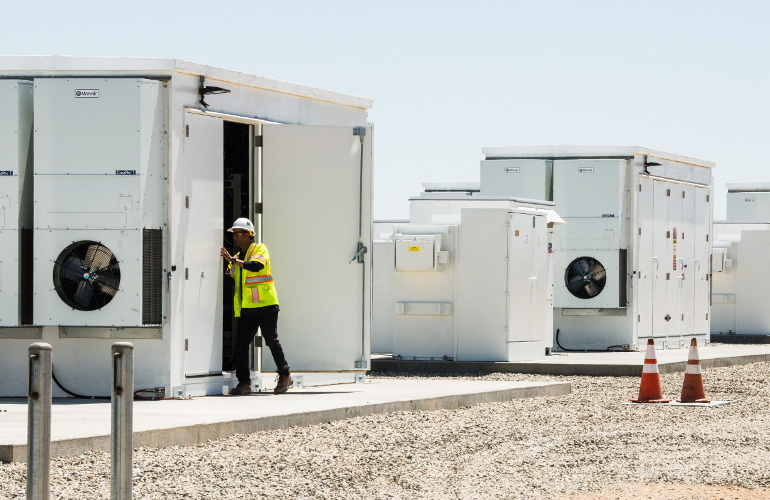
Photo by Dennis Schroeder / NREL
Thermal runaway is a battery failure condition in which overheating can cause the release of flammable gases and, in some cases, ignition. Understanding how this process unfolds at full installation scale is critical for evaluating safety risks.
“Battery energy storage systems are being deployed at larger scales and closer to where people live and work,” said Wesley Kwok, vice president and general manager of the Energy and Industrial Automation group at UL Solutions. “This testing gives authorities and fire departments practical data they can use to evaluate layouts, separation distances and fire protection strategies with greater confidence.”
During large-scale tests, UL Solutions intentionally initiates a fire within a BESS enclosure and observes how it develops under realistic installation conditions. The testing examines whether fire can spread between battery units, whether heat or flames could ignite nearby structures and how ventilation and gas release influence fire behavior. It also evaluates how active and passive fire protection features perform when exposed to battery fires.
Test configurations are designed to mirror real installations, including outdoor containerized systems, indoor battery rooms and sites where multiple enclosures are grouped or stacked. Aligning test setups with actual layouts helps ensure results are practical and relevant.
The findings are documented in detailed reports that can be used by code authorities to evaluate installation proposals, review alternative design approaches permitted under fire and building codes and assess whether manufacturer‑recommended clearances are appropriate. Battery energy storage system designers can use the same information to develop compliant, risk‑informed layouts, justify alternative designs and address permitting and code authority concerns early in the design process. Fire departments can also leverage the findings for hazard assessments, pre‑incident planning and response strategies.
The updated 9540A testing includes installation-level, large-scale fire testing that evaluates fire propagation risk to adjacent or nearby BESS or structures.