

Working out where you can install a home battery is one of the fiddliest parts of any solar job. AS/NZS 5139 sets the rules, and it reads like it was written to be argued about. Where a battery can go, where it can’t, and where you need to bang up a sheet of fibro. Get the battery installation location wrong and you fail the inspection. Worse, you could help a fire spread into the house.
So we built an interactive guide to sort it out. It walks a whole house, page by page, with the clause behind every call. This post follows the same order: the floor plan, appliances, corners, doors and windows, then ceilings and high-set jobs. There’s a quick FAQ at the end for the common questions.
One note on currency: the rules here are AS/NZS 5139:2019 with Amendment 1, which became mandatory on 19 December 2025. The guide reflects it, including the wide-door exception.
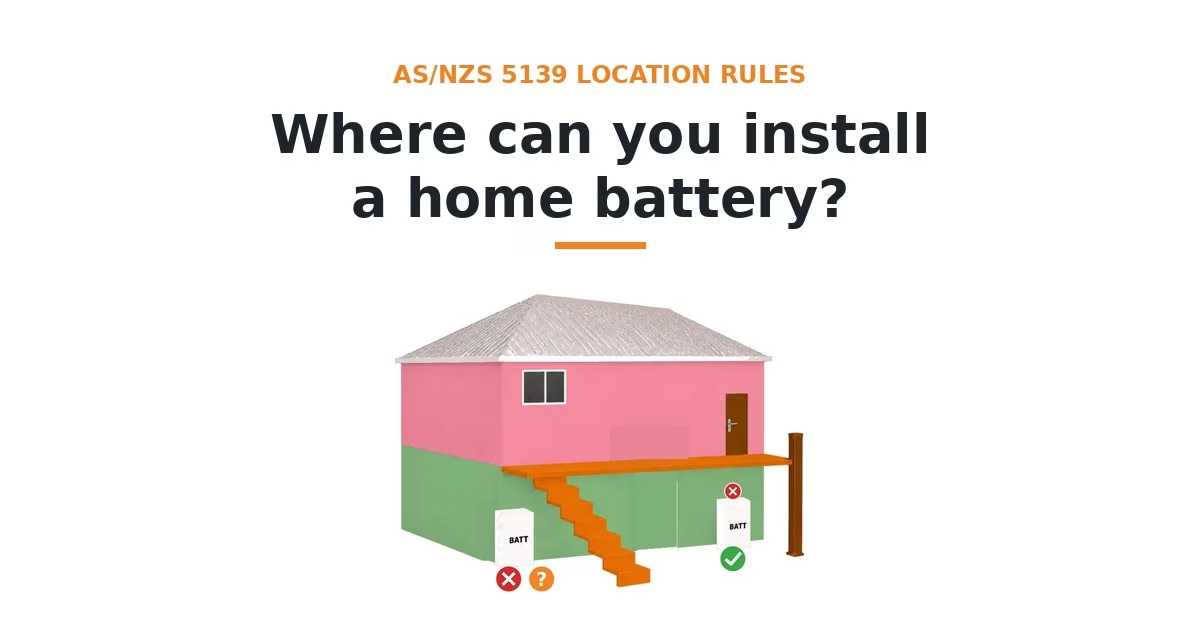
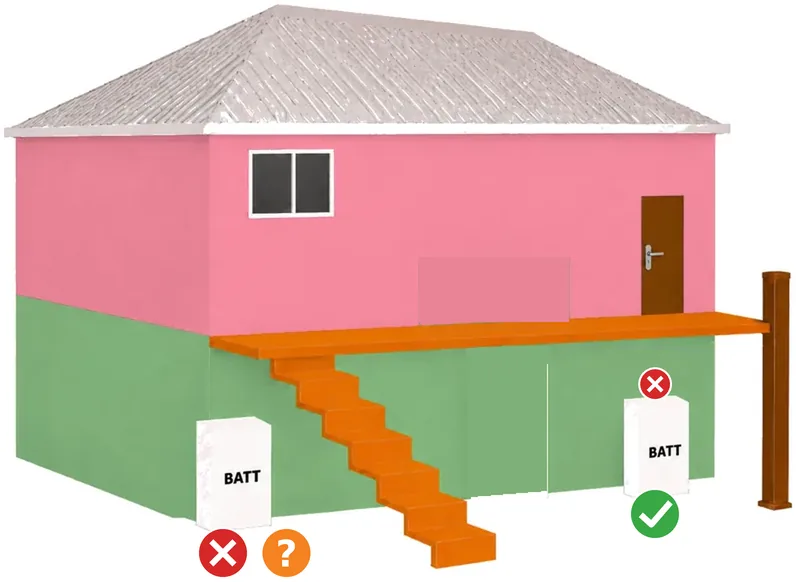
On the diagrams below, a green tick means it’s fine, a red cross means no, and an orange question mark means it’s a grey area.
Have a play with the interactive Battery Location Guide here.
1. Start with the floor plan: the no-go list (clause 4.2.2.2)
Start with the big picture. Green is fine. Orange means the wall needs fireproofing. Salmon is habitable, so the battery can’t go there.
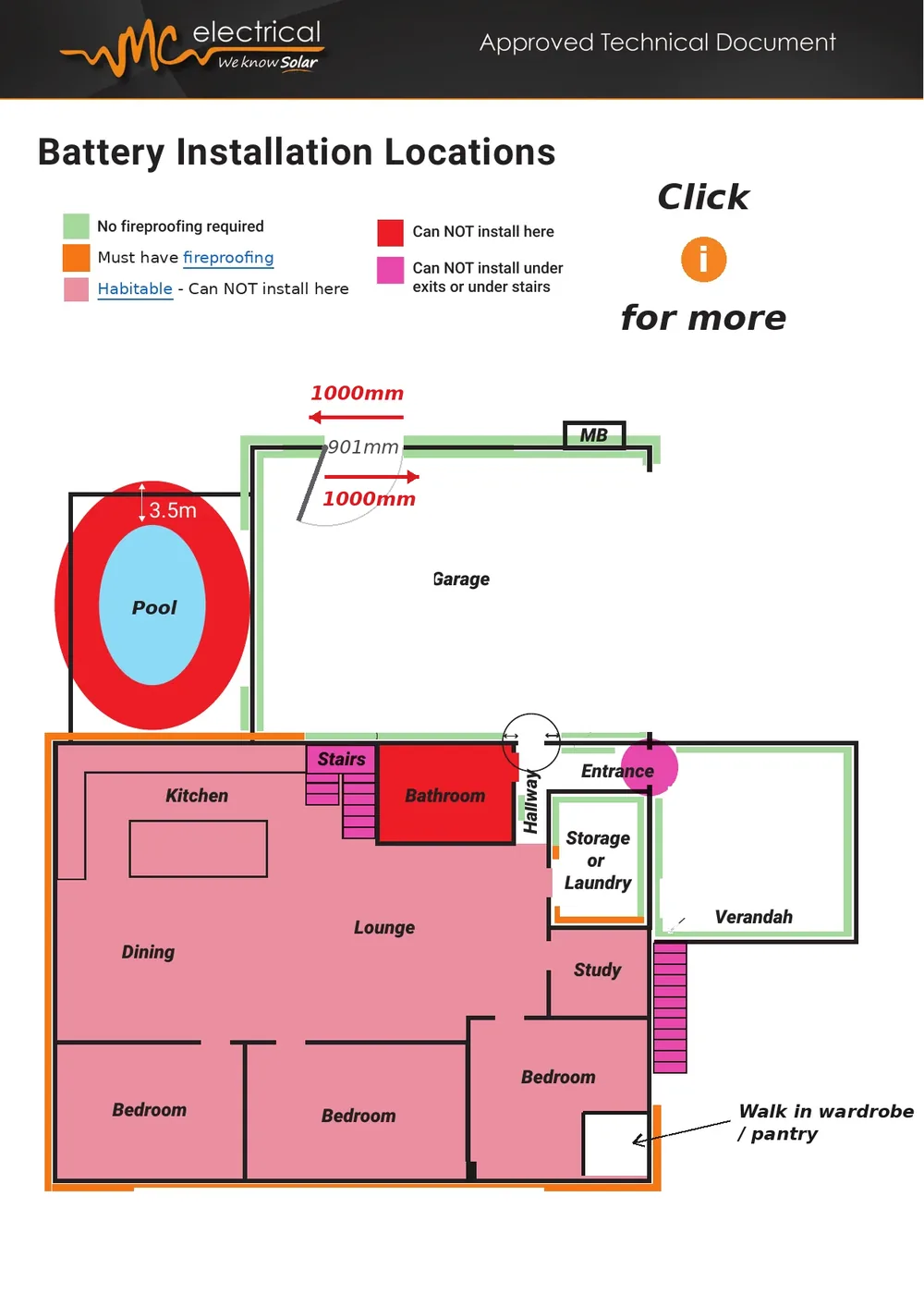
Clause 4.2.2.2 is the no-go list.
A battery shall not be installed –
(a) in restricted locations, as defined for switchboards in AS/NZS 3000;
(b) within 600mm of any exit;
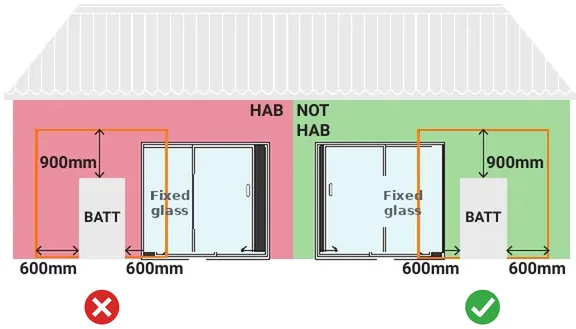
(c) within 600mm of any vertical side of a window or building ventilation that ventilates a habitable room;
(d) within 600mm of any hot water unit, air conditioning unit or any other appliance not associated with the battery;
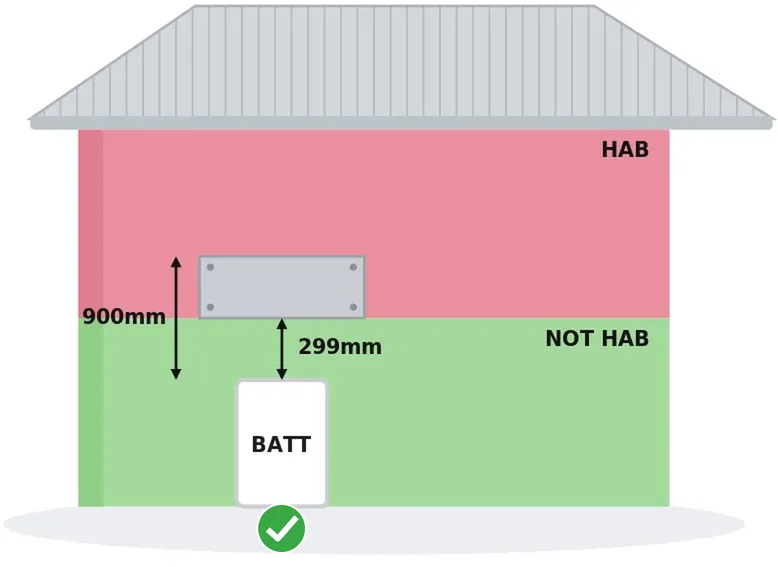
(e) within 900mm below any of the items included in Items (b), (c) and (d);
(i) under stairways;
(j) under access walkways.
Most of it is common sense. Keep 600mm clear of exits, windows, vents and appliances. Don’t mount 900mm below any of them. No batteries under stairs. None in a pool or spa zone.
Access matters too (4.2.2.1). We give 150mm each side for airflow and service. In a hallway or lobby you need 1m of safe egress from the front and sides. And if a car could hit the battery, you need bollards. We make white ones so the job doesn’t look like a building site.
“Under access walkways” is banned, but the standard never defines an access walkway. I reckon a verandah is fine. We’re allowed to install below a doorway and within 600mm of it (4.2.2.2). If immediately inside or outside a door is allowed, that’s not an access walkway, and neither is the path to it. The clause pairs access walkways with evacuation routes, which points at commercial gear. Not your nan’s back verandah.
2. Battery clearance from appliances: the 600mm rule
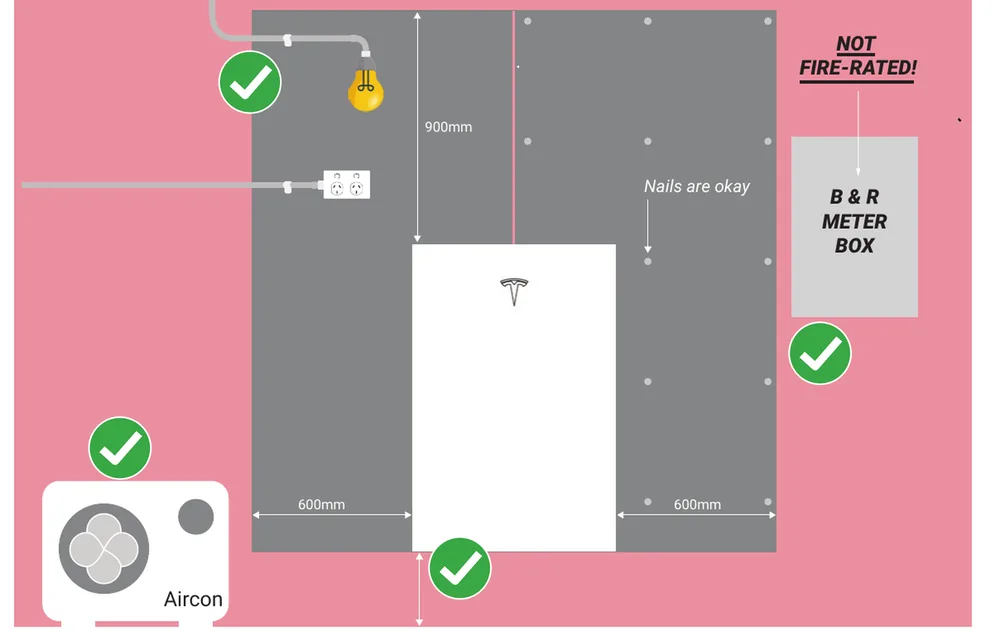
The 600mm appliance rule (4.2.2.2 d) catches people on what counts as an appliance.
An aircon is an appliance. A hot water unit is an appliance. An EV charger is one too. It’s got comms, lights and heat, a Zappi especially. Keep your 600mm.
Power points and lights are not appliances, so the 600mm rule doesn’t apply. Conduit is fine, just no penetrations through the fibro. Next to the battery you can have the inverter, because it’s associated with the battery, and the switchboard, because it isn’t an appliance. A meter box isn’t an appliance either, but if there’s a habitable room behind it, keep it 600mm clear to hold the fire rating. If the wall behind is not habitable, you don’t need any fire sheeting.
3. Fire barriers, corners and habitable rooms (clause 4.2.4.2)
This is clause 4.2.4.2, the one that makes those odd patches of fibro.
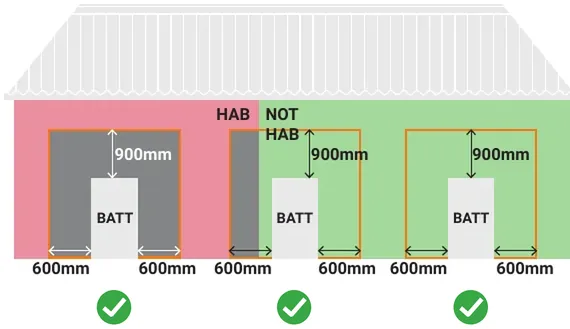
To protect against the spread of fire to habitable rooms, where the battery is mounted on or placed against or near a surface of a wall or structure that has a habitable room on the other side, the wall or structure shall be a suitably non-combustible barrier.
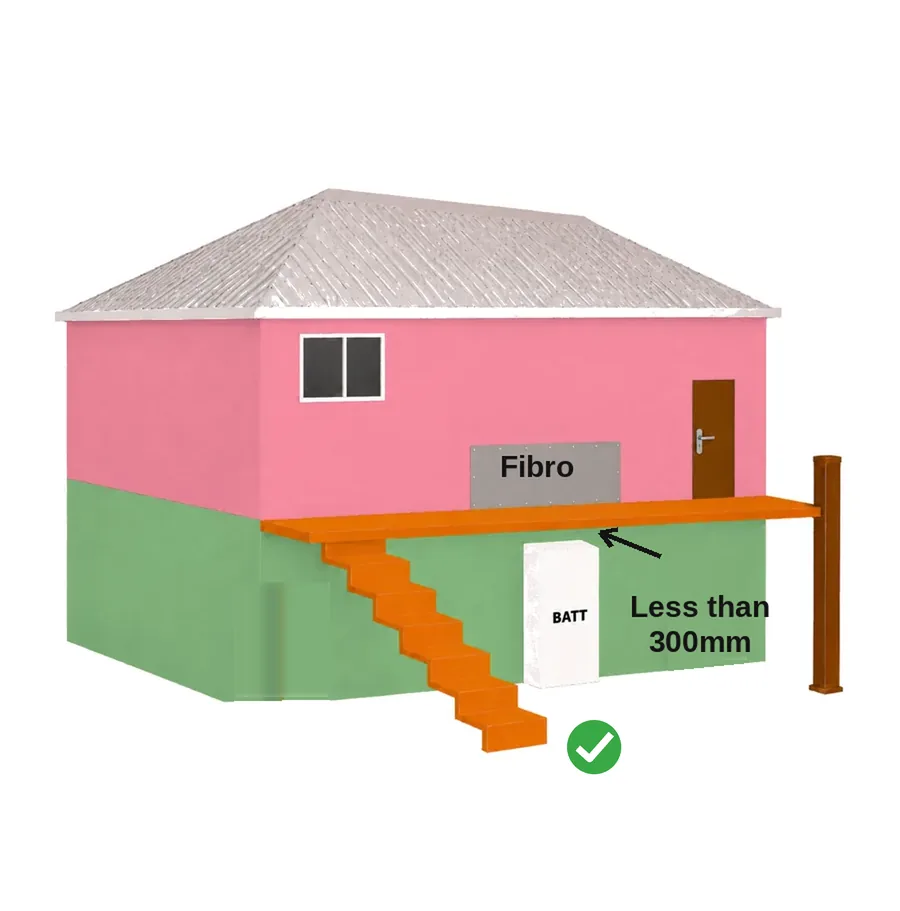
Where the battery is located on the wall, or mounted on the floor within 300mm of the wall or structure separating it from the habitable room, the barrier shall extend –
(i) 600mm beyond the vertical sides of the battery;
(ii) 900mm above the battery; and
(iii) to the extent of the bottom of the battery.
The magic number is 300mm. Battery on the wall, or on the floor within 300mm of it, and the barrier kicks in. Sheet 600mm past each side, 900mm above the top, down to the bottom. Nothing below.
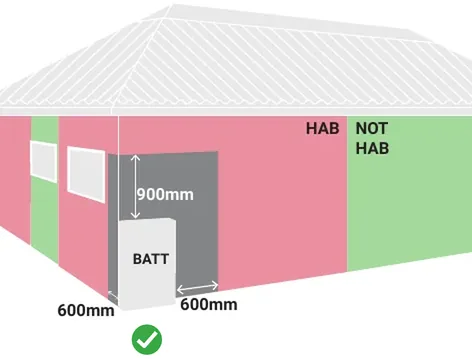
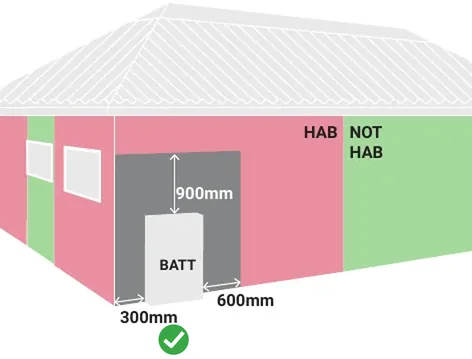
You don’t fibro everything. A few materials are already non-combustible.
Materials exempt from the need to be tested are –
(a) brick or masonry block;
(b) concrete;
(c) compressed cement sheeting; and
(d) ceramic or terracotta tiles.
So don’t go sheeting a brick wall.
4. Installing a battery near doors and windows
Doors come down to width.
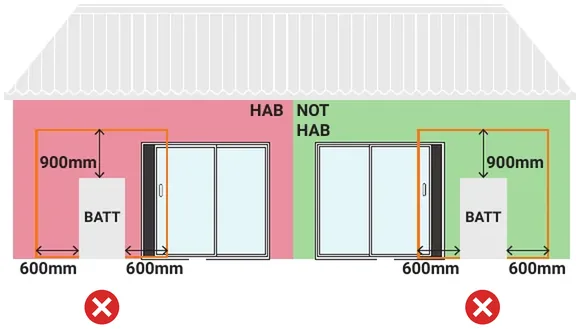
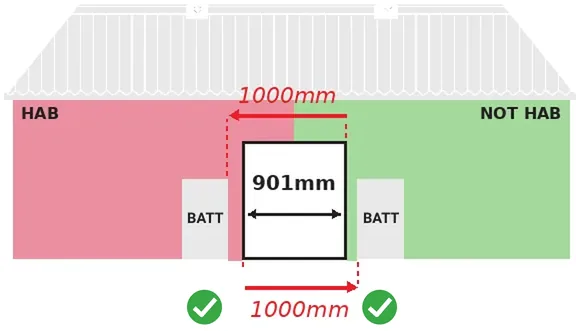
It doesn’t have to be a big garage opening. A 901mm door counts. That exception (4.2.2.2 b) frees up a lot of walls you’d otherwise write off.

Then watch the glass.
5. Ceilings, high-set homes and under-floor installs
The barrier rule isn’t just walls.
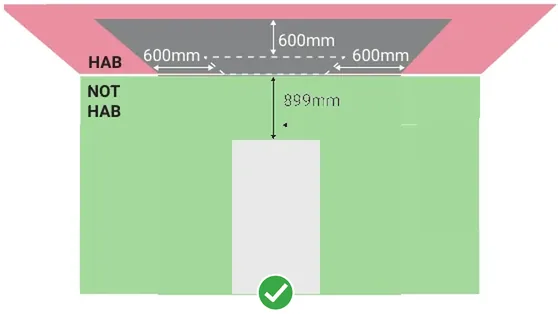
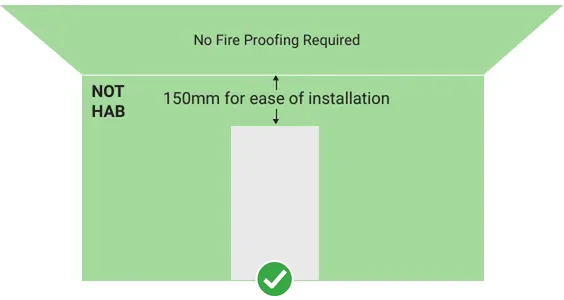
High-set homes throw up the tricky ones.
Battery location FAQs
Can you install a home battery in a bedroom?
No. A bedroom is a habitable room under AS/NZS 5139, and batteries can’t go in habitable rooms. Same goes for living rooms, kitchens, studies and the like.
Can a battery be installed in a garage?
Yes. A garage is non-habitable, so it’s one of the easiest spots to comply. Just keep your clearances, watch any habitable wall behind, and add bollards if a car could hit it.
What is the 600mm rule for batteries?
Keep the battery at least 600mm from any exit 900mm or narrower, from the vertical sides of windows and vents into a habitable room, and from appliances like air conditioners, hot water units and EV chargers. You also can’t sit it within 900mm below any of those.
Can a battery go under the stairs?
No. Clause 4.2.2.2 bans batteries under stairways, full stop. Under a verandah or landing is a different thing, and we reckon that’s fine.
Do you need a fire barrier behind a battery?
Only if there’s a habitable room on the other side of the wall and the battery is on the wall or within 300mm of it. Then you need a non-combustible barrier 600mm past each side and 900mm above. Brick, concrete, compressed cement sheet and tiles already count, so you don’t sheet a brick wall.
Can you install a battery in a garage with an EV charger nearby?
Yes, but an EV charger is an appliance, so keep the battery 600mm from it. The inverter and switchboard can sit next to the battery.
The bottom line
There’s a lot here, and 5139 can feel overwhelming when you’re on the tools. So keep the main points in your head. Stay off the no-go list. Keep 600mm from exits, windows, vents and appliances. Mind the 300mm trigger and the 600mm / 900mm fibro rule. Give yourself 150mm for access and 1m for egress. And don’t fibro a brick wall. Then let the interactive guide carry the rest on the job.
The grey areas, the verandah and the access walkway calls, come down to undefined terms. I’ve shown my working so you can back it to an inspector. Reckon I’ve got something wrong? Tell me in the comments.
The interactive Battery Location Guide walks the whole house with every clause attached. Send it to the apprentices. It’ll save a phone call from the roof. If you’re a homeowner weighing up a battery, have a look at our solar and battery pricing, or read up on the new 5033 solar standards while you’re here.