

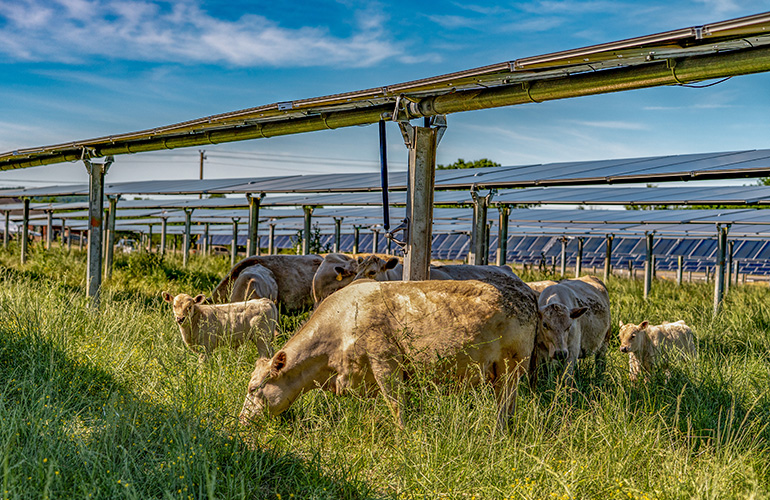

Silicon Ranch officially launched its CattleTracker energy and cattle grazing technology today on the Christiana Solar Ranch in Christiana, Tennessee. The facility represents the first-ever commercial deployment of Silicon Ranch’s patented cattle-compatible agrivoltaics platform, designed to cultivate solar energy and regenerative grazing.

Credit: Silicon Ranch
“CattleTracker was born at the intersection of American energy, American manufacturing and American farming — all areas that are under tremendous pressure to evolve and grow in this country,” said Reagan Farr, CEO and co-founder of Silicon Ranch. “We have long believed that doing what’s right for our country, our grid and our economy can also benefit our land, our animals and our farmers. The innovation we celebrate today represents the tangible application of that belief and our commitment to make it possible, and I am confident it will yield many benefits for the surrounding community and wider region for a long time to come.”
Silicon Ranch funded, built and will own, operate and maintain the facility in Christiana, which is in the service territory of Middle Tennessee Electric (MTE). MTE is partnering with Silicon Ranch to purchase the power and environmental attributes generated by the facility — realizing savings on day one of operation — to benefit the more than 750,000 Tennesseans that the cooperative serves across 11 counties. MTE is the largest electric cooperative in the Tennessee Valley Authority (TVA) region and the second largest in the United States.
The Christiana Solar Ranch will be the first project of its size in the world to co-locate a legitimate cattle ranching operation with a commercially viable solar energy infrastructure facility. The years of research involved in this project resulted in two patents being awarded to the company. Silicon Ranch Chief Technology Officer Nick de Vries served as Principal Investigator for the research and led the development of a solar tracking system that is designed and engineered to move into “grazing” mode to allow cattle to safely graze and move beneath the panels.
“As a researcher, what’s most exciting about CattleTracker is that it brings rigor and real‑world validation to agrivoltaics at a commercial scale,” said Dr. Anna Clare Monlezun, founder of Graze, La Dolce Vita Ranch, and a member of the CattleTracker research team. “At the Christiana Solar Farm, we’re demonstrating that thoughtfully designed solar infrastructure can support normal, healthy beef cattle behavior, align with animal welfare standards and enhance land stewardship while also delivering reliable energy. This project provides an important foundation for continued transdisciplinary research into how regenerative grazing and energy production can successfully coexist.”
Silicon Ranch hopes Christiana will be proof of concept that solar development and cattle grazing can have similar success as the sheep industry has seen with agrivoltaics.
The CattleTracker project uses domestic materials and technology. Technologies were purchased regionally, including partnerships with First Solar, which recently opened a solar panel manufacturing plant in northern Alabama, and Nextpower, which manufactures the low-carbon steel components for the trackers used on the CattleTracker site at its Memphis manufacturing facility.
As the long-term owner of both the energy infrastructure and the underlying property, Silicon Ranch is handling maintaining of the land through its own Regenerative Energy land stewardship program. In addition to rotational sheep grazing and now cattle, Regenerative Energy practices aim to improve the quality of land and nurture the soil by promoting multi-species grasses and pollinator habitat under and around the solar array.
The CattleTracker research team has been performing field work since 2023 and has published its findings in academic journals. Led by Silicon Ranch, the research team includes representatives from Graze, Quanterra Systems, Colorado State University and White Oak Pastures. Additional support was provided by an advisory committee that includes representatives from the National Laboratory of the Rockies, DNV, University of Georgia, Michigan State University, Standard Soil & Blue Nest Beef and the Solar Energy Industry Association.
News item from Silicon Ranch