

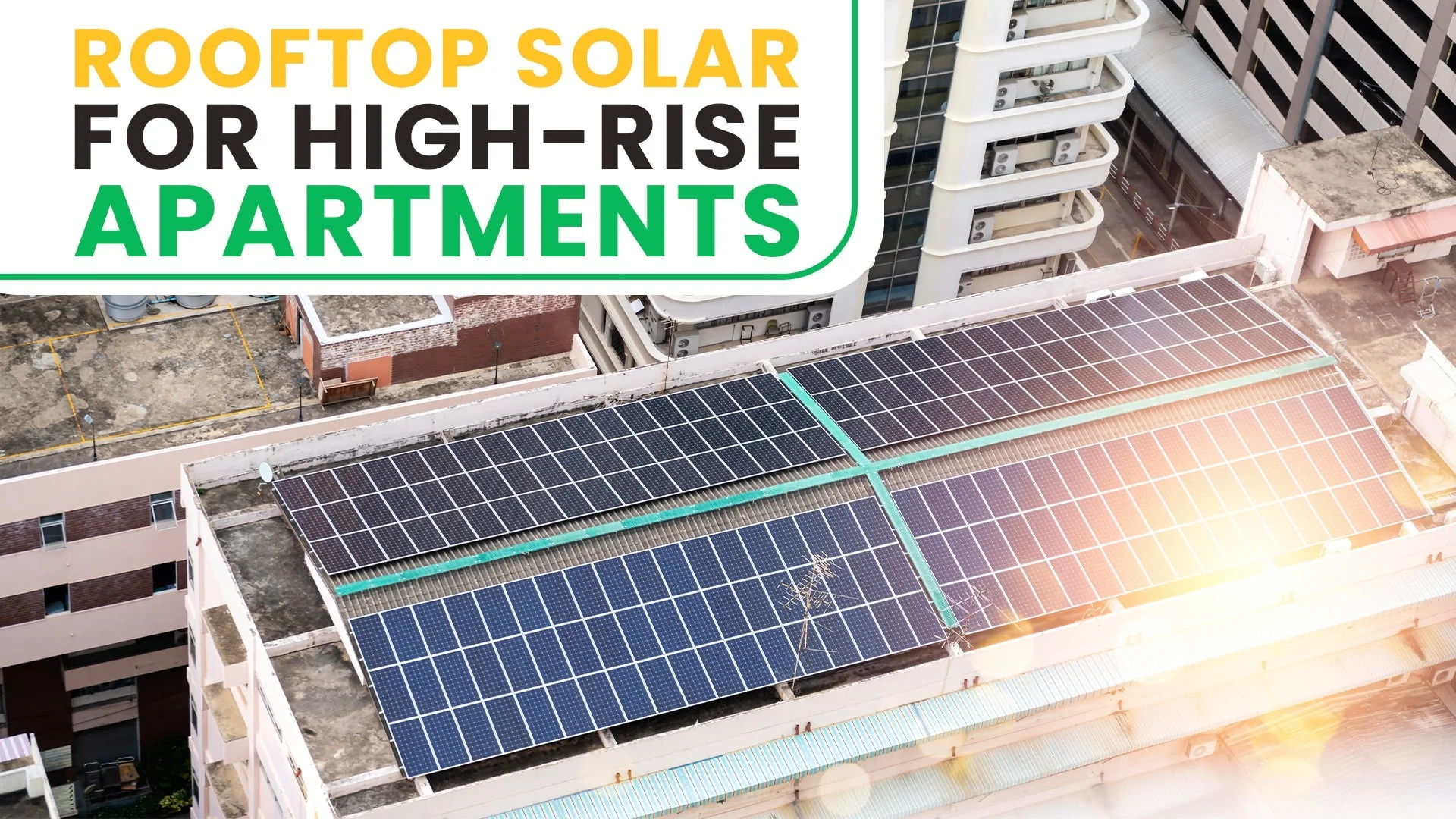
Rooftop solar for high rise apartments has become essential nowadays due to the rise of electricity bills in urban areas. Solar panels have emerged as a practical and sustainable solution, helping the residential apartments to switch from conventional electricity to non-conventional electricity.
According to MERCOM Clean Energy Insight, “India added 4.9GW of rooftop solar capacity in first 9 months of the calendar year 2025”
In urban areas where the space is limited and energy demand is high, high rise apartments are turning to rooftop solar panels for non conventional electricity. But installing a rooftop solar for individuals is totally different compared to the solar system established for the High Rise apartment with a shared Net metering system.
Which leads us to one question- How can rooftop solar be effectively implemented in high rise apartments and how do all residents benefit equally from it? Read the full blog below to know more about this- Rooftop Solar for High-rise Apartments
Rooftop Solar Panels are the series of photovoltaic (PV) modules that are installed on the roof of a high rise apartment which helps in converting the sunlight into solar energy. Rooftop solar panels play a crucial role in creating clean and sustainable energy and are one of the sources of renewable energy.
This energy can be used in powering the house lighting, charging the inverters, and meeting the basic household energy needs.
Installing the Rooftop solar in High Rise Apartments.
To install a solar panel on the rooftop in a high rise apartment it is essential to know the overall requirement of energy in a household to install the solar panel with appropriate system size and capacity to meet the required energy needs efficiently.
These are the requirements for installing the rooftop solar in high rise apartment:
-
Available rooftop space: Shared among residents, so proper planning is needed
-
System type: On-grid systems are most commonly used in apartments
-
Net metering policies: Vary by state and determine how excess electricity is credited
-
Structural strength: The building must be able to support the solar installation
-
Permissions: Approval from the housing society or RWA is usually required
Individual or Shared Net Metering system?
For a person either residing or owning a high rise apartment, it is important to decide whether the installation of solar panels will be an individual or shared net metering system.
In most of the high rise apartments, the rooftop space is limited and may not be sufficient for every single individual to install their own solar panel. Due to which shared net metering system is the most practical and efficient solution.
Installing a high capacity shared net metering system that supplies electricity to the common area such as lifts, parking areas, water pumps.
Later the benefits or savings can be distributed among the residents either through reduced maintenance cost or shared billing adjustments.
Benefits for high rise apartment residents.
Installing a rooftop solar panels brings many benefits for a resident in high rise apartment, such as:
-
Backup for common area– Keep corridor, lifts, parking area lights, water pump running.
-
Eco friendly- Convert sunlight into electricity without any carbon emission.
-
Low maintenance– Solar panels only need cleaning and lasts for at least 25 years.
-
Low dependence on grid electricity- Solar power makes people less dependent on traditional electricity.
-
Increased property value- Building installed with solar panels gives them a modern and energy efficient look which attracts the environmentally conscious buyers.
Do shared systems create unfair benefits?
Many people think that a shared net metering system creates an unfair advantage for some people as not all residents consume electricity equally.
While another issue is that the shared systems usually prioritise common area consumption such as lifts, water pumps, lighting, even if this reduces the overall maintenance cost for everyone but individual households may not see any reduction in their personal electricity bills.
However, these challenges can be effectively managed through proper planning of transparent billing mechanisms, fair contribution model, use of common areas first, and setting clear agreements.
Challenges and practical solutions.
While rooftop solar for high rise apartment does provide numerous benefits but with implementation can bring some of the challenges, such as:
-
Limited Rooftop Space: In high rise apartments it is practically impossible for every individual to establish their own solar panels on the rooftop due to the lack of readiness of space.
-
Unequal benefit distribution: Residents may feel that there is an inequality in benefit distribution specially in the case of a shared system.
-
High Initial investment: The initial cost of installing a solar system can be concerning for housing societies.
-
Maintenance and management Issue: Maintaining and managing a solar system can be difficult without a clear responsibility.
These were some of the challenges faced by the user and practical solutions that can break these challenges down.are:
-
Opting for a shared net metering system that mainly focuses on generating the electricity for common area consumption, lightning, water pumps, parking area.
-
Implementing the transparent billing and accounting system and setting clear agreements regarding the finance.
-
People can take advantage of government subsidiaries and incentives or opt for a group funding model in the society.
-
To maintain and manage the solar panels the society can either opt for Resident Welfare Associations (RWAs), Annual maintenance contract (AMC) or monitor the system performance regularly on their own.
Companies like Loom Solar offers advanced technology such as Bifacial Panels that can generate 30 to 50% more energy in limited space compared to the conventional solar panels, a SHARK bifacial, fewer panels can generate higher wattage means the installation cost for stand, wires, connectors, and civil work gets significantly reduced.
Conclusion
Rooftop solar for high rise apartments are emerging as a sustainable as well as practical solution due to the rise of electricity bills in urban areas. While solar systems do offer many significant benefits such as environmental sustainability, reduced electricity expenses, along these benefits there are also some challenges faced by the residents such as limited rooftop space, shared ownership, and concerns regarding unfair benefit distribution.
However, these challenges are not impossible to overcome. Through proper planning, transparent billing system and clear agreements rooftop solar can be successfully implemented.
And when it comes to choosing the right solar partner for a high rise apartment, Loom Solar is India’s No. 1 company and best choice for rooftop solar. By choosing Loom Solar not only the housing societies will be investing in the latest available technology but also gain the support of a proven and trusted brand that will help the residents benefiting from cleaner, greener and more affordable energy.
By overcoming all these challenges, not only will it create a sustainable environment but as well as benefit all the residents and become a valuable asset for high rise apartments.