

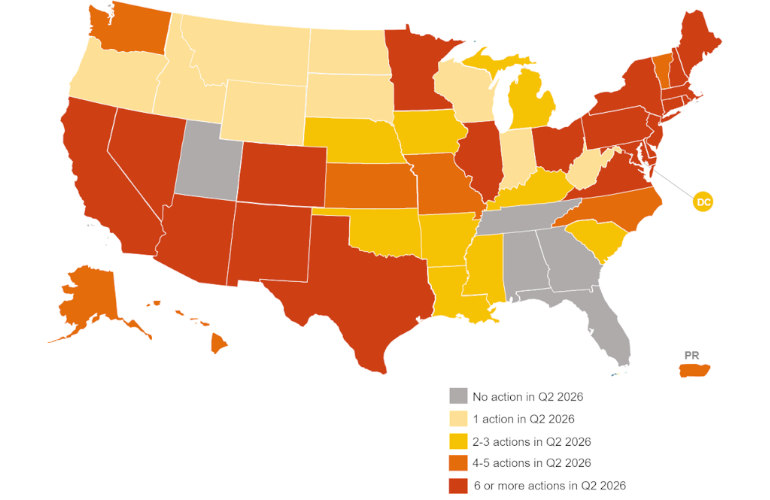

The Q2 2026 edition of “The 50 States of Solar” report finds that 45 states, plus the District of Columbia and Puerto Rico, took some type of distributed solar policy action during Q2 2026, with the greatest number of actions continuing to address net metering policies (53), community solar policies (48) and residential fixed charge or minimum bill increases (45). A total of 284 distributed solar policy actions were taken during Q2 2026, with the most actions taken in Illinois, Maryland, New Jersey, Virginia, New Hampshire, Connecticut, Maine and Rhode Island.
 The NC Clean Energy Technology Center (NCCETC) releases the quarterly series that provides insights on state regulatory and legislative discussions and actions on distributed solar policy, with a focus on net metering, distributed solar valuation, interconnection rules, community solar, residential fixed charges, residential demand and solar charges, financial incentives and third-party ownership.
The report identifies three trends in solar policy activity taken in Q2 2026: (1) legislators continuing to advance bills authorizing plug-in solar, (2) decision-makers balancing the costs of distributed generation programs and (3) states considering interconnection improvements for residential and public sector customers.
“This quarter saw a flood of bills addressing plug-in solar, with half of all states considering bills that would lessen the regulatory burden for these systems,” said Brian Lips, Senior Project Manager at NCCETC. “This signals strong interest in the technology across all corners of the country as a way to increase opportunities for customers who can’t access traditional solar systems.”
The report notes the Top 5 distributed solar policy actions of Q2 2026:
- Connecticut legislators mandating net-metering and community solar successor programs,
- Arizona courts vacating Arizona Public Service’s grid access charge,
- Maryland lawmakers requiring adoption of a successor net-metering program,
- Virginia regulators issuing a decision on Dominion Energy’s net-metering successor and
- Texas regulators approving a residential distributed generation rate for El Paso Electric.
“As distributed generation and net metering grow, states are looking for ways to ensure associated costs are properly allocated between participating and non-participating ratepayers,” said Rebekah de la Mora, Project Manager at NCCETC. “From new cost recovery mechanisms to program revamps that must consider ratepayer impacts, states are using a variety of tools at their disposal to prevent cost shifting.”
News item from NCCETC