


Solar energy now accounts for most new generation capacity added to the U.S. grid, solar and storage accounted for a majority of the capacity growth coming from renewables last year and a variety of solar-adjacent home energy technologies have become staples of residential energy systems. Concurrently, installation is taking longer, systems are harder to get right on the first try and avoidable truck rolls are increasing. What installers face at the job site has fundamentally changed.
Even as global annual renewable capacity additions increased by 16%, an installer rarely deploys just a standalone solar array anymore. Both residential and commercial systems now routinely include energy storage, advanced monitoring, sophisticated load management, EV chargers and even generator or heat pump control integrations. Each component adds new installation and configuration steps, communication pathways and dependencies.
Static-passive installation and commissioning processes, however, have not evolved significantly. Static-passive commissioning workflows were fine for simpler systems, but as component complexity grew, those workflows have begun to hinder installers. In practice, this means installers are often working with tools and workflows that only verify the components and system after everything is installed, instead of actively guiding and verifying the work on-site, as it occurs.
The consequences of this static-passive approach are twofold: slower installation speed and increased opportunity for human error. Installers spend valuable time manually entering system data, cross-checking configurations across disconnected and non-interconnected platforms and troubleshooting issues that could have been identified earlier in the installation process. At the same time, small mistakes in system architecture, configuration or communication pathways can remain invisible until after the crew has left the site. That means more service tickets, more truck rolls and more time spent fixing problems instead of completing new installations.
Building a resilient foundation
Legacy commissioning processes rely heavily on manual inputs and post-installation troubleshooting. Serial numbers must be entered individually. Multiple digital installer tools serve narrow purposes without sharing full-system awareness, and product documentation tends to be printed in outdated paper brochures. Validation frequently occurs only after the wrenches have stopped turning, when correcting errors is both disruptive and more costly.

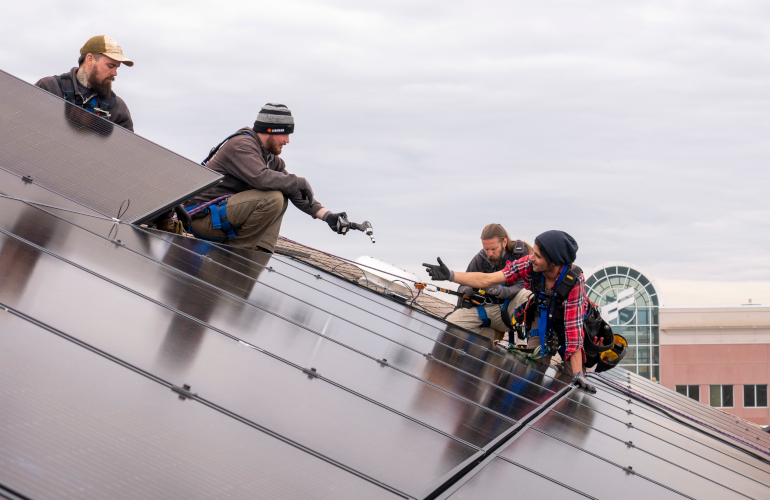
Credit: Sugar Hollow Solar
Addressing these limitations requires a shift toward what can be described as real-time active commissioning. Unlike the static-passive approach, real-time active commissioning monitors and interacts continuously during the installation process, with a software platform that guides installers through each step while validating progress in real-time. All is directly at the fingertips of installers.
In practice, such an installation platform will outline system elements before installation begins; guide installers step-by-step through the full workflow; verify that components are installed and configured correctly in real time; and alert crews when an error condition is detected.
This is the foundation of “Total Quality Solar” (TQS), an adaptation of the long-established principles of “Total Quality Management” applied to modern solar deployment, where system design, installation and commissioning are treated as a unified quality process rather than disconnected steps. This is particularly important for installation companies that have scaled to the point where the efficiency dividing labor means that system design, scheduling, truck loading and on-site work are no longer performed by the same individual or group of people.
A digital map of the system as well as real-time visibility enables installers to confirm communication and functionality immediately after devices are installed. Further, sequenced digital workflows should guide crews from one step to the next, ensuring that progress is validated rather than assumed.
The operational benefits of a new installation assist system compound quickly: faster job completion, improved crew productivity, error reduction, reduced on-site rework, more reliable distributed energy assets and, ultimately, more satisfied customers.
A new reality at the job site
Consider a typical residential solar-plus-storage installation today. Before arriving, installation teams are already managing tight scheduling windows, labor constraints and permitting timelines. Once work begins, they must coordinate mechanical installation, electrical configuration, communications setup and system registration, often with equipment from different vendors and across multiple platforms that do not communicate with one another.
Historically, commissioning has occurred at the end of this process. Installers complete physical work first, then attempt to verify operation afterward. If serial numbers were entered incorrectly, devices were misconfigured, or communication pathways failed, those issues might not become visible until final activation, or worse, after the system is already in operation. In the interest of advancing TQS, the focus of innovation must now turn to this portion of the process.
One U.S.-based solar installer recently described how this traditional workflow created uncertainty throughout the installation process. Crews relied on printed guides and manual verification steps while juggling multiple mobile apps to register equipment and validate performance. Even experienced teams found themselves double-checking work or regularly contacting technical support simply to confirm that systems were behaving as expected “on their side.”
For this installer, the inflection point came when installation software began mirroring how systems are assembled in the field. Instead of treating commissioning as a final administrative task, the workflow shifted toward guided installation, where system components were defined in advance and installers received step-by-step validation as work progressed. Equipment could be confirmed immediately after installation, while bulk scanning of module-level devices reduced registration time significantly.
The impact was felt through reduced uncertainty during installation, fewer configuration errors, and measurable time savings, eliminating 15 to 30 minutes per system, while reducing the likelihood of repeat truck rolls.
A similar approach was implemented during while commissioning a solar installation at a solar company headquarters in Los Gatos, California. As the system is deployed, engineers are using active commissioning tools to monitor communication performance, confirm device discovery and validate system configuration at each stage of the installation progresses. Rather than waiting until the end of the installation to discover problems, the system’s components are continuously verified throughout the process, allowing adjustments to be made immediately when issues appear.
This type of installation illustrates the practical difference between static-passive commissioning and real-time active commissioning. Instead of waiting to verify the installation after the fact, the commissioning environment becomes an active participant in the deployment itself.
While commissioning must evolve from a final checkpoint into an intelligent, verification-driven process deeply embedded in the installation process itself, there is another key ingredient of TQS that should not be ignored. The level of installer performance needed to deploy today’s home energy systems requires installation teams that have a deep understanding of the work they do and the equipment they install.
A new standard of insight while the work is performed must be augmented by regular and rigorous installer training.