

Imagine looking at your electricity bill every month and seeing a fraction of what you used to pay, or nothing at all. This is no longer a dream for millions of Indian homeowners. That’s the new reality created by rooftop solar panels.
India is on the brink of a solar revolution. Cheaper panels, more government help, and higher electricity prices mean that putting a solar system in your home is shaping up to be one of the smartest money moves any homeowner can make in 2026. Whether you live in a bustling city apartment or a quiet suburban home, solar panels for home use are more accessible, more affordable, and more rewarding than ever before.
Still confused? This blog tells you all you need to know in plain, everyday language, from how much money you can save to what the government will pay you to go solar. Let’s get this done.
India is going through an unprecedented rooftop solar boom. As electricity tariffs rise, solar technology improves, installation costs fall, and government incentives are generous, there is no better time than now for homeowners to go solar.
Here are a few important reasons why more and more Indian families are switching:
-
Costs are falling: Solar panels have become more affordable, dropping in price by over 80% in the last decade. A decade ago, a system that would have cost 8-10 lakh rupees now costs 1.5-2.5 lakh rupees after subsidies.
-
Increasing electricity bills: India’s electricity tariffs are increasing by 3-5% year-on-year. The longer you wait to go solar, the more money you will pay on conventional power.
-
Big government push: The PM Surya Ghar Yojana, introduced in February 2024, has already installed 4,946 MW of residential rooftop solar capacity across India as of July 2025, with subsidy disbursements crossing ₹9,280 crore (around USD 1.05 billion).
-
Increased awareness: States like Gujarat and Kerala lead the way, with high solar adoption rates, supported by mature vendor ecosystems and strong consumer education. Rooftop solar is no longer the domain of early adopters, with nearly 5.8 million applications filed under the PM Surya Ghar scheme alone.
-
Better technology: Newer solar panels are more efficient and more durable, with 25-year performance warranties. Today, many panels work well even in partly cloudy or diffused light conditions, which is ideal for India’s diverse climatic zones.
In short, the economics, the technology, and the policy support have all aligned, making 2026 the best time yet to go solar.
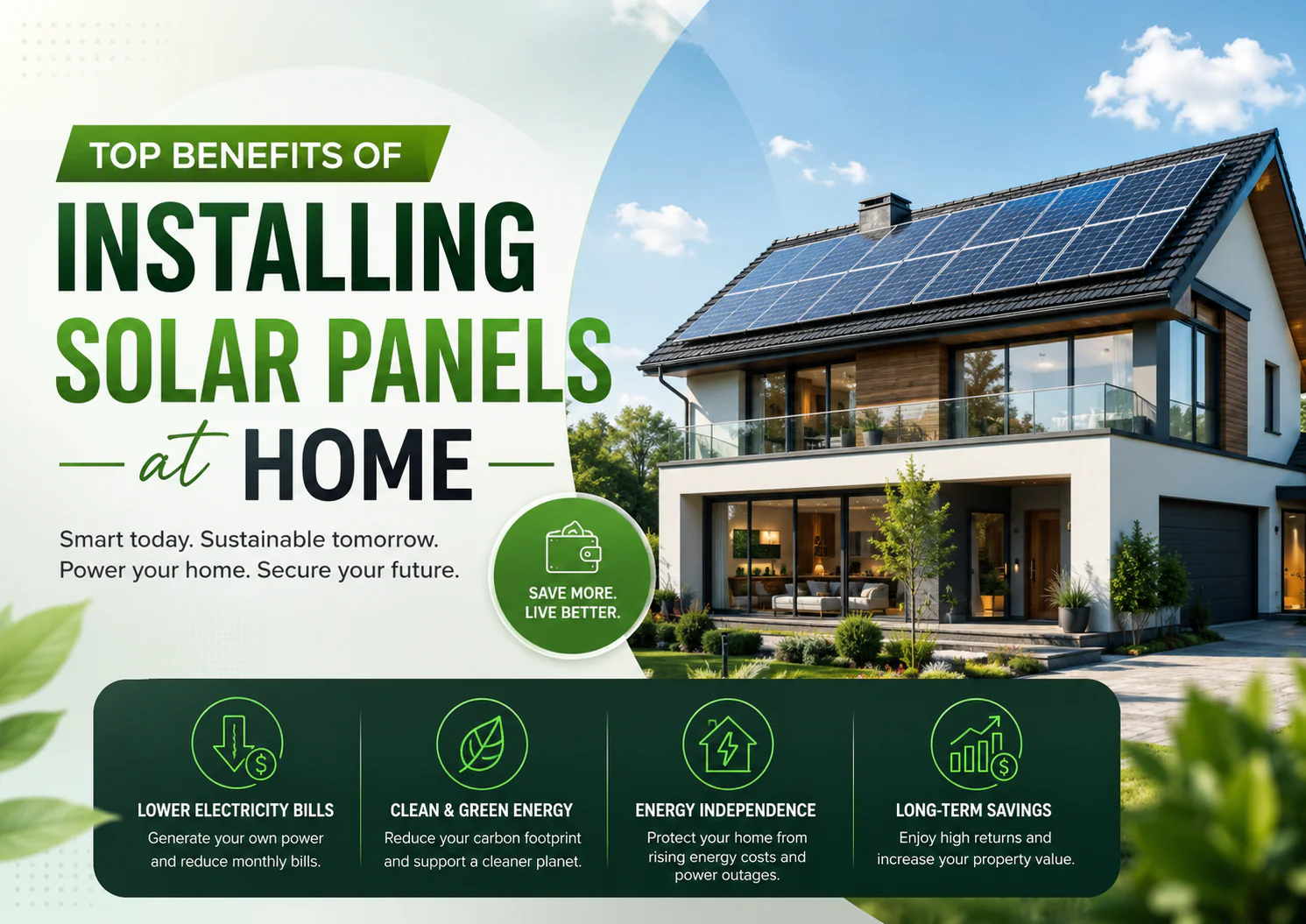
Lower electricity bills and long-term savings
The most obvious and immediate benefit of installing solar panels on your home is the dramatic reduction in your monthly electric bill. And in India, where electricity tariffs have been consistently rising by 3–5% each year, this saving only gets larger over the years.
Better technology: Newer solar panels are more efficient and more durable, with 25-year performance warranties. Today, many panels work well even in partly cloudy or diffused light conditions, which is ideal for India’s diverse climatic zones.
In short, the economics, the technology, and the policy support have all aligned, making 2026 the best time yet to go solar.
The most obvious and immediate benefit of installing solar panels on your home is the dramatic reduction in your monthly electric bill. And in India, where electricity tariffs have been consistently rising by 3–5% each year, this saving only gets larger over the years.
What About the Return on Investment (ROI)?
The payback period for a home solar system has come down quite significantly in India. Most of the homeowners recover their investment in 4-6 years after the PM Surya Ghar subsidy. Then you get free electricity for the rest of the 20+ years. That is an annual return on investment of 18-25%. Far better than a fixed deposit or most mutual funds.
Solar is also a natural hedge against rising electricity prices. Your solar-powered home is mostly insulated from those rising power bills of your neighbors each year.
Net Metering: Be Paid for the Energy You Don’t Use.
Here’s a bonus that most don’t know about: net metering. If your solar panels generate more power than your home uses, which happens often on sunny days when you’re not home, that excess power is sent back to the electric grid. Your electricity provider then gives you a credit for it, which they deduct from your next bill.
Net metering is available in most Indian states for residential systems
Energy independence and protection from power cuts
Those who have been through a long power cut in summer know the misery: no fan, no AC, food spoiling in the refrigerator, and work grinding to a halt. Power cuts are still a serious problem in a lot of India, especially in the height of summer when the demand on the grid is at its highest.
A rooftop solar system, especially when paired with a solar battery or hybrid inverter, allows your home to run independent of the grid during these outages.
What energy independence means for an average Indian homeowner:
-
During the day, solar panels power your home directly, no grid needed.
-
The solar battery stores the excess power generated during the day to be used at night or if the power goes out.
-
Hybrid solar inverters can automatically switch between solar, battery, and grid power, so your home never loses power.
During the 8–10 hours of peak sunshine, an on-grid solar system will reduce your dependence on the grid, even if you don’t have a battery. And with India averaging 250-300 sunny days a year, that’s a lot of free, uninterrupted electricity.
During peak summer, that is, May and June, when the AC runs all day long, and electricity bills skyrocket, your solar panels are producing maximum power because sunshine is also at its peak. The timing is almost perfect: the months you need the most electricity are the months your panels are working the hardest.
Environmental benefits of the solar system
Installing solar panels at home is one of the most meaningful things you can do for the environment, apart from the savings in your pocket. And unlike vague promises about going green, the numbers here are real, quantifiable ones.
Standard 3 kW Solar System for Home in India:
-
Generates about 4,000–5,000 units of clean electricity per year
-
offsets some 3–4 tonnes of carbon dioxide (CO₂) emissions annually
-
That’s like planting hundreds of trees or removing a car from the road for several years over 25 years.
Here are some of the environmental benefits of a solar system:
-
Clear energy with zero emissions: during operation, the solar systems emit zero greenhouse gases, which means no carbon dioxide, no methane, or nitrous oxide is released while generating electricity.
-
Long-term sustainability: Solar panels, especially the rooftop ones, are built to sustain a decade or longer to produce clean energy, which makes them a durable and eco-friendly choice.
-
A valuable choice for your household: Installing solar panels isn’t only about reducing your electricity bills; it’s a wise long-term investment in a cleaner future.
-
Supporting the global shift towards renewable energy: Solar power is slowly becoming one of the fastest-growing sources of electricity production in the world. By choosing clean, renewable energy sources such as rooftop solar panels, you are helping to power a larger movement to reduce the world’s dependence on fossil fuels.
Government subsidies and financial benefits
This is where it gets really interesting for Indian homeowners. The Indian government has made going solar more affordable than ever before with one of the world’s most generous residential solar subsidies.
PM Surya Ghar Muft Bijli Yojana:
The PM Surya Ghar Yojana was launched in February 2024 to install rooftop solar on all Indian homes. The scheme gives direct subsidies to homeowners who install rooftop solar systems:
|
System Size |
Subsidy Amount |
|
1kW |
₹30,000 |
|
2kW |
₹60,000 |
|
3kW |
₹78,000 |
Read this blog to know more about PM Surya Ghar Yojana—Haryana solar subsidy 2026 PM Surya Ghar Yojana
On top of this, many states add their own top-up subsidies. For instance, in Jammu & Kashmir, a 1 kW system qualifies for a combined central + UT subsidy of ₹36,000, significantly lowering the household’s out-of-pocket cost.
The scheme aims to deploy 30 GW of residential solar capacity and reach 10 million households by FY2027, making this a once-in-a-generation opportunity for homeowners to invest in solar at heavily subsidized costs.
Application procedure:
You also apply for the rooftop solar subsidy online on the official National Portal for Rooftop Solar, pmsuryaghar.gov.in. You will need your electricity bill, Aadhaar card, PAN card, and proof of property ownership. Your solar system is installed and inspected, and the subsidy is paid into your bank account.
Low Interest Rate Solar Loans:
Interest rates for loans for solar installation from public sector banks are 7-8%. Often, the monthly EMIs for a 3 kW system are similar to or less than your current monthly electricity bill, so going solar can be financially pain-free from day one.
Why Choose Loom Solar for Home Solar Installation?
You’ve decided to go solar; now the question is, who do you trust to install this long-term investment?
Loom Solar is one of the most trusted and recognized names in the residential solar market in India, and rightly so. Loom Solar was founded with a vision to provide clean energy to every Indian household and has carved a niche for itself in terms of quality, reliability, and end-to-end customer support.
This is why Loom Solar is a smart choice for your home:
-
High-efficiency solar panels: Loom Solar has a variety of monocrystalline solar panels, including the popular SHARK and SHARK Neo series, that deliver superior power output even in low-light or cloudy conditions. Ideal for Indian weather conditions across different states.
-
Complete home solar solutions: Whether on-grid, off-grid, or hybrid, Loom Solar has everything you need to make your rooftop solar system fully functional, from panels to inverters to batteries.
-
MNRE-Approved Products: All Loom Solar panels are MNRE-certified and are eligible for government subsidies under the PM Surya Ghar Yojana. When you apply for your subsidy, don’t worry about eligibility.
-
Pan India service network: Loom Solar has installers and service partners in hundreds of cities and towns across India so you can be assured of professional installation and after-sales support no matter where you are.
-
25-year performance warranty: Loom Solar’s panels are backed by a long-term performance warranty like the best in the industry, giving you peace of mind for decades.
-
Transparent Pricing & Easy EMI Options: With Loom Solar, you get transparent pricing and the ease of simple EMI options through leading banks, making it easy to budget for your solar investment.
Whether you are a first-time solar buyer in a metro city or a homeowner in a Tier-2 town looking to reduce your electricity bill, Loom Solar has a solution for you.
Conclusion
It’s not just a green choice anymore to install solar panels at home; it’s a financially smart, future-proof decision for every Indian homeowner. From saving thousands of rupees on your electricity bills every month, to earning money through net metering, to getting generous government subsidies under the PM Surya Ghar Yojana, to doing your bit for a cleaner environment, the benefits of a home solar system are clear, compelling, and backed by real numbers.
India is on a mission to build a clean energy future. And your rooftop is the starting point. With more than 6 million applications already filed under PM Surya Ghar Yojana and the adoption of residential solar soaring across the country, there has never been a better time to switch.
Ready for the next step? Trust a brand that’s already helped thousands of Indian homeowners make the switch seamlessly. Loom Solar offers dependable, MNRE-approved rooftop solar solutions. Ranging from high-efficiency panels to complete hybrid systems, tailored for Indian homes and conditions, making your transition to clean, affordable energy easy and beneficial from the very first day.