

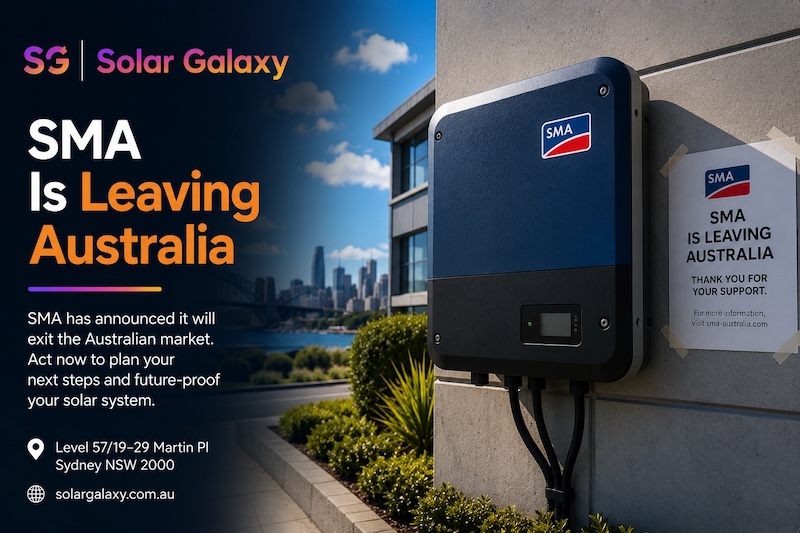
SMA Solar Technology has officially withdrawn from the Australian residential and commercial solar inverter market. The German manufacturer, once the undisputed leader in Australian solar installations, confirmed in April 2026 that it will no longer sell residential or commercial inverters here. The company is refocusing entirely on large-scale utility projects.
Your system is not about to stop working if you own an SMA inverter. But there are practical steps you should take now to protect your investment and plan ahead.
What Happened With SMA in Australia?
SMA Solar Technology confirmed in April 2026 that it was pulling out of Australia’s residential and commercial solar inverter market, ending its direct sales of products like the Sunny Boy, Sunny Tripower, and Sunny Island ranges. CEO Jürgen Reinert stated that the company would refocus on “large-scale infrastructure, grid-forming technology and hybrid integration.” He also noted that “Australia represents enormous potential in the global energy transition,” signalling SMA’s intent to stay active in utility-scale projects.
SMA has not gone bankrupt. The company is maintaining a local Australian office to honour existing warranty obligations for Sunny Boy, Sunny Island, and Sunny Storage owners. It will not, however, sell new residential inverters to Australian homeowners or businesses.
According to PV Magazine Australia, SMA supported over 10GW of solar and storage installations across the country over the past 15 years. That exit leaves a significant gap and a lot of homeowners wondering what comes next.
Why Did SMA Leave the Australian Market?
SMA’s withdrawal resulted from a combination of intense price competition, a missing battery product, and mounting financial losses that made the Australian residential segment unsustainable for the company. This was not a sudden decision. It followed years of declining market share.
1. Chinese Competition Crushed Margins
The residential inverter market experienced rapid commoditisation driven by massive oversupply and aggressive pricing from Chinese manufacturers. Brands like Sungrow, GoodWe, and Huawei undercut SMA on price while offering competitive feature sets, particularly around battery integration and hybrid inverter technology. SMA’s premium pricing model could not compete.
2. SMA Never Built Its Own Battery
This was SMA’s biggest strategic failure. Australian homeowners increasingly moved toward solar-plus-storage systems, pairing rooftop PV with lithium battery packs from brands like Tesla Powerwall, BYD, and Sungrow. SMA had no battery product of its own. Competitors who offered complete inverter-and-battery packages, such as Sungrow’s SH series with its SBR battery or GoodWe’s ET hybrid paired with the Lynx battery, captured the growing demand. SMA was left selling standalone string inverters in a market that wanted integrated solutions.
3. Significant Financial Losses
SMA reported losses exceeding €65 million in 2025. The company cut 1,100 jobs worldwide, with 350 more cuts planned for 2026. Those numbers tell a clear story. A premium German manufacturer simply could not sustain its cost structure while competing against state-subsidised Chinese production.
4. Commoditisation of the Residential Segment
State-subsidised manufacturing changed the competitive dynamics of residential inverters entirely. Price gaps between SMA and competitors widened year after year. The economics of selling residential inverters in Australia no longer made sense for SMA, even as the overall solar market continued to grow.
What Does SMA’s Exit Mean for Current SMA Inverter Owners?
Your SMA inverter will keep working normally, and there is no reason to rush into an emergency replacement if your system is performing well today. SMA inverters are well-built, reliable units with a track record spanning over two decades in Australia. That said, there are practical implications you need to understand.
In practice, this means your hardware is fine, but the support infrastructure behind it is shrinking. Here is what to expect across 3 key areas: warranty support, spare parts availability, and product updates.
Warranty Support Continues, for Now
SMA has confirmed they are maintaining a local Australian office to continue honouring warranty obligations for existing Sunny Boy, Sunny Island, and Sunny Storage owners. SMA’s standard warranty is 5 years, extendable to 10 or more years if your installer registered the extended warranty at the time of installation. You should still be able to make a warranty claim if your inverter develops a fault during the coverage period.
Warranty support from a company that has left the market is never as reliable as support from one actively selling here. Address any existing issues sooner rather than later.
Spare Parts May Become Harder to Source
Sourcing replacement components like DC isolators, control boards, and fan assemblies for SMA inverters will likely become more difficult and more expensive over time. This is not an immediate concern, but factor it into your long-term planning, especially if your system is already 8 to 10 years old.
No New Residential Products or Updates
SMA will not release new residential inverters for the Australian market. Firmware updates for residential products like the Sunny Boy and Sunny Tripower may slow or stop entirely. The SMA Sunny Portal monitoring platform for residential users may receive less development attention over time.
What Should You Do if You Have an SMA Inverter?
You should check your warranty status, monitor your system performance, and get a professional assessment to understand your inverter’s remaining lifespan and plan your next steps. Whether your SMA system is relatively new or approaching end of life, here are 5 concrete actions to take.
Step 1: Check Your Warranty Status
Dig out your original installation paperwork and confirm whether your SMA inverter is still within its warranty period. The standard warranty is 5 years, but extended warranties of 10 or more years were available through registered installers. Lodge any claims for existing faults now, while the local support office is still active.
Step 2: Monitor Your System Closely
Check your system performance regularly through the SMA Sunny Portal or SMA Energy app. Look for specific warning signs: unusual drops in daily generation, error codes like “Fac-BFR” or “Iac-Max” flashing on the display, or connectivity issues between the inverter and your monitoring platform. Catching problems early gives you the best chance of resolving them while support is still available.
Step 3: Get a Professional Replacement Quote
Talk to a qualified, SAA-accredited solar installer about your replacement options. At Solar Galaxy, we help SMA inverter owners understand their upgrade paths, whether that means a like-for-like swap with Fronius or a move to a hybrid inverter with battery storage from Sungrow or GoodWe.
Step 4: Plan for Replacement
Your SMA inverter does not need replacing today. Inverter lifespan is typically 10 to 15 years, and quality units like SMA can last 15 to 20 years. Start thinking about what you will replace it with, especially if you are also considering adding battery storage. Planning ahead avoids rushed decisions when the inverter eventually fails.
Step 5: Talk to Solar Galaxy
Our team works with all major inverter brands including Fronius, Sungrow, GoodWe, Solis, and Enphase, and can help you navigate this transition. You need a warranty assessment, a replacement quote, or advice on upgrading to a hybrid system with battery storage. Get in touch with us.
What Are the Best SMA Inverter Replacement Options in 2026?
You have 5 strong replacement options from brands with active Australian presence, local warranty support, and long-term market commitment. The key difference is that all of these manufacturers offer hybrid inverter models with battery integration, something SMA never delivered.
| Brand | Best For | Warranty |
|---|---|---|
| Fronius | Premium quality, best monitoring (Solar.web platform) | 10 years (extendable) |
| Sungrow | Best value hybrid, SH-RS series with SBR battery | 10 years |
| GoodWe | Wide range of hybrid and battery-ready inverters (ET, EH series) | 10 years |
| Solis | Budget-friendly with solid reliability, S6-GR1P series | 10 years |
| Enphase | Microinverters for complex, shaded, or multi-orientation roofs | 25 years |
There are 3 things to know about replacing your inverter:
- Your existing solar panels will work with any compatible new inverter. You do not need to replace them.
- Replacing a standard string inverter with a hybrid model is a practical opportunity to add battery storage capability to your home.
- Size matching matters. Your new inverter must be compatible with your existing panel configuration, including total wattage, string voltage, and number of MPPTs. A qualified installer will ensure the right match.
Not sure which inverter is right for your setup? Read our guide to choosing solar panels and inverters or contact Solar Galaxy for personalised advice.
Could Fronius Be the Next European Brand to Exit Australia?
Fronius, the Austrian inverter manufacturer, faces similar competitive pressures from lower-cost Chinese rivals like Sungrow, GoodWe, and Huawei. SMA’s exit has naturally raised concerns about whether Fronius could follow. However, Fronius has 3 advantages SMA lacked: stronger Australian brand loyalty, continued investment in residential R&D, and better battery integration roadmaps through partnerships with BYD and other storage manufacturers.
Nothing is guaranteed in a market this competitive. Fronius appears better positioned to maintain its Australian presence, at least in the near term. This situation highlights an important lesson for anyone buying solar equipment: evaluate the manufacturer’s financial health, local support infrastructure, and long-term commitment to the Australian market. Do not choose based on product specifications alone.
What Does SMA’s Exit Tell Us About the Solar Industry?
SMA’s departure reflects a broader pattern in the global solar industry where Chinese manufacturers, backed by state subsidies and massive production scale, are reshaping competitive dynamics across residential inverters, battery storage, and solar panel manufacturing. For Australian consumers, this trend has driven solar system prices down significantly. A typical 6.6kW residential system now costs a fraction of what it did 5 years ago.
SMA’s exit is a reminder that low prices come with trade-offs. When manufacturers leave markets, consumers holding their products bear the long-term risk through reduced warranty support, harder-to-find spare parts, and discontinued firmware updates. This pattern has played out before with brands like Delta and ABB in Australia’s residential solar sector.
At Solar Galaxy, we carefully vet every brand we recommend. We look beyond price and specifications to evaluate each manufacturer’s financial stability, local parts supply chain, and long-term viability in the Australian market. That approach protects our customers from exactly the situation SMA owners now face.
Frequently Asked Questions
Is SMA going out of business?
No. SMA Solar Technology is not going out of business. The company has exited the Australian residential and commercial inverter market but continues to operate globally in over 20 countries. SMA maintains its large-scale utility division in Australia and is refocusing on utility-scale solar, grid-forming technology, and hybrid integration for commercial-scale projects.
Will my SMA inverter stop working?
No. Your SMA inverter will continue to operate normally. The hardware installed on your roof functions independently of SMA’s market presence. Your Sunny Boy, Sunny Tripower, or Sunny Island will keep generating or managing power exactly as it did before the announcement.
Is my SMA warranty still valid?
Yes. SMA has confirmed they are maintaining a local Australian office to honour existing warranty obligations for Sunny Boy, Sunny Island, and Sunny Storage products. The standard warranty period is 5 years, extendable to 10 or more years. Address any warranty claims promptly while local support remains active.
Can I still get my SMA inverter repaired?
Yes, for now. Australian solar installers can still source and replace SMA inverter components like control boards, display screens, and cooling fans. Sourcing these parts may become more difficult over time as SMA winds down its residential supply chain, so address any issues sooner rather than later.
What inverter should I replace my SMA with?
The best SMA replacement depends on your priorities. Fronius is the closest like-for-like premium alternative with a 10-year warranty. Sungrow offers the best value with strong hybrid options like the SH-RS series. You can add battery storage with a hybrid inverter from GoodWe or Sungrow. Contact Solar Galaxy for a personalised recommendation based on your panel configuration and energy goals.
Do I need to replace my solar panels when I replace my SMA inverter?
No. Your solar panels are independent of your inverter. When you replace your SMA inverter, your existing panels will work with any compatible new inverter. An SAA-accredited installer will ensure the right size and configuration match between your panels and the new inverter.
How long will my SMA inverter last?
SMA inverters are well-built and typically last 10 to 15 years, with quality units lasting 15 to 20 years. There is no urgent need to replace your inverter if it is currently working well. Start planning for an eventual replacement, especially if your system is already 8 to 10 years old, so you can make an informed decision rather than a rushed one.
Can I add a battery to my existing SMA inverter?
This depends on your specific SMA model. The Sunny Island was designed to work with external battery systems, but most standard SMA string inverters like the Sunny Boy and Sunny Tripower are not battery-compatible. You will likely need to upgrade to a hybrid inverter from Sungrow, GoodWe, or Fronius to add battery storage. Talk to Solar Galaxy about your options.
Why did SMA leave Australia?
SMA left the Australian residential market due to 4 converging factors: intense price competition from Chinese manufacturers like Sungrow and Huawei, the company’s failure to develop its own battery product, financial losses exceeding €65 million in 2025 with 1,100 job cuts, and the broader commoditisation of the residential inverter segment driven by state-subsidised manufacturing.
Is the SMA Sunny Portal still working?
As of May 2026, the SMA Sunny Portal and SMA Energy app continue to function for existing users. The long-term future of these monitoring platforms for residential users is uncertain given SMA’s exit from the residential market. Consider setting up alternative monitoring through your installer or through a third-party energy monitor like Solar Analytics.
How Can Solar Galaxy Help With Your SMA Inverter?
Solar Galaxy provides replacement quotes and upgrade guidance for homeowners affected by SMA’s market exit. Whether you are planning ahead or ready to explore your upgrade options now, our SAA-accredited installation team is here to help.
Here’s How We Can Help:
- Inverter Replacement Quotes – Get a tailored quote for upgrading to a new inverter from Fronius, Sungrow, GoodWe, Solis, or Enphase.
- Battery Storage Upgrade – Replacing your SMA inverter with a hybrid model is the ideal time to add battery storage from brands like BYD, Tesla, or Sungrow.
- Full System Upgrade – For older systems, we design a complete solar and battery package that maximises your energy savings and export income.
Contact Solar Galaxy today or call us on 1300 339 596 to get your free replacement quote.