

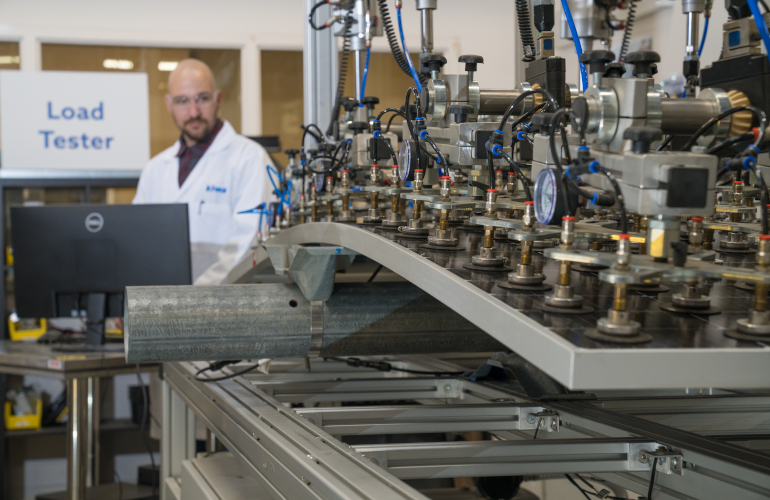

Solar panel testing lab Kiwa PVEL has updated its Product Qualification Program (PQP). The revisions address growing concern areas for the global solar industry, including the rise of field failures related to spontaneous glass breakage, frame structural failures and increasingly severe hail events.
“Across the industry, we continue to see increasing instances of spontaneous glass breakage in the field,” said Tristan Erion-Lorico, VP of sales and marketing at Kiwa PVEL. “As manufacturers have pushed toward larger modules and thinner materials, these sudden breakage events have made it clear that more rigorous and statistically meaningful testing is needed. Our updated PQP now uses higher sample sizes and test‑to‑failure methodologies to better assess module durability.”
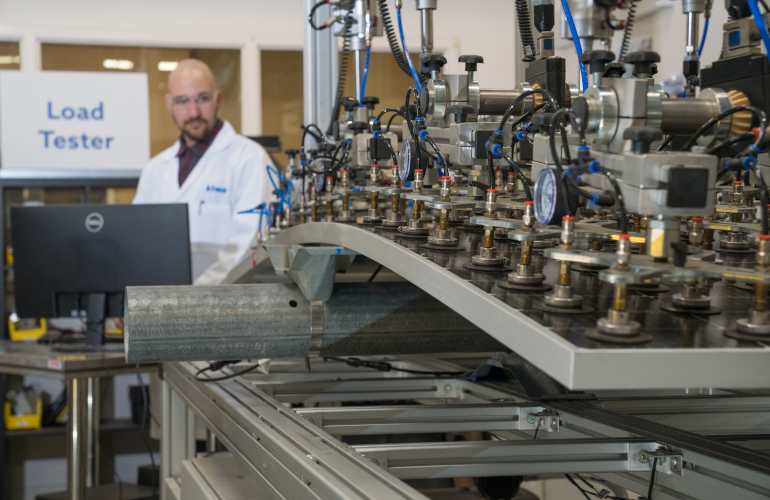
Kiwa PVEL has introduced test‑to‑failure (TTF) protocols for both static mechanical load (SML) and hail testing to the PQP. The new SML-TTF complements the PQP’s existing mechanical stress sequences (MSS) by quantifying the dominant failure mode and achievable maximum load for each module design submitted for PQP testing. It also expands the test sample quantity to five additional SML-TTF samples, on top of the two MSS samples.
Kiwa PVEL
The Hail‑TTF protocol replaces the previous hail stress sequence (HSS) in the PQP. The updated hail test increases the sample size to five modules and focuses on impact locations in the areas most prone to breakage, such as edges, corners, and junction box regions. Hail‑TTF greatly improves repeatability and comparability across manufacturers and glass suppliers, by escalating hail diameters until failure occurs, providing buyers with more quantifiable breakage thresholds.
Kiwa PVEL has also updated its PQP sample production witness process to more systematically verify critical frame and glass dimensions in factories, further reducing uncertainty related to material and assembly variability.
As n‑type technologies become dominant in the PV market, testing labs have encountered increased measurement uncertainty driven by metastability mechanisms. Kiwa PVEL’s team spent the past years quantifying these effects and identified three distinct forms of metastability that can distort post‑test performance measurements:
- Slow dark‑storage degradation following damp heat testing
- Accelerated dark‑storage degradation following UV exposure and field exposure
- Potentially recoverable PID‑polarization degradation following voltage stress
To counter these effects, the updated PQP introduces final stabilization steps, including short doses of full‑spectrum light soaking and UV‑light soaking, after UVID, field exposure, damp heat and PID testing. These steps ensure that post‑test flash measurements more accurately reflect true module behavior in the field.
Several other refinements further enhance the PQP’s relevance for modern day modules:
- Reduced LID sample size from 17 to 10 modules, justified by low and consistent LID values in recent years.
- Allowance for pre‑test current induced preconditioning (in addition to outdoor and indoor light‑soaking) to speed testing and improve scheduling flexibility.
- Streamlined UVID sequencing, eliminating the interim UV60 characterization in favor of a continuous 120 kWh/m2 exposure, with an option to extend up to 360 kWh/m2 for BOMs that show higher UVID susceptibility.
- Updated energy ratings following IEC61853-3/4 methodology, leveraging our high accuracy PAN and IAM testing data.
“Regularly iterating on the PQP makes it the most relevant test plan for today’s module technologies and failure modes,” said Kevin Gibson, Managing Director at Kiwa PVEL. “These updates allow module manufacturers to better showcase product reliability and performance on their current offerings. The new PQP also ensures that solar buyers receive meaningful, statistically robust and actionable data.”
News item from Kiwa PVEL