

The reality of a solar-only system in Australia right now is that it truly only benefits those who use energy only during daylight hours. If you’re like me, or a vampire, then you’ll know that solar alone simply does not cut it anymore. When the crux of your energy usage falls outside of solar production hours, there’s really only one solution (that does not involve shipping the kids to their grandparents). Adding battery storage has been playing on my mind for a couple of years, and we finally did it! With the careful guidance of Hytech Solar and the GoodWe ESA tech set to change the trajectory of our bills, we bit the proverbial bullet and installed a battery.
When shifting energy usage isn’t enough
We installed solar on our home in late 2024, and it has already saved us over a thousand dollars on our electricity bills. While the system has truly been fantastic, we were not saving the amount of money that we had hoped. Quarterly bills of $250 or more were a far cry from the $9 bills we had at our previous home with solar. This was primarily due to our usage habits. The majority of our energy usage happens between 6pm and 11pm every night. As much as we tried to shift our habits, using certain appliances was completely unavoidable. Our feed-in tariff was lowered from 8c/kWh to 3c/kWh, further reducing our savings. The only practical solution was to install a battery. But the cost! Oh, the cost.

Thank you, Cheaper Home Batteries Program!
Knowing that current VPP programs like Amber and GloBird would see an ROI in less than 7 years made the decision much easier.
We only needed to decide on the battery and the installer.
The GoodWe ESA All-in-One: An easy decision
I write about solar and batteries for a living. Choosing the right battery for our home was probably the easiest and fastest decision I’ve ever made! The moment I laid eyes on the ESA at 2025’s All Energy Australia, I knew that I had to have one. Two features stood out to me: The 6 levels of safety and whole-home backup straight out of the box.
I have 3 young kids that I need to protect, and I’ve seen firsthand what can happen when price is prioritised over quality. The house could very nearly have burned down when a cheap USB cable melted part of my couch. Home batteries are nothing to skimp out on, and knowing that built-in fire extinguishers form part of a sophisticated lineup of safety features was the tipping point for me.
Whole-home backup was also a clincher. We have experienced blackouts on two occasions in the two years we’ve lived in this house, with one lasting almost 24 hours. Only being able to power a fridge and a few other essentials seems like a wasted opportunity. The ESA can back up your whole home without the need for an additional gateway. This means that your home can operate as per usual, limited only by the inverter and available battery capacity.
Hytech Solar: Professional from start to finish
As we did with installing solar, we turned to Energy Matters to help us get the ball rolling with free quotes. We were quickly contacted by Luke from Hytech Solar, and we haven’t looked back since. Based in Victoria and operating since 2014, we were given the peace of mind that in the unlikely event that something goes wrong with the system, Hytech will be around to help. The quote fit perfectly in our budget and was tailored to our current and future needs.
Luke recommended the GoodWe ESA before we even mentioned it. We discussed our desire to add an EV in the future, as well as the plan for whole-home backup. As we use an average of 19kWh of electricity a day, and our energy needs would be increasing, he suggested that the best course of action would be to maximise the single tower capacity for the ESA (48kWh) with a 10kW inverter and to utilise a VPP for a faster ROI.


Every step was straightforward and surprisingly quick. The federal battery rebate will be reduced heavily from 1 May 2026, so we thought that we might not be able to have the battery installed until late April. We were provided an installation date within a week, and the system was installed 3 weeks after the initial quote.
The day of installation could not have been smoother. The install team arrived at 8am on the dot, the work was completed by 3pm, and the work area was cleaned spotless. Jimmy, the head installer, set up the GoodWe SEMS + app for us, ran us through the switchboard upgrade and what to expect during a blackout event, and even checked in on us post-install. The system was installed on a Friday and inspected by a qualified inspector the following Tuesday. We now have a fully functioning battery.
Important things we needed to consider
While the installation was mostly straightforward, there were things to consider prior to installation:
- Would we AC or DC couple?
- What would happen to the current inverter if we DC couple?
- Where would we install the battery?
- Additional costs for fireproofing, cable runs, and whole-home backup
The benefits of DC coupling
Because we had an existing solar inverter, AC-coupling the battery was a viable option. The GoodWe ESA All-in-One combines an inverter with battery storage, and AC coupling would see the unit connected to the home’s electrical system alongside the existing inverter. While installation is typically faster, AC coupling results in around 5% to 15% more energy loss compared to DC coupling.

In an AC-coupled setup, the DC electricity generated by the solar panels is first converted to AC by the existing solar inverter to power the home. Any excess energy is then detected by the ESA, which converts that AC electricity back into DC so it can be stored in the battery. This extra conversion step is where the additional energy loss occurs.
Choosing DC coupling eliminates these extra steps. The existing inverter is removed, and the solar panels are connected directly to the new inverter inside the ESA. This allows DC power from the panels to charge the battery directly, improving overall efficiency.
What happened to our existing solar inverter?
The solar inverter we installed a little over a year ago was fantastic, and had many years of life left in it, not to mention the warranty. Choosing to DC couple meant that we no longer needed the inverter. We have chosen to donate the system so that it stays out of landfill and provides many years of electricity for its new home.
The installation location of the battery
Hytech Solar initially offered 3 locations for the ESA within our home. The first location was within our garage. With 6 battery modules plus the inverter, the ESA would stand at over 2.1m tall. Because of this, and to meet strict battery installation regulations, fireproof sheeting would need to be installed behind and above the unit. Bollards would also need to be installed, a requirement for garage installations. While we loved the idea of the ESA being shielded by the elements, these additional safety requirements were less than palatable.
Location no.2 was the wall that housed the existing inverter. Due to spacing restrictions and regulations requiring a minimum of 600mm on either side, Hytech Solar ruled against this.
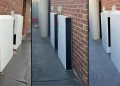
The third and final location was the outside wall towards the back of the home. This location required additional cable due to its distance from the switchboard, but was otherwise perfectly placed and required no additional safety installations.
We decided on location no.3.
Additional costs
No two installations are ever the same, and many come with additional costs. Because we opted for an exterior location towards the rear of the home, DC coupling, and whole-home backup, we incurred extra costs. The added expenses covered the additional cable length, extended work hours, and the switchboard change-out.
The final result
The moment the ESA was switched on, after clearing the electrical safety inspection, we saw changes immediately. The batteries were around 40% charged out of the box, and Jimmy set up the ESA so that the handshake required for the grid (a few watts for grid synchronisation and anti-islanding) uses power from the batteries and does not take from the grid. This has meant that we have not taken a single watt from the grid since it was powered on. Solar charges the batteries to around 85% capacity during the day (often 100%), and we’ll wake up to a 50% battery or more every morning.
Even if we do not sign up for a VPP, we will only ever pay for the daily supply charge (currently $1.40 with our current retailer). This would take our current yearly bill of approx. $1,300 down to $511 (not taking into account any feed-in tariffs). Obviously, we will be joining a VPP, which should see our bills in credit.
Worth every cent
The aim of the game is to eliminate our electricity bills, which the GoodWe ESA, thanks to Hytech Solar, will absolutely achieve.
I cannot recommend the GoodWe ESA All-in-One and Hytech Solar more highly. We now have our dream system. But our electrification journey does not end with solar and battery storage. We will be replacing one of our cars with an electric vehicle in the near future. With a 48kWh battery ready to charge, we are one step closer to full home electrification.
Thank you to the fantastic teams at Hytech Solar and GoodWe for collaborating with us.
If this sounds like something that you would like to explore, start your journey today with Energy Matters. We’ll connect you with local installers who are ready to provide you with tailored, no-obligation quotes. The best part? This service is completely free! So get started today and find out how much you can save.