



The Virginia General Assembly has officially passed legislation that would significantly expand the Commonwealth’s shared solar programs, unlocking new opportunities to lower electricity bills and strengthen reliability. These bills passed with bipartisan support and will now be presented to Virginia Gov. Abigail Spanberger for action.
The legislation includes SB 254 and HB 807, sponsored by Senator Scott Surovell and Delegate Rip Sullivan, which apply to Dominion Energy’s service territory, as well as SB 255 and HB 809, also sponsored by Sen. Surovell and Del. Sullivan, which address Appalachian Power Company (APCo) territory. Together, the bills build on the success of Virginia’s existing shared solar programs by expanding capacity, improving certainty for customers and developers, and ensuring these programs can play a meaningful role in addressing rising energy costs and growing electricity demand.
“Shared solar has already proven itself as one of the fastest, most cost-effective ways to deliver real savings to Virginians,” said Sen. Surovell. “These bills are about scaling what works — giving more families access to affordable power while strengthening reliability and keeping investment here in Virginia.”
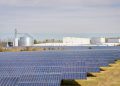
Virginia’s shared solar (community solar) programs are currently capped at pilot-scale levels and have been fully subscribed, leaving customers and projects on waitlists despite strong demand. In Dominion territory, the original 200-MW program has been fully awarded across 52 projects, serving tens of thousands of customers. In APCo territory, the 50-MW program launched in 2025 and was oversubscribed almost immediately.
The Dominion bills (SB 254/HB 807) would require the release of an additional 525 MW of shared solar capacity by July 1, 2026, including a dedicated portion for low-income subscribers, while establishing a clear, predictable process for future program expansion overseen by the State Corporation Commission (SCC). Once a portion of that capacity reaches substantial completion, the SCC would initiate a proceeding to evaluate additional allocations and program design.
The APCo bills (SB 255/HB 809) would improve customer participation by establishing consolidated billing, or net crediting, aligning APCo’s program with best practices already in place elsewhere in the state. The legislation also lays the groundwork for future capacity releases to meet strong interest in Southwest Virginia, where many counties have expressed interest in hosting shared solar projects.
“Affordability is front and center for Virginians right now, and shared solar delivers immediate, guaranteed bill savings while benefiting all ratepayers,” said Del. Sullivan. “These bills provide certainty, transparency, and a responsible path forward so shared solar can help meet the Commonwealth’s growing energy needs.”
To date, shared solar saves participating customers 10% or more on their monthly electricity bills — roughly $175 per year — while also delivering system-wide benefits by reducing the need for costly generation, transmission and distribution investments. A third-party analysis of expanded shared solar in Virginia found $64 million in net benefits in the first two years alone and more than $2.4 billion in net benefits over 25 years, with savings accruing to all utility customers, whether or not they directly subscribe.
“Virginia is facing unprecedented load growth and rising energy costs, and shared solar is one of the most practical tools available to respond quickly and affordably,” said Charlie Coggeshall, Mid-Atlantic Director at the Coalition for Community Solar Access. “These bills recognize that shared solar is far from a pilot concept — it’s a proven solution that can deliver lower bills, local jobs, and grid benefits at scale.”
News item from CCSA