

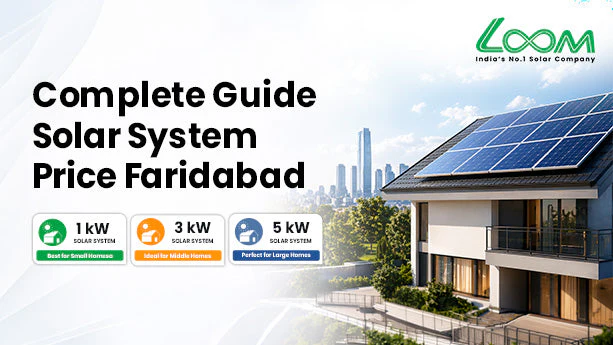
Faridabad is one of the haryana’s largest industrial and residential hubs which falls under the jurisdiction of Dakshin Haryana Bijli Vitran Nigam (DHBVN). With electricity tariff in the state reaching up to ₹7.10 per unit for high consumers along with additional fuel surcharges frequently inflating monthly bills, going solar has become not only an eco-friendly choice but also a smart financial choice for thousands of households in Faridabad.
According to The Times of India, “India adds a record 51GW of renewable capacity in FY26.”
Haryana receives an average of 300 sunny days per year making rooftop solar not just viable but highly productive in NCR cities like Faridabad and Gurgaon. In these cities solar adaptation rates are among the highest in the country.
In order to understand what each system size means, below is the information regarding each system specifically to help you understand it better.
|
1kW On-grid system (Small House) |
|
|
Price Range |
₹65,000 – ₹85,000 |
|
Daily Output |
4-5 units |
|
Panels Needed |
2-3 Panels |
|
Roof area |
~65 sq ft |
1kW–The Entry Point.
It’s good if you have a limited roof space or if you just want to offset a portion of your electricity bill. Output is modest enough to cover lightning, fans, and small appliances, not ideal if you want to run an AC.
|
3kW On-grid system (Most Popular) |
|
|
Price Range |
₹1,89,,000 – ₹2,25,,000 |
|
Daily Output |
12-15 units |
|
Panels Needed |
6-9 Panels |
|
Roof area |
~200 sq ft |
3 kW– The Most Popular choice among Indian Households.
It is a most popular choice among 3-4 BHK Homes. It handles everyday load including fridge and a 1.5-ton AC during daylight hours. The payback is very favourable once you apply for PM Surya Ghar Subsidy.
To know more about Subsidy. Checkout this blog: Haryana solar subsidy 2026 PM Surya Ghar Yojana
|
5kW On-grid system (Large Home) |
|
|
Price Range |
₹2,25,,000 – ₹3,00,,000 |
|
Daily Output |
20-25 units |
|
Panels Needed |
10-14 Panels |
|
Roof area |
~350 sq ft |
5kW– For high consumption or small businesses.
If your monthly bill regularly crosses ₹3,000-₹4,000 or if you run a shop, clinic, small office from home, a 5 kW system would be appropriate for that setting.and the subsidy is ₹78,000 regardless of size above 3 kW.
What’s included in the system cost?
Many buyers make the mistake of comparing “panel prices” instead of full system costs. A rooftop solar system in Faridabad has many parts and low-cost quotes often compromise on important components. Here is what a complete, properly scoped quotes look like:
|
Solar Panels Mono PERC, TOPcon, HJT panels |
Inverter MPPT-based (String or Micro) |
|
Mounting Structure GL or aluminium; raised if needed |
Wiring & Protection DC cables, AC cables, MCBs, SPDs |
|
Earthing & Grounding Safety- critical; never skip |
Net Meter coordination DHBVN application & documentation |
|
Installation & Commissioning Includes testing & handover |
Monitoring System App-based performance tracking. |
In places like Faridabad, high dust levels can reduce panel efficiency by 25-30% if panels aren’t cleaned regularly. Ask your installer about Annual Maintenance Contracts (AMC) that include periodic cleaning.
Which system size is right for your home?
Choosing the right capacity comes down to your average monthly electricity consumption. Here’s a practical sizing guide based on typical household in faridabad:
-
1kW system: Best for 1-2 BHK flats using 90-120 units/months. Covers fans, lights, TV, a small fridge, and a laptop. Not suitable for air conditioning.
-
3kW system: Ideal for 3 BHK homes using 250-400 units/months. Can power 1AC (1-ton), fridge, washing machine, fans, and lights simultaneously. The most common choice in faridabad residential areas.
-
5kW system: Suited for large 4 Bhk homes or those using 450-600 units/months. Comfortably runs 2 inverter ACs, a fridge, washing machine, and other heavy appliances concurrently.
Below is the table to help you understand better:
|
Appliances |
1kW system |
3kW system |
5kW system |
|
Lights/ Fans |
Yes |
Yes |
Yes |
|
Refrigerator |
Yes |
Yes |
Yes |
|
TV + set-top box |
Yes |
Yes |
Yes |
|
Washing machine |
Partial |
Yes |
Yes |
|
15-ton inverter AC (1 unit) |
No |
Yes |
Yes |
|
15-ton inverter AC (2 unit) |
No |
Partial |
Yes |
|
Geyser/water heater |
No |
Partial |
Yes |
|
Water pump (0.5 HP) |
No |
Yes |
Yes |
Which type of solar system should you choose?
Beyond system size, the type of solar setup you choose also affects both cost and performance. In faridabad most solar installation are on grid systems, but it does help knowing all three systems before deciding:
-
On grid system: This system is connected to the electricity grid and there is no need for any battery in it. It is most popular among urban areas.
-
Off grid system: This system is not connected to the electricity grid and requires the battery backup. It is most popular among rural areas.
-
Hybrid system: This system is connected with the electricity grid and also uses battery backup for the time of power cuts.
|
Feature |
On grid |
Hybrid |
Off grid |
|
Work during power cuts |
No |
Yes |
Yes |
|
Battery included |
No |
Yes |
Yes |
|
Exports to grid |
Yes |
Yes |
No |
|
Lowest upfront cost |
Yes |
No |
No |
|
Best for Faridabad |
Most home |
Frequent cuts |
Remote area |
Why is Faridabad perfectly suited for solar?
Faridabad sits in the heart of Haryana’s solar radiation belt. The city receives between 5.0 and 5.5 peak sun hours per day on average, which is significantly higher than coastal or northeastern cities which means the electricity generated per installed Kilowatt here is significantly higher than the most of the cities in India.
Along with the city’s rising demand for electricity, frequent summer grid stress, and DHBVN’s increasingly efficient net metering system you have a location which delivers exceptional returns.
The homeowners in Faridabad who had installed the solar panels 3-4 years ago have already recovered their full investment and now are generating free electricity.
The local installer market is already mature, most of the installers in the locality are MNRE-empanelled vendors due to which it keeps price competitive and ensures quality installations backed by proper warranty.
Necessary things to install these systems.
Here are some of the necessary things to install these systems:
-
Solar panels: These are the primary power generating components. For a 1kW system it needs 6-9 panels, and a 5kW system needs 10-14 panels.
-
Solar Inverters: Converts DC electricity from panels into AC electricity which your home can use. It’s like a brain of the system, for on grid setups (most common in faridabad), a string inverter with MPPT technology is standard
-
Mounting structure: It is the frame that holds panels on your roof, it is made of either galvanised steel or aluminium. Must be engineered to handle wind speeds of at least 150 km/h as per MNRE norms.
-
DC wiring & AC wiring:It separates cable runs from panels to inverter (DC side) and inverter to your home (AC side).
-
Net meter (for on grid system): It is installed by DHBVN after your application is approved. It replaces your existing electricity meter and tracks both import and export of electricity from the grid.
Conclusion
For homeowners in faridabad choosing to establish a solar is no longer any future option but a most practical way to control and manage the rising electricity cost. So, whether you choose a 1 kW system for basic saving, 3 kW system as a balanced solution for the households, or a 5 kW system for higher consumption and near zero electricity bill. The main key is to select a system that matches your usage while also considering your future needs.
However system size does not determine your savings, you have to look beyond that such as the type of panels quality, inverter efficiency, proper installation, and a smooth net metering approval plays a crucial role in a long term performance.
Companies like Loom solar stand out in this space due to its strong focus on residential solar solutions, high efficiency panels, and integrated product offers that are well suited for the installation in 1 kW – 5 kW range