

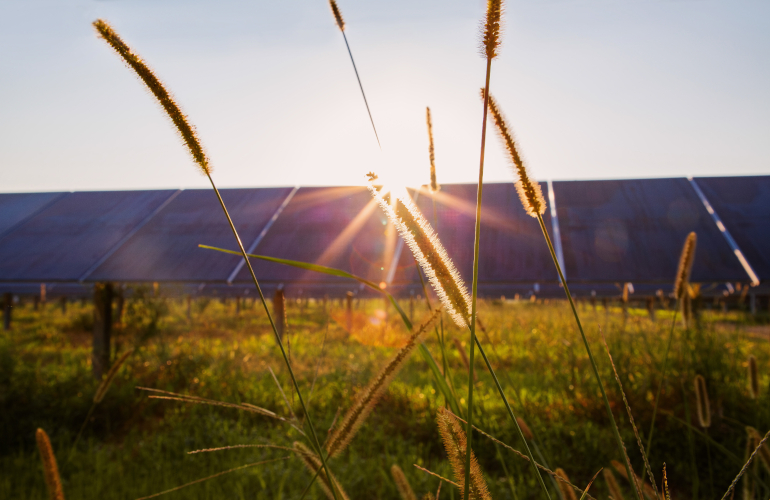

A new study analyzing hundreds of renewable energy projects across the United States finds that most wind and solar facilities under state jurisdiction receive permits within roughly a year and that nine in 10 are ultimately approved.

Credit: Lightsource bp and JERA Nex
The study, co-led by researchers at the University of Massachusetts Amherst, examines permitting data for 460 projects across 19 states, analyzing how long it took them to move from permit application to a final decision and how frequently projects were approved. A companion study also reviewed locally permitted projects in Massachusetts.
Despite the approval rate, researchers found variations among states. Kentucky and Mississippi processed applications roughly five months faster than the national average, while Maryland, Ohio, Minnesota and New York took about three months longer.
Approval rates also varied, ranging from 80% to 100% depending on the state.
“Governance structures matter,” said Juniper Katz, assistant professor of public policy at UMass Amherst and co-author of the study. “States where permitting boards must incorporate local preferences tend to have higher approval rates — possibly because developers bring projects into compliance before applying.”
Other states have recently shifted authority to centralized state-level siting processes. In Minnesota and New York, centralized oversight coincided with more project proposals but also more complex regulatory dynamics, the study found. After state authority was scaled back in Ohio, there was a 20% cancellation rate among proposed projects.
The findings come as many states revise permitting policies to meet climate and clean energy targets. Although debates often focus on federal permitting reform, the study stresses that most renewable energy facilities in the U.S. are permitted at the state level on private land.
While the national analysis focused on projects reviewed by state authorities, a companion study by the same research team examined permitting timelines in Massachusetts, where most wind and solar projects are reviewed by local governments.
That analysis compiled data on 26 projects in 17 Massachusetts communities and found the permitting process lasted about 250 days on average, with a median of 173 days. Approved projects had shorter timelines, while projects that were canceled or challenged in court saw longer decision times. Massachusetts delegates most land-use authority to municipalities, so permitting processes can vary widely among the commonwealth’s 351 cities and towns.
“This dataset provides a baseline — as reforms take effect, researchers and policymakers can now measure whether changes actually shorten timelines or improve outcomes, and which governance structures best balance efficiency with meaningful public participation,” Katz said.
The research was co-authored by Natalie Baillargeon, a master’s degree candidate at UMass Amherst, together with colleagues from Lawrence Berkeley National Laboratory: Robi Nilson, Lanbing Tao, Will Maddock and Ben Hoen.
News item from the University of Massachusetts Amherst