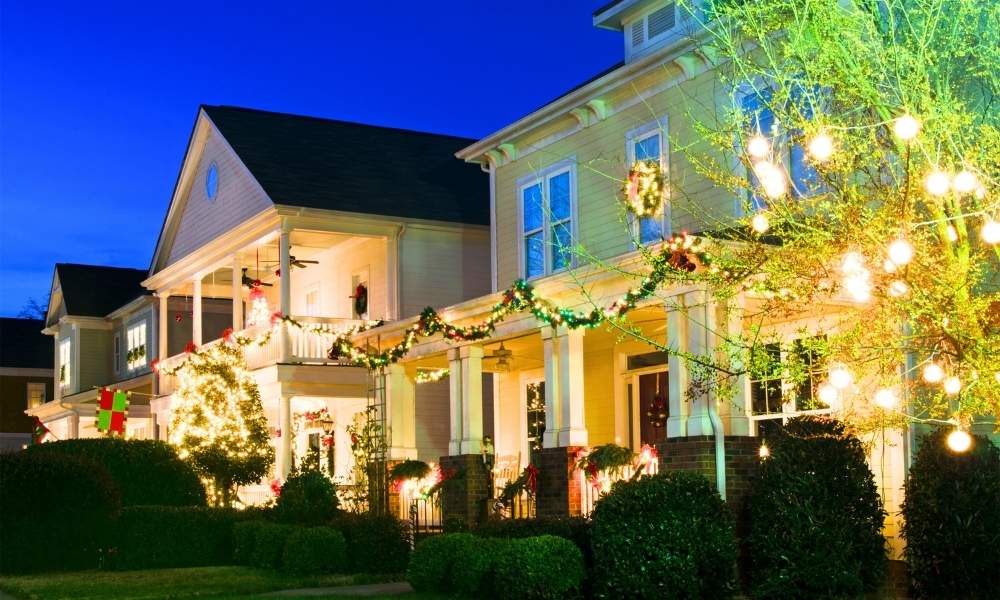
December changes how Australian homes use energy in ways most people never notice. It’s not just the Christmas lights—it’s everything that comes with the season. Outdoor inflatables, garden lighting, projectors, extra fridges, long evenings with the air conditioner running, and decorations plugged into multiple timers and transformers all build a different load pattern than the rest of the year.
These aren’t huge individually, but together they reshape the home’s daily energy curve at the exact time solar production drops and heat pushes appliances harder.
Understanding that shift helps households stay on top of bills and make their solar work smarter through the busiest, brightest month of the year.
What actually drives December’s holiday energy load
LED fairy lights barely register on a power bill. The real holiday load comes from everything wrapped around them, such as:
- Outdoor projectors
- Inflatable displays
- Moving ornaments
- String-light controllers
- Power packs
All of these draw more energy than people expect — especially when they run for hours every night. Many homeowners also plug these into older extension leads and power boards that waste energy as heat, adding unnoticed inefficiency.
Inside the home, the seasonal load is even more noticeable. Small decor pieces add a constant background draw, including:
- Animated tabletop ornaments
- Rotating trees or tree bases
- Plug-in scent warmers
- Indoor string lights and decorative lamps
The bigger impact comes from how households actually use their homes in December. Holiday rhythms lead to heavier appliance use, such as:
- Extra fridge or freezer space for food storage
- Ovens are cycling more often
- Dishwashers running multiple times a day
- Air conditioning works harder when the house is full
Most of these loads occur after sunset, long after solar production dips. That’s why even solar households see a noticeable December spike: the holiday load profile simply shifts more activity into the hours when the grid takes over.
Why holiday energy loads matter in ways you don’t immediately see
The real December difference isn’t the weather, but the timing collision that happens inside almost every home. Holiday decor switches on during the one part of the day when the home’s energy system is already under maximum pressure. It happens during the same window when:
- Solar production collapses
- Air conditioning ramps up to deal with stored heat
- Cooking loads spike
- Fridges and freezers recover from constant opening
- Dishwashers, pool pumps, and laundry often overlap.
Individually, none of these loads is dramatic. But what homeowners rarely see is how December creates a stacked-load event—a perfect overlap in which multiple systems compete for power at the exact moment the home has the least daylight energy left.
This is why the same decor setup barely registers in July, but feels different in December. The load isn’t higher because decorations are inefficient. The load is higher because every holiday behaviour converges into the evening peak, creating a pattern that doesn’t exist in any other month of the year—and one that the home’s energy system can’t smooth out without help.
How holiday decor reshapes your home’s energy profile
December doesn’t add one big new load; instead, it rearranges the shape of the day. Holiday decor introduces a long, steady draw that didn’t exist in the months before. That matters because it changes how the rest of the home behaves.
Decorations create a new “background baseline” that runs every night for hours. Even small loads, when stretched across 20-30 evenings, shift how often appliances cycle and how quickly the home hits its peak demand. The home starts each evening with a slightly higher foundation load, which means everything layered on top (cooling, cooking, dishwashing, guests) climbs faster and lands later into the night.
Holiday setups also introduce more standby behaviour than homeowners realise. Timers, controllers, projectors, and power packs all keep drawing during the day, even when the decorations are off. This daytime phenomenon load skews the home’s baseline, pulling small amounts of grid energy at times when the house normally would have slipped comfortably into “solar surplus.”
The end result is a December load curve that looks stretched: higher in the afternoon because of daytime standby, higher in the evening because everything overlaps, and higher at night because holiday displays run past the point where the home usually settles. Decorations aren’t the star or the curve—they’re the thing that changes its shape.
Why most holiday displays don’t actually run on solar
Most homeowners assume their rooftop solar offsets the cost of holiday decorations. In practice, almost none of that energy is used to power the display. The timing simply doesn’t line up.
Solar production fades just as decorations turn on. Even on long summer days, meaningful output drops sharply after 5pm. By the time lights, protectors and inflatables activate between 7pm and 8pm, solar is contributing almost northing. Without a battery, every watt comes from the grid.
But there’s another, less obvious reason displays end up running on grid power: daytime standby consumption. Timers, control boxes, and transformer bricks draw small amounts of energy all day. Solar households do cover this part, but this daytime credit evaporates when homeowners run more daytime loads in December: extra fridge cycling, food prep, washing for guests, pool equipment, and pre-cooling the home for evening hosting. What could have gone to decor standby is absorbed by the household’s higher daytime demand.
The result is counterintuitive: even solar-rich homes often power their entire Christmas setup from the grid, not their panels — not because the display is large, but because the timing is mismatched.
Small shifts that meaningfully reduce the December load
You don’t need to cut decorations or dim anything festive. The biggest savings come from adjusting when and how the holiday setup interacts with the rest of the home’s energy rhythm.
A few low-effort shifts make a noticeable difference:
- Start the display earlier, end it earlier: Running lights from 6:30-9:30pm uses less grid energy than 8pm-11pm, simply because the early-evening overlap with peak cooling is smaller. Solar households may also catch the last tail end of daylight.
- Avoid all-night standby: Many control boxes, outdoor plugs and animated decor stay warm all night, drawing a slow, unnecessary trickle. Putting them on a proper off-cycle cuts the load without touching the actual display.
- Separate decor from major appliances: If your oven, dishwasher and AC all run during peak hosting hours, shifting the display’s start time by even 45 minutes smooths the stacked load that makes December feel expensive.
- Use one master outdoor switch instead of multiple bricks: Running everything through a single, high-quality outdoor timer reduces the baseline losses from multiple transformer packs warming all day.
- Skip unnecessary motors: Inflatable or rotating decorations cycle harder in warm weather. Using fewer motorised pieces has a bigger impact than cutting lights.
These aren’t about using fewer decorations but about preventing your display from colliding with the parts of December that already strain the home’s energy system.
Holiday decorations don’t transform a home into an energy-guzzler. What they do is shift the rhythm of how the house uses power, stretching the evening peak and adding a layer of background load that didn’t exist in November. Once homeowners see that pattern — not as a problem, but as a seasonal signature — it becomes easy to manage without cutting back on anything festive. A few small changes in timing or setup smooth the curve, the home stays comfortable, and the display still shines. December has its own energy shape; understanding it simply makes the season easier to enjoy.
Energy Matters has been in the solar industry since 2005 and has helped over 40,000 Australian households in their journey to energy independence.
Complete our quick Solar Quote Quiz to receive up to 3 FREE solar quotes from trusted local installers – it’ll only take you a few minutes and is completely obligation-free.