


Terabase Energy announced it is ready for commercial shipment of its automated solar panel construction platform, Terafab.
The first-generation Terafab has been deployed across five solar power projects, and Terafab V2 is now available to the market. Terafab automates solar construction with AI and autonomous robotics.
 “We built the technology that deploys the safest, fastest and lowest cost solar. Terafab is physical AI applied to one of the largest infrastructure buildouts in history,” said Matt Campbell, CEO and co-founder of Terabase Energy. “Every week we shave off a construction schedule means earlier revenue for project owners, lower financing costs, and faster delivery of clean electrons to the grid. That’s the speed-to-power advantage.”
Factory automation has been widely demonstrated indoors, where conditions are controlled and predictable. Terafab operates in an entirely different outdoor environment. Terabase has invested years of R&D into engineering a system that delivers factory-grade precision and throughput year-round in the uncontrolled conditions of active construction sites, from fine desert dust and triple-digit heat to wind, rain and mud.
See a Solar Power World Q&A with Terabase here.
Terafab V2 is a physical AI system that uses advanced robotics, real-time decision-making and autonomous operation to build at a pace manual crews cannot match. A single line achieves two-minute cycle times that, running 24/7, translate to more than 20 MW installed per week, or roughly 1 GW per factory per year.
 In conventional solar construction, steel torque tubes are installed in the field first, and workers then manually attach hundreds of thousands of (getting heavier) glass solar panels to them one by one. Terafab inverts that process: modules are pre-assembled onto tracker torque tubes with in-line quality control verifying every unit, so defects are caught immediately. The system eliminates manual lifting of heavy steel and glass components, improving jobsite safety and enabling sustained operations in extreme heat.
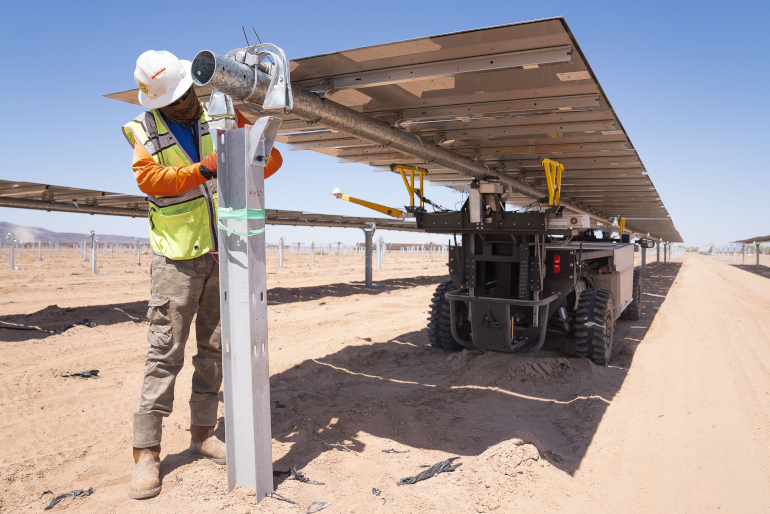
Once each unit is assembled, a fleet of purpose-built rovers delivers the pre-assembled components to their final installation points, completing the last mile of construction. Terabase expects those rovers to operate fully autonomously soon. Behind it all, Terafab’s Manufacturing Execution System (MES) uses AI to actively manage and optimize the construction process of the full PV plant.
Over the next 12 months, Terabase is building factory capacity at its Northern California facility capable of installing up to 10 GW per year. Designed and manufactured in the United States, Terafab represents a significant investment in American manufacturing and clean energy infrastructure.
“The companies building the AI-powered future need electricity at a scale and speed that the construction industry has never delivered before,” Campbell said. “We’ve developed Terafab to close that gap.”