

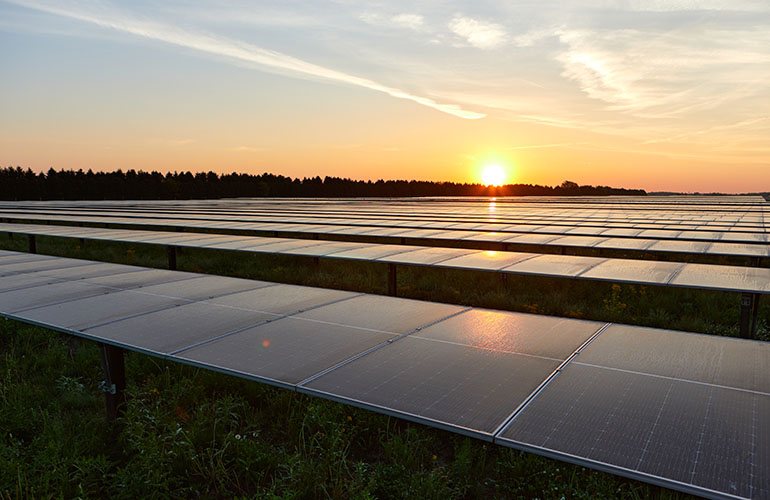

Solar accounted for 72% of new electrical generating capacity on the U.S. grid for the first 10 months of 2025, according to a review of FERC data by the SUN DAY Campaign. Solar PV has held this position for 26 months in a row and has now edged out wind power as the largest source of renewable energy capacity on the U.S. grid.
In October alone, solar was 60% of new generating capacity and FERC expects another 90 GW of solar to be deployed over the next three years, eclipsing new nuclear power and coal deployment. In FERC’s latest monthly “Energy Infrastructure Update” report (with data through October 31, 2025), 1.082 GW of solar was placed into service in October, accounting for 59.8% of all new generating capacity added during the month. Compare that to natural gas with 727 MW and oil with 1 MW.
The utility-scale solar added during the first 10 months of 2025 is just 161 MW less than what was installed in the first 10 months of 2024. From September 2023 to October 2025, solar has been the largest source of new generating capacity, growing from 91.82-GW to 160.56-GW. Wind expanded by 12.39-GW while natural gas’ net increase was just 6.55-GW, with a total capacity of 160.09 GW.
Solar, wind, hydropower and biomass accounted for 87.2% of all new generating capacity while natural gas added 12.4%, with the remainder being oil and waste heat. Taken together, wind and solar constitute nearly one-fourth (23.79%) of the United States’ total available installed utility-scale generating capacity. More than 25% of U.S. solar capacity is in the form of small-scale (rooftop) systems that are not reflected in FERC’s data. Including that additional solar capacity would bring the share provided by solar + wind to more than a quarter of the nation’s total, according to the SUN DAY Campaign.
All renewable energy capacity currently claim a 32.72% share of total U.S. utility-scale generating capacity. If small-scale solar capacity is included, renewables are now more than one-third of total U.S. generating capacity.
Solar is on track to become the second largest source of U.S. generating capacity
Based on FERC estimations, utility-scale solar is slated to account for 17.3% of installed U.S. generating capacity alone in three years, placing it in second place behind natural gas with an estimated 40.1% capacity. Combining all estimated renewable energy capacity, utility scale renewables could exceed 38%.
“It has now been a full year since Trump launched his assault on renewable energy with a string of anti-solar and anti-wind executive orders,” said Ken Bossong, the SUN DAY Campaign’s executive director. “And while they may have slowed progress, the economic and environmental benefits of renewable energy sources continue to drive their dramatic growth.”
News item from the SUN DAY Campaign