

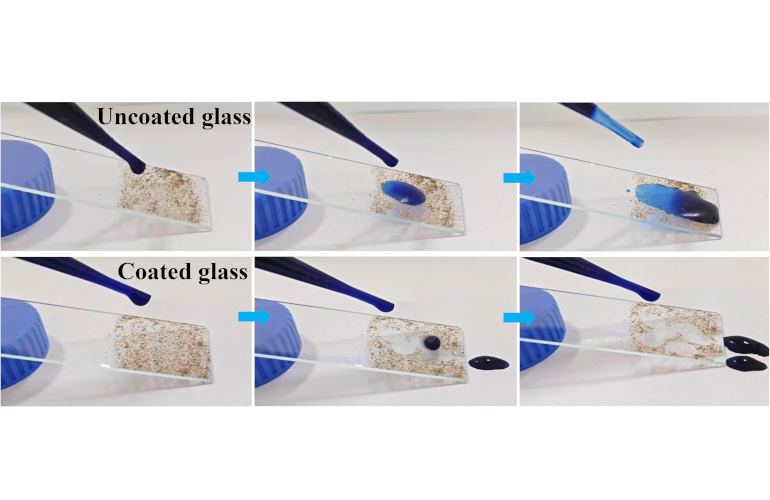

A transparent, water-repellent coating developed by researchers in Scotland, China and India could make solar panels self-cleaning and improve their power output. The dual-layer coating repels water, dust and dirt without reducing the amount of light reaching the photovoltaic cells. The breakthrough is reported in the academic journal Colloids and Surfaces A: Physiochemical and Engineering Aspects.
 “We have designed the coating so that it can be applied retroactively onto solar cells, as well as new panels. Dust, dirt and bird droppings all affect solar panel performance. Maintenance risks damaging the panels, is costly and sometimes a logistical challenge,” said Dr. Sudhagar Pitchaimuthu, associate director of energy materials and technology at Heriot-Watt University’s Research Centre for Carbon Solutions (RCCS) in Edinburgh. “Our clear, highly water-repellent coating works by combining a thin adhesive base layer with hydrophobic silica nanoparticles that lock into place as the material cures. The microscopic roughness created by these particles traps air at the surface, causing water to bead up and roll off, carrying dirt away with it. The result is a durable, transparent coating with strong self-cleaning performance.”
The researchers deliberately chose to use silica and avoid polyfluoroalkyl substances (PFAS) for their coating, and it will use green ammonia during the manufacturing process.
Shanhu Liu, lead author from Henan University in China, said: “Silica is an abundant, low-cost and environmentally benign material derived from widely available resources such as sand and quartz. This makes it a more sustainable option than fluorinated polymers or rare metal oxides. We are investigating whether we could substitute conventionally produced ammonia with green ammonia, made from renewable hydrogen, as a sustainable chemical input.”
Sanjay S. Latthe, co-author from Vivekanand College in India, said: “Improving the performance of solar cells and panels could have an incredible cumulative effect. Over the past 20 years, a range of coatings have been brought to market, but they all have limitations. Our next focus is testing the coating in panels in extreme weather conditions, from Scottish winters with low temperatures and rainfall to desert conditions in Dubai. We should have our product to market within five years, if not sooner.”
The research was supported by the National Natural Science Foundation of China, the State Key Laboratory of Water Pollution Control and Green Resource Recycling Foundation, the Petro-China Research Institute of Petroleum Exploration and Development and the Seed Money Scheme from Vivekanand College, Kolhapur.