

What does a small business solar system actually cost in Australia?
A 6.6kW commercial solar system costs between $5,500 and $7,500 after the federal STC rebate, and generates $2,000 to $2,800 in annual electricity savings for a typical Australian small business. Larger systems scale proportionally: a 13kW system runs $10,000 to $14,000 and a 20kW to 30kW system sits between $16,000 and $28,000. These figures assume Tier 1 panels and a commercial-grade inverter from brands such as Fronius, GoodWe, or SMA.
Australian commercial electricity rates averaged 25 to 35 cents per kilowatt-hour (c/kWh) across NSW, Queensland, Victoria, and South Australia in 2024-25. Businesses on time-of-use tariffs with peak rates above 40c/kWh see the strongest returns from solar, because generation aligns directly with peak pricing windows.
How much can a small business save each year with solar?
Annual savings range from $2,000 to $6,000 depending on system size, self-consumption rate, and local electricity tariff. A small manufacturing business in Queensland paying 30c/kWh with a 6.6kW solar system generating 26 to 28kWh per day and self-consuming 80% of that output avoids purchasing roughly 21kWh from the grid each day. That translates to $6.30 per day in avoided grid costs, plus around $0.28 per day in feed-in tariff credits on the 20% exported surplus at 5c/kWh.
The total daily benefit of $6.58 adds up to approximately $2,400 per year. On an installed cost of $6,500 after the STC rebate, the payback period sits at 2.7 years, with 20-plus years of useful system life remaining. A 13kW solar system producing double the output delivers annual savings of $4,500 to $6,000 and pays for itself in 2 to 4 years.
What is the difference between payback period and return on investment?
Payback period measures the time to recover the initial outlay, while return on investment (ROI) measures total financial gain over the system’s lifetime. For a business capital decision, ROI is the more useful metric. A $6,500 system saving $2,400 per year returns $24,000 over 10 years (conservatively), producing a net return of $17,500 and an ROI of approximately 269%.
Few comparable business investments match that risk-adjusted return. Term deposits, managed funds, and commercial property all carry higher complexity and lower certainty. Solar generates returns with zero ongoing management once installed, and the asset continues producing for 25 years.
What factors affect a business’s solar savings?
Four variables determine how much a specific business saves: daytime energy consumption, current electricity tariff, roof orientation, and system sizing relative to load.
Daytime consumption is the single largest factor. A business operating 7am to 5pm Monday to Friday, such as a medical practice, warehouse, or retail shop, self-consumes 70% to 85% of generation. A business running mostly at night, such as a restaurant or bar, self-consumes less and benefits from pairing solar with battery storage to shift generation into evening hours.
Electricity tariff determines the dollar value of each kilowatt-hour avoided. A business paying 40c/kWh on a time-of-use tariff saves almost double per kWh compared to a business paying 22c/kWh on a flat rate.
North-facing, unshaded roofs produce the most output in Australia. East-west split arrays are common on commercial buildings and provide a longer generation window across the day, which suits businesses with loads spread from 8am to 6pm.
System sizing requires matching generation to consumption. Undersizing leaves savings on the table. Oversizing generates surplus exported at a low feed-in tariff of 3 to 7c/kWh, reducing the effective return per dollar invested.
How does the instant asset write-off improve the financial case?
The instant asset write-off allows eligible small businesses to deduct the full cost of a solar system in the year of purchase, rather than depreciating it over 20 years. Under the current rules published by the ATO’s instant asset write-off guidelines, businesses with aggregated turnover under $10 million can immediately deduct assets costing less than $20,000 each. This threshold applies until 30 June 2026, after which it drops to $1,000.
For a business in the 25% company tax bracket purchasing a $10,000 solar system, the write-off returns $2,500 in tax savings in year one. That brings the effective out-of-pocket cost down to $7,500 before a single unit of electricity is generated. Combined with annual electricity savings of $3,000 to $5,000, the after-tax payback period drops to under 2 years for many installations.
How do STC rebates reduce the upfront cost?
Small-scale Technology Certificates (STCs) provide an upfront point-of-sale discount of $2,000 to $4,000 or more, depending on system size and installation location. The Small-scale Renewable Energy Scheme administered by the Clean Energy Regulator creates STCs based on the expected output of a solar system over its deeming period. Installers typically handle the STC process, passing the value through as a discount on the system price.
All pricing quoted in this article already includes the STC discount. The deeming period reduces by one year on 1 January each year, which means the STC rebate value decreases slightly each calendar year. You can find more detail on how these solar rebates work and what is available in your state.
How do you get an accurate savings estimate for your business?
An accurate estimate requires modelling your actual consumption data against a system sized for your roof and load profile. Averages and rules of thumb give a useful starting range, but real savings depend on your specific tariff structure, daily load curve, roof orientation, and shading.
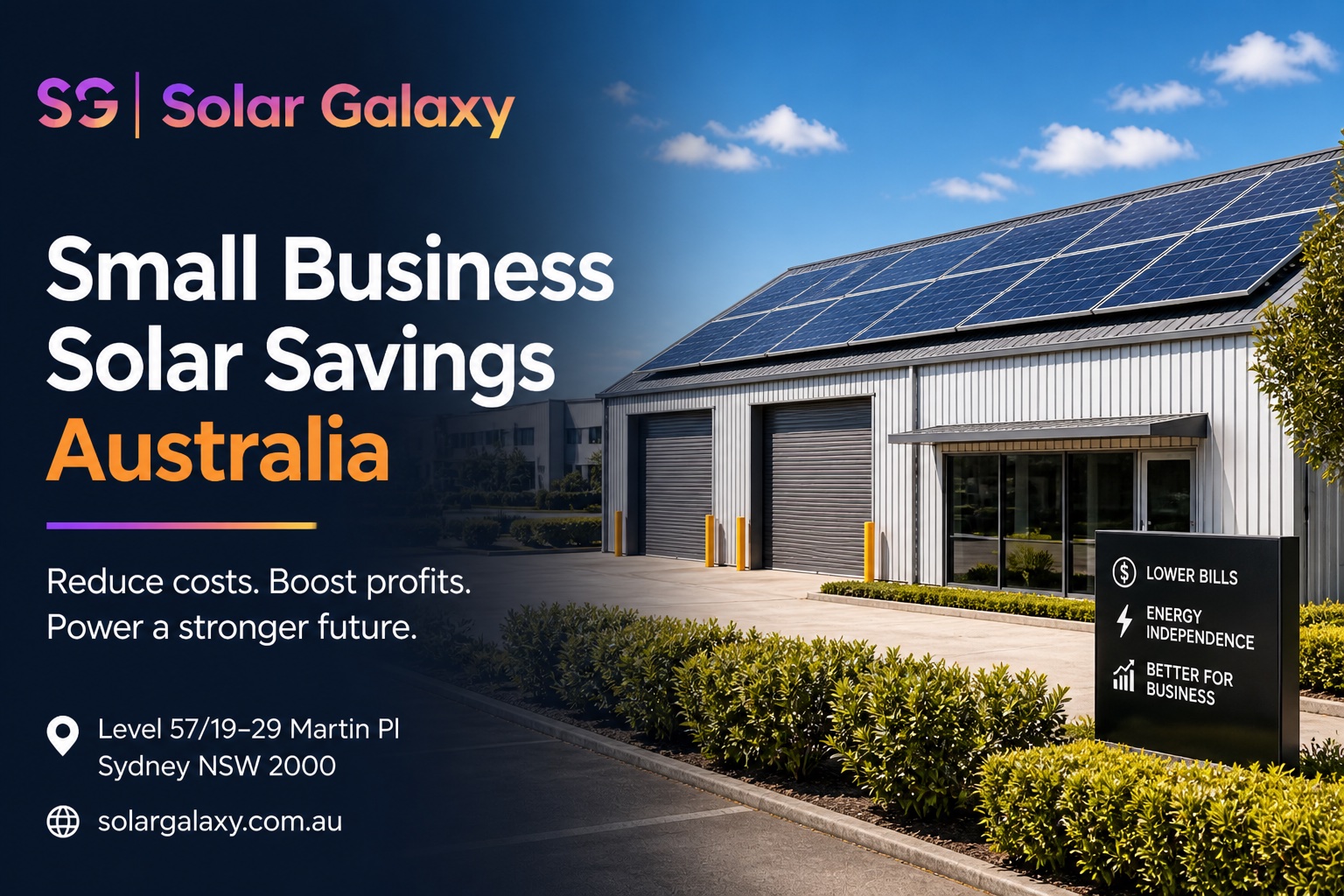
At Solar Galaxy, we analyse 12 months of interval meter data (not just bill totals) to model your self-consumption rate and project annual savings before you commit. Get in touch with our team to arrange a free commercial solar assessment for your business.
This article is general information only and does not constitute financial or tax advice. Consult a registered tax agent for advice specific to your business.