

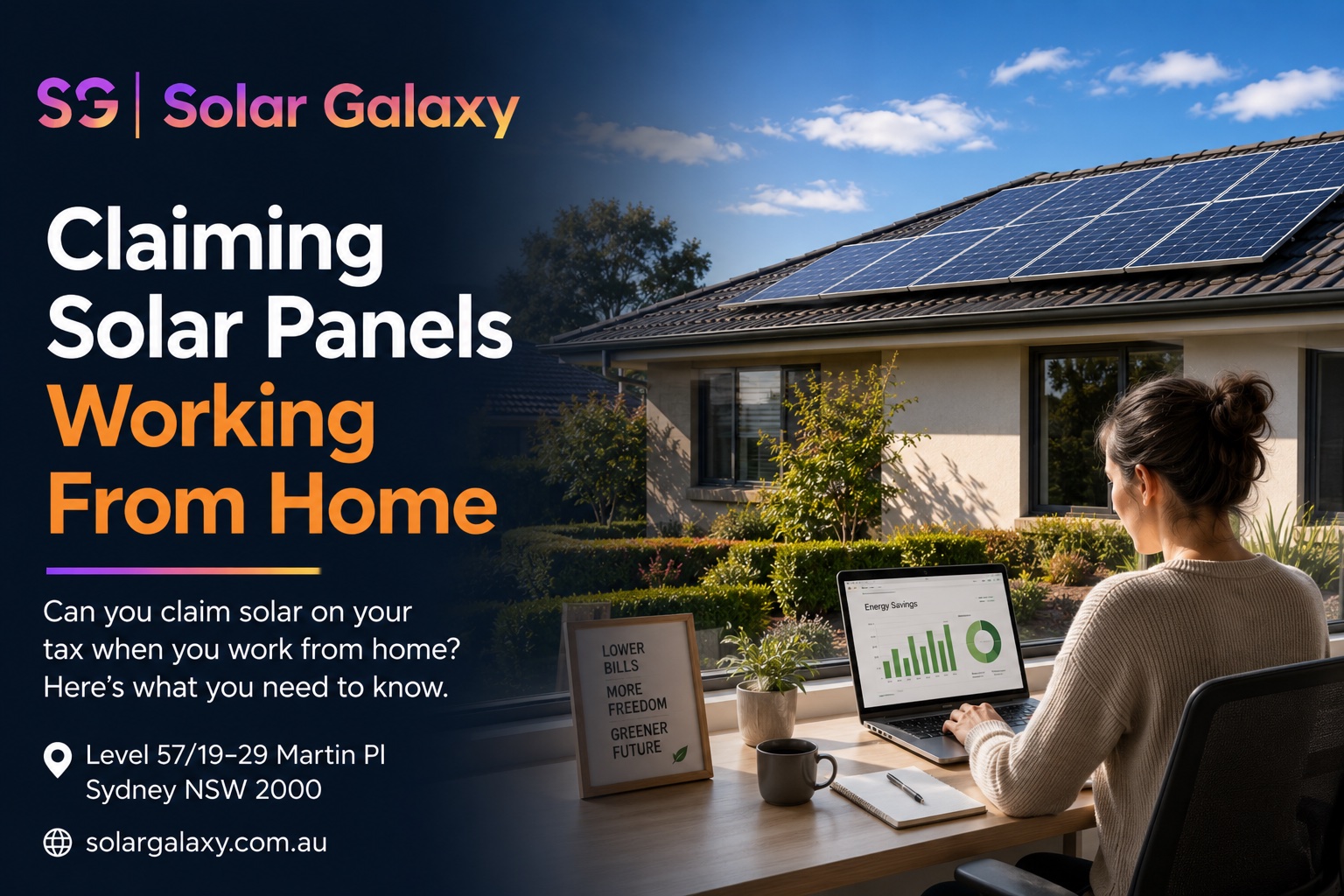
Can you claim solar panels as a work from home deduction?
Australians working from home can claim a portion of their solar system as a tax deduction, but the amount and method depend on whether they use the ATO’s fixed rate method or the actual cost method. The ABS reported that 37% of Australians regularly worked from home in 2023-24, up from 24% before the pandemic. That shift has made home office energy costs, including solar, a genuine tax planning consideration.
What are the two methods for claiming home office expenses?
The ATO provides 2 methods for claiming working from home expenses: the fixed rate method at 67 cents per hour, and the actual cost method based on real expenses incurred.
The fixed rate method covers electricity, internet, phone, and stationery in a single 67c/hour claim. If you use this method, you cannot separately claim solar panels as an electricity expense. The solar benefit is already bundled into the hourly rate.
The actual cost method requires calculating the real cost of running your home office. Under this method, you can claim the depreciation of the solar system proportioned to business use, the floor area percentage that your home office occupies, and the hours worked from home relative to total occupancy hours.
How do you calculate the business-use proportion of a solar system?
The business-use proportion combines 3 factors: home office floor area as a percentage of total home area, hours worked from home as a percentage of total home occupancy, and the proportion of daytime electricity attributable to work activities.
Example: a home office occupying 15% of the total floor area, with the occupant working from home 4 days per week. An accountant might calculate that 10% to 15% of the solar system’s output relates to business use. On a 6.6kW solar system costing $7,000, the business-use portion would be $700 to $1,050, which forms the depreciable amount for work-related claims.
Can home-based business owners use the instant asset write-off for solar?
Home-based business operators with an ABN and aggregated turnover under $10 million can claim the business-use portion of a solar system under the instant asset write-off, deducting it immediately rather than depreciating over 20 years. The $20,000 threshold applies until 30 June 2026, after which it drops to $1,000.
The write-off applies to the business-use proportion only. A solar system costing $8,000 with 15% business use means $1,200 is the claimable amount. That $1,200 is deducted in full in the year the system is installed and ready for use, rather than spreading it over the asset’s 20-year effective life at $60 per year.
Why does solar make financial sense for work from home professionals?
Solar panels generate peak output between 9am and 3pm, which aligns directly with standard work-from-home hours and maximises self-consumption of generated electricity.
- Self-consumption rates for WFH households reach 60% to 80%, compared to 30% to 40% for households where occupants are away during the day
- Every kilowatt-hour consumed directly avoids purchasing grid electricity at 25 to 40c/kWh
- Adding battery storage shifts excess daytime generation into evening use, further reducing grid dependence
- Electricity prices across NSW, Queensland, Victoria, and South Australia have increased 20% to 35% over the past 3 years
What steps should a WFH professional take before claiming solar?
3 steps: consult your accountant on claiming method, get a solar quote sized to your daytime usage, and set up record-keeping for work hours and home office area.
- Talk to your accountant to determine whether the fixed rate or actual cost method produces a larger deduction for your situation
- Get a solar quote from Solar Galaxy sized to your daytime consumption pattern
- Record your work-from-home hours, dedicated office space measurements, and electricity usage for your tax return
Learn more about the instant asset write-off for solar if you have an ABN and want to maximise your deduction before the 30 June 2026 deadline.
This article is general information only and does not constitute tax advice. Consult a registered tax agent for advice specific to your situation.