

Ausgrid’s new Community Power Network (CPN) trial marks one of the most significant tests of how shared energy infrastructure could operate within Australia’s modern grid. Approved under the Australian Energy Regulator’s (AER) trial-waiver framework, the project brings together community batteries, shared solar generation, and local energy orchestration across two New South Wales (NSW) regions. It is not a replacement for the current market structure. Instead, it is a controlled environment designed to answer specific questions about consumer benefit, grid stability, and competitive neutrality.
For households and businesses, the trial offers a glimpse into how neighbourhood-scale storage and coordinated local generation might function in practice.
For regulators and industry, it provides the chance to examine whether models like this can support broader policy goals without distorting the market.
The next five years will reveal which parts of this approach deliver measurable value, and which elements need refinement before community-energy models can be considered for wider use.
Why a regulatory sandbox? Understanding the framework
The CPN trial sits under the AER’s regulatory sandbox program, a mechanism created to let new energy models be tested without requiring permanent rule changes.
Traditional ring-fencing rules prevent distribution networks from owning or operating assets that participate in competitive markets. Those rules exist to protect consumers and ensure a level playing field. For this trial to proceed, Ausgrid received a time-limited waiver that allows the company to operate community batteries and shared solar assets under strict conditions.
The purpose of this framework is not to pre-approve the model but to create a controlled space where regulators can observe real-world performance. The AER will examine whether network-operated storage and shared generation can produce measurable benefits, avoid harming competition and improve local grid outcomes.
The sandbox exists to gather evidence, not to endorse a particular market direction—and the Ausgrid trail is the first major test of how these temporary arrangements can support responsible innovation.
What Ausgrid is testing
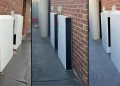
The CPN trial brings several emerging concepts together within one coordinated system. At its centre are community-scale batteries operated by Ausgrid, paired with shared solar generation that households and businesses can access without installing their own rooftop systems. These assets are orchestrated through virtual power plant (VPP) capabilities, allowing local energy to be stored, dispatched, and managed in response to network conditions.
The model at a glance
- Shared solar supporting two NSW regions
- Community batteries providing 130 kWh of neighbourhood storage
- VPP software coordinating charging, export, and local demand
- 32,000 households and businesses are participating
- Operating under a time-limited AER sandbox waiver
Purpose: Test consumer benefit, grid performance, and competitive neutrality in a controlled environment.
The trial is structured to observe how neighbourhood-level infrastructure behaves when operated as a shared energy resource. It will allow regulators to assess whether community-scale storage can reduce peak demand, support voltage management, and make better use of local solar generation. It also provides a real-world environment to study how customers engage with shared assets and whether this model can operate alongside retail-led services without distorting the market.
The potential benefits regulators want to measure
Over the next five years, regulators will be looking for evidence on whether neighbourhood-level energy infrastructure can deliver both consumer and system-level value.
One focus is affordability: shared storage could help households use more local renewable energy, ease pressure on peak-time prices, and create pathways for people who cannot install solar.
Another focus is grid performance, particularly whether battery capacity placed close to where electricity is used can reduce stress on local infrastructure and defer costly upgrades.
A third area of interest is how effectively the model coordinates local solar generation. High-solar communities often face challenges such as voltage rise and daytime export constraints. The trial provides an opportunity to see whether community batteries and orchestration tools can increase the value of existing rooftop systems. Regulators will also assess customer engagement, participation patterns, and how benefits can be allocated transparently. Each of these areas helps build the evidence base for whether shared energy models have a role in Australia’s long-term energy transition.
What keeps the trial accountable
Since Ausgrid is a regulated network business operating assets that usually sit within competitive markets, the trial is running under strict oversight. The AER has set clear conditions that limit the scope of Ausgrid’s activities and define how performance will be measured. These include a five-year cap on the waiver, detailed reporting obligations and requirements that operational data be shared to support evaluation. The temporary nature of the approval ensures that the model can be tested without committing customers or the broader market to long-term structural change.
Competitive neutrality is another key safeguard. The trial must demonstrate that the network’s involvement does not disadvantage retailers, third-party VPP operators, or other participants offering similar services. Oversight also covers consumer protections, ensuring that information, participation frameworks, and potential benefits are communicated transparently and fairly.
These create a controlled environment in which risks are contained, and earnings can be gathered without compromising the broader energy market.
What industry will be watching closely
Retailers and VPP providers will be observing how network-operated batteries interact with existing market services, particularly in areas where customers already participate in VPPs or have their own storage. The trial will reveal whether shared assets complement those services or compete with them, and how value is distributed when multiple actors operate within the same local energy ecosystem.
Technology providers and installers will also follow the outcomes closely. Community batteries can influence how much rooftop solar is exported, how often home batteries cycle and whether grid constraints change over time. Any change in these dynamics can affect investment signals for distributed energy resources.
At the policy level, market designers will examine whether the model aligns with long-term reform directions, including the transition toward more localised energy markets. Each group is looking for evidence that clarifies the model’s role without drawing premature conclusions.
A national opportunity if the model works
One of the most significant questions the trial aims to explore is whether shared energy infrastructure can. Broaden access to clean-energy benefits. Many households cannot install rooftop solar due to property type, tenancy agreements, or building constraints. Community-scale solutions offer a potential pathway for these customers to participate in the energy transition without requiring individual investment in panels or storage. By pooling assets across neighbourhoods, the model could help distribute benefits more evenly, particularly in areas with dense housing or lower solar uptake.
Regulators will examine whether the trial meaningfully improves access for these groups and whether any benefits can be delivered consistently and transparently. This includes understanding how shared assets influence bills, how customers engage with the program and whether the model can support communities that have traditionally been excluded from renewable energy opportunities. If the evidence shows positive outcomes, it may help inform future policy settings designed to improve equity in distributed energy markets.
The open questions the trial must answer
Despite the potential of shared solar and community storage, several uncertainties remain central to the trial’s purpose. One key question is whether network-operated batteries can deliver measurable consumer value once operational costs, market participation, and local demand patterns are accounted for. The trial will also test how reliably these assets support the grid during peak periods and whether they improve the utilisation of rooftop solar in areas where exports are already constrained.
Another unknown is how the model interacts with the competitive market. Retailers, VPP operators, and technology providers all have established roles in distributed energy services. Regulators will be assessing whether a network-led model can coexist with these offerings without discouraging investment or narrowing consumer choice.
The final area of uncertainty is longevity: the trial will provide insight into whether this structure is financially and operationally viable beyond the five-year waiver period. Each of these questions must be answered with evidence before any broader policy direction can be considered.
A trial designed to inform, not decide
The CPN trial marks a meaningful moment in Australia’s shift toward more localised energy systems. Its purpose is not to settle debates about the future structure of the market, but to generate evidence on how shared solar, community storage, and network-led orchestration perform under real conditions. Over the next five years, it will show where the model delivers value, where it falls short and how it interacts with the broader competitive environment.
What emerges from this trial will shape how regulators, policymakers and industry approach community-level energy infrastructure in the years ahead. The findings may confirm the potential of shared assets, reveal limitations or identify refinements needed before wider adoption can be considered. Either way, the trial offers a structured path to understanding what works — and what does not — in a rapidly changing energy landscape.
Energy Matters has been in the solar industry since 2005 and has helped over 40,000 Australian households in their journey to energy independence.
Complete our quick Solar Quote Quiz to receive up to 3 FREE solar quotes from trusted local installers – it’ll only take you a few minutes and is completely obligation-free.