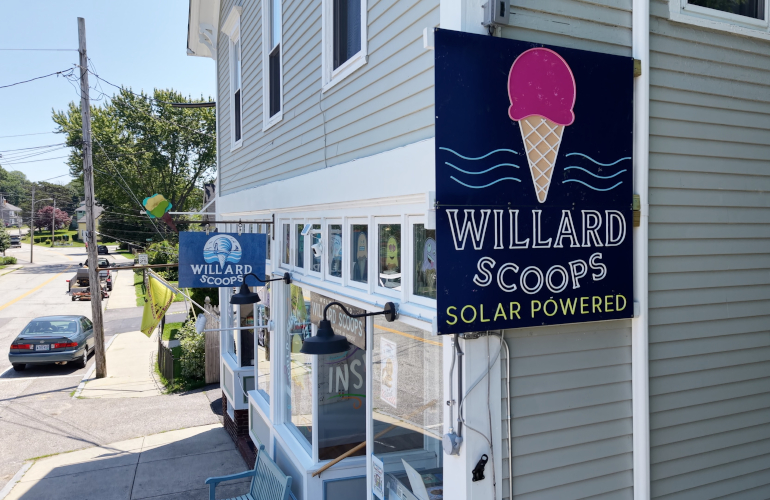

Willard Scoops in South Portland, Maine, is now likely the first 100% solar-powered ice cream maker in the state. The small-batch, high-butterfat ice cream shop makes its flavors on-site and has a commitment to sustainability, local ingredients and community. The shop features a sign broadcasting its solar association.
 “This was about building a business that reflects the kind of future we want to be part of,” said David Bass-Clark, owner of Willard Scoops. “Ice cream is surprisingly energy-intensive. We make more than 8,000 gallons and serve over 100,000 scoops every year. If a small neighborhood shop like ours can make this work, hopefully it shows other small businesses that sustainability can be practical, not just aspirational.”
The project was made possible in part through support from Coastal Enterprises Inc. (CEI), a local nonprofit community development financial institution that has financed solar installations for more than 81 Maine businesses, farms and community facilities.
 “More and more Maine businesses are seeing solar as a viable way to reduce operating costs by producing some or all of their own power,” said Jesse McKinnell, SVP of specialty finance at CEI. “Financing solar replaces the unpredictability of utility bills with a fixed payment, and once the system is paid off, the panels still have decades of productive life ahead.”
The solar installation is part of a broader environmental commitment at Willard Scoops. Over the past year, the shop has transitioned its cups, spoons and other consumables to compostable materials, helping divert an estimated 15,000 pounds of waste annually through its partnership with Garbage to Garden.
 Together, those efforts create what Willard Scoops calls its “Sun to Scoop” model: locally made ice cream powered by renewable energy and paired with waste-conscious operations.
Solar Power World estimates the array to be between 25 and 30 kW. The installation was completed by Maine Energy Experts.
Solar and ice cream is a popular pairing. A 50-year-old ice cream brand in Florida installed a nearly 800-kW array last year.