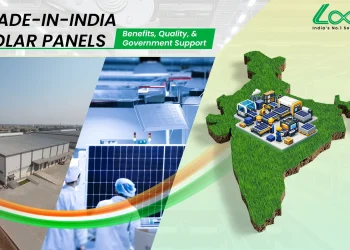



Over the last decade, the Indian solar sector has transformed dramatically. From being almost entirely dependent on the imported solar panels (mostly imported from China). The country has emerged as one of the world’s fastest-growing solar manufacturing hubs in a decade. Today, made-in-India solar panels are not only available in the market, but they are also genuinely competing with other imported companies in quality, efficiency, and pricing altogether.
While it has been difficult to track the exact number of domestic solar panels installed, according to the data provided by the Press Information Bureau, “as of December 2025, 23.9 lakh households have already installed the solar rooftop capacity of 7 GW of clean energy; ₹13,464.6 crore of subsidy was released under PM Surya Ghar Yojana.”
For homeowners looking to go solar, this change matters more to them as they are not only saving their electricity by going solar but also contributing to the local job generation, supporting India in becoming energy independent, while using the solar panels made specifically taking into account the Indian weather conditions. Along with this, these Indian manufacturing companies are backed by the local service network that helps in solving any queries of the customers.
This guide will walk you through everything you need to understand about made-in-India solar panels, their benefits, quality standards, and government support in manufacturing these products.
Made-in-India solar panels are photovoltaic (PV) modules manufactured by Indian companies using domestically assembled or product components, just like any other panels on the market: they use sunlight to generate electricity. But what makes a made-in-India solar panel different from others is that they are specifically designed to fit the Indian weather conditions, which means they are designed to withstand the +40°C temperature of the Indian summer season.
The story of domestic solar manufacturing in India has been one of rapid scale-up. According to the Approved List of Models and Manufacturers (ALMM) maintained by the Ministry of New and Renewable Energy (MNRE), India’s domestic solar module manufacturing capacity is 121.7 GW as of November 2025. Put it into perspective: India had less than 3 GW of module manufacturing capacity only a few years ago. The capacity additions of modules alone will be a 216% increase post-2022, according to the December 2025 joint report from IEEFA and JMK Research.
Solar cell manufacturing has expanded even more rapidly. India now has about 29 GW of solar cell manufacturing capacity, up from practically zero a few years ago, with 24 GW registered under ALMM List-II as of July 2025.
This expansion is part of a deliberate national strategy to make India a global solar manufacturing hub while also meeting its own increasing clean energy demands.
Key benefits of indian solar panels
Choosing a made-in-India solar product comes with practical everyday advantages that go beyond price:
-
Designed for Indian weather conditions: Indian manufacturers build panels that are tested against the specific demands of Indian weather conditions, such as intense summer heat, monsoon humidity, dusty environment and high UV radiation. Panels that perform well in controlled lab conditions sometimes underperform in the harsh real-life conditions. Domestically manufactured panels are specifically engineered by keeping these realities in mind.
-
Easier after-sales services: one of the biggest pain points in solar installation is its after-sales services. If a Chinese or American system fails, then getting support can be a logistical nightmare. Meanwhile, getting after-sales support from an Indian company can be easier due to the availability of local offices, service partners, and dedicated helplines.
-
Availability and shorter lead time: Imported panels could be delayed by shipping, port hold-ups and currency fluctuation. Indian panels are distributed via a large national network, with shorter delivery times and more stable prices, which is helpful in rooftop solar projects that need fast installation.
-
Supporting the Indian economy & employment: Every solar panel you buy from India creates jobs back home for the workers who make the panels, move them around, install them, and maintain them. As per IBEF, PM Surya Ghar Yojana alone is expected to create around 17 lakh direct employment opportunities in solar manufacturing and related services.
-
Better alignment with government subsidies: Most of the central and state government solar subsidies, such as the PM Surya Ghar Yojana, require or strongly favour ALMM-listed panels, most of which are made in the country. Indian panels are subsidy-eligible and compliant.
If you are considering your options, Best Solar Panels for High-Temperature Climates: Preventing Summer Power Degradation provides you with the information regarding what you need to look up while purchasing a solar panel in India in 2026.
Quality standard & technology advancement.
Many buyers ask whether the quality of the Indian solar panels will be on par with the imported ones. The answer is, yes. And the gap is closing fast.
Certifications & Testing All the solar panels referred to under the ALMM are to be compatible with BIS (Bureau of Indian Standards) certification and IEC (International Electrotechnical Commission) testing. It is certified to key standards, including IEC 61215 for performance durability and IEC 61730 for safety. Indian manufacturers also get ISO and, in many cases, international certifications like MCS (UK) and UL (USA) certifications for export markets.
India’s premier solar R&D institution, the National Institute of Solar Energy (NISE), plays a vital role in testing, standardization, and capacity building for the domestic manufacturing sector.
Indian manufacturers are not only making basic PERC panels but are also making top-tier products. Some companies now produce Mono PERC, TOPCon (Tunnel Oxide Passivated Contact), and bifacial solar panels, technologies that provide higher efficiency and better energy yield in real-world conditions.
-
Mono PERC panels have efficiencies of 20-22% and are perfect for homes and businesses with limited roof space.
-
TOPCon panels can achieve efficiencies above 22% and perform well in low-light and high-temperature conditions. Learn more about TOPCon Solar Panels in our TOPCon Solar Panels Explained guide and see if this technology is right for your home.
-
Bifacial panels capture light from both sides, boosting energy production by 10-20% in open installations.
Indian manufacturers are also investing in automated production lines, AI-based quality inspection, and R&D partnerships with IITs and other technical institutes. The result is a home industry that is fast closing the quality gap with international leaders.
Our Solar Panel Installation Guide for Homeowners covers everything you need to know about installing a home solar system, from choosing panels to installation.
Government support for domestic solar manufacturing
The Indian government’s support for the domestic solar manufacturer is comprehensive, sustainable, and strategic, which helps the solar industry grow exponentially.
Following are some of the policies introduced by the Indian government to support domestic solar manufacturers:
-
Production Linked Incentive (PLI) scheme: The PLI Scheme for High Efficiency Solar PV modules are arguably the most impactful policy intervention for Indian solar manufacturing. The scheme offers incentives to manufacturers based on actual sales for five years after commissioning, with a total outlay of Rs 24,000 crore.
-
Approved list of models and manufacturers (ALMM): ALMM is a quality control mechanism maintained by MNRE. The panels on this list are the only ones that can be used in solar projects that are government-funded or supported. This policy effectively guarantees that Indian solar deployments use tested, reliable, domestically manufactured panels.
-
PM Suriya Ghar Muft Bijli Yojana: The flagship rooftop solar program was launched in February 2024, aiming to install solar panels in 1 crore Indian households by March 2027. As of March 2026, the scheme has already benefited over 32 lakh households, with the government disbursing central financial assistance of ₹14,771 crore.
-
Basic Custom Duty (BCD) on imported panels: Basic Customs Duty on imported solar modules and cells has made imported panels significantly expensive, thus providing leverage for domestic manufacturers and pushing buyers to choose Indian-made products.
-
Make in India initiative: The Make in India campaign supports Indian solar manufacturers looking for global markets with eased regulations, infrastructure investment and export promotion.
Collectively, these policies have established India as a genuine solar manufacturing powerhouse. India will be one of the top 3 solar manufacturing countries in the world in the coming years, with a huge export potential, said the International Energy Agency (IEA).
Conclusion
The made-in-India solar panels have become one of the reasons behind the success in the rise of India’s clean energy transition. Indian solar panels now deliver real quality, reliable performance, and real economic benefits to consumers across the nation, thanks to strong government policies, rapid technology adoption, and growing manufacturing capacity.
The message to homeowners and small business owners is simple: Indian solar panels mean simpler warranty support, quicker delivery times, access to government subsidies and the pride of helping the country become self-sufficient in clean energy. Quality is only getting better, and prices are remaining competitive, so there has never been a better time to invest in the solar energy that India has to offer.
Consumers looking for advanced made-in-India solar solutions can explore products from Loom Solar, which offers modern solar technology made to withstand Indian weather conditions.