

Picture this: your electricity bill arrives at the end of the month and it has climbed — again. You have looked at solar power as a solution, but every guide you find assumes you own the rooftop above your head. You rent a flat on the fifth floor of a high-rise in Bengaluru or Noida or Pune, and the roof is not yours to touch. So you scroll past another solar ad, sigh, and pay the bill.
Here is the part most people do not know: you do not need a rooftop to go solar. Balcony solar — a fast-growing category of compact, plug-and-play photovoltaic systems designed specifically for apartment dwellers — is quietly changing the equation for millions of urban renters in India and around the world. And it is far simpler, far more affordable, and far more practical than you might imagine.
In this guide, we will walk through everything you need to know — what balcony solar actually is, whether renters can legally install it, what it costs, how much you can save, and the smarter alternatives if a full kit is out of reach right now.
What Is Balcony Solar, Exactly?
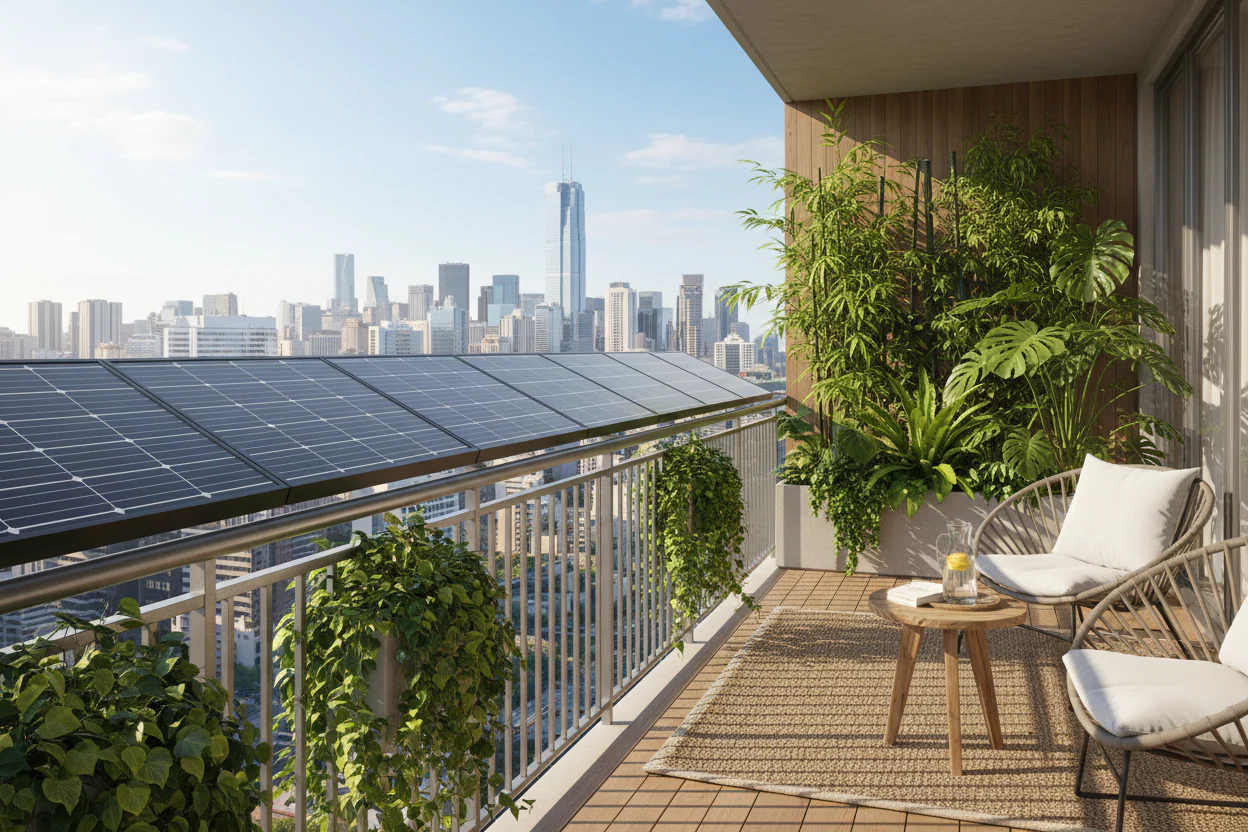
Balcony solar refers to small-scale photovoltaic panel systems that can be mounted on balcony railings, parapets, or south-facing exterior walls — without any permanent structural modification to the building. Unlike traditional rooftop installations that require scaffolding, inverter rooms, and net-metering agreements, balcony systems are designed to be compact, lightweight, and — in many configurations — completely removable.
The most popular format in this category is the plug-in solar kit (sometimes called a Balkonkraftwerk in Germany, where the concept first went mainstream). These kits typically include one or two solar panels, a micro-inverter or solar converter, mounting brackets, and a standard power cable that plugs directly into a wall socket — feeding solar electricity back into your home’s circuit in real time. No battery, no complex wiring, no electrician required.
In India, the concept is gaining traction alongside the government’s push for distributed solar. According to the Ministry of New and Renewable Energy (MNRE), India’s installed solar capacity crossed 85 GW by early 2025, with an increasing share coming from distributed and small-scale systems. Balcony solar sits at the grassroots edge of this shift — and renters are increasingly driving adoption. [Internal Link: What is Distributed Solar Energy in India?]
Can Renters Legally Install Solar Panels?
This is always the first question — and the answer is nuanced. In India, there is no blanket law that prevents a tenant from installing a removable, non-permanent balcony solar system. Unlike rooftop installations, which often require utility approval, structural assessments, and net-metering registration, a plug-in balcony kit that does not penetrate walls or alter the building’s exterior may not require formal permission at all.
That said, your rental agreement matters enormously. Most tenancy contracts include clauses about modifications to the property. A removable railing-mount system is generally considered a non-permanent fixture — similar to installing a window AC unit — but you should always check with your landlord before proceeding. In practice, most landlords are comfortable once they understand that the system leaves no marks and can be removed completely at the end of the tenancy.
If you live in an apartment society, there’s one more thing to keep in mind: your RWA (Resident Welfare Association) rules. Every society works a little differently. Some are still cautious about anything installed outside a flat, while others are becoming more open to solar as electricity bills rise and EV charging becomes more common. Instead of treating balcony solar like a loophole, it usually works better to have an open conversation with your landlord or society committee. Once they understand that the setup is removable, doesn’t damage the structure, and can be taken along when you move out, approvals often become much easier.
How Balcony Solar Works: Installation Approaches
Plug-and-Play Systems
The simplest option — and the one growing fastest in India — is the all-in-one plug-in solar kit. You clip or bolt a bracket onto your balcony railing, angle the panel toward the south (or south-west for afternoon sun), connect it to the micro-inverter, and plug the inverter’s output cable into a standard 5-amp or 16-amp wall socket. The system immediately begins feeding solar power into whatever appliance or circuit is drawing from that socket — your fan, your router, your television.
A 300W plug-in solar kit may not look like much at first glance, but on a typical sunny day in most Indian cities, it can generate around 1.2–1.5 units (kWh) of electricity. Over the course of a month with roughly 25 good sunlight days, that adds up to nearly 30–37 units of power. In practical terms, that could be enough to run a standard refrigerator or noticeably reduce the electricity used for everyday essentials like ceiling fans and lights. No, it won’t turn your apartment into a fully off-grid setup overnight — but it can quietly chip away at your monthly electricity bill in a way you actually start noticing after a few billing cycles.
Balcony Railing Mounts
For renters who have a south-facing balcony and a landlord who is open to the idea, railing-mounted solar setups can be a smarter upgrade over a basic plug-in panel. Instead of being fixed permanently, these systems use adjustable brackets that attach directly to the balcony railing without drilling or damaging the structure. That flexibility also means you can slightly adjust the panel angle during different seasons to make better use of available sunlight. One of the biggest advantages for renters is portability — when it’s time to move to a new apartment, the system can simply come with you instead of being left behind.
Some panels are designed to make even better use of limited balcony space. For example, the Loom Solar Shark Bifacial range can be configured for balcony installations. Unlike conventional panels that absorb sunlight only from the front, bifacial panels also capture reflected light bouncing off nearby surfaces like floors and walls. In balcony conditions, that extra reflected energy can improve performance by around 5–10% compared to a standard mono panel of similar capacity — making every bit of available sunlight work a little harder.
Balcony Solar Options at a Glance
Not all balcony solar systems are created equal. Here is a side-by-side comparison of the three main approaches to help you identify the best fit for your apartment and budget:
|
Feature / Type |
Plug-&-Play Kit |
Balcony Mount |
Portable Solar |
|---|---|---|---|
|
Panel Wattage |
300–600W |
200–400W |
60–200W |
|
Approx. Cost (₹) |
₹18,000–₹45,000 |
₹12,000–₹30,000 |
₹5,000–₹18,000 |
|
Installation Need |
Minimal (DIY) |
Railing/wall clamp |
None (portable) |
|
Monthly Savings Est. |
₹400–₹900 |
₹250–₹600 |
₹100–₹350 |
|
Payback Period |
3–4 years |
3–5 years |
2–4 years |
|
Landlord Permission? |
Usually needed |
Always needed |
Not required |
|
Best For |
Long-term renters |
South-facing flats |
Frequent movers |
How Much Does Balcony Solar Cost in India?
The good news for renters is that balcony solar is genuinely affordable — especially compared to the ₹2.5–₹4 lakh investment a rooftop system typically requires. A basic 200W plug-in kit starts at around ₹12,000 to ₹16,000 all-inclusive. A more capable 400–600W system with a higher-efficiency panel and a better micro-inverter lands in the ₹25,000 to ₹45,000 range.
Many solar brands — including Loom Solar — now offer EMI options starting at ₹999 per month, which effectively means your monthly EMI is equal to or lower than the savings you generate from day one. That is a break-even profile from month one, not year three, which fundamentally changes the financial case for renters who have historically felt excluded from the solar opportunity. [Internal Link: Solar Panel EMI — How to Finance Your Home Solar System]
One thing worth keeping in mind is that India’s PM Surya Ghar Muft Bijli Yojana, introduced in 2024, currently offers rooftop solar subsidies of up to ₹78,000 for eligible residential users. For renters, though, access isn’t always straightforward. If you live in an independent rented house, there may be a way to apply through the property owner, but apartment renters in multi-storey buildings usually don’t qualify directly under the current structure. That said, conversations around making solar more accessible for renters are gaining attention, and as policies continue to evolve, balcony and shared solar models could become more renter-friendly in the years ahead.
|
☀️ Did You Know? Germany — which popularized plug-in balcony solar — had over 400,000 registered plug-in solar devices (Balkonkraftwerke) by 2024, a number that grew fourfold in just two years. The German government even simplified regulations in 2024 to allow renters to install units up to 800W without landlord approval. India’s solar policy is yet to follow suit, but the momentum is unmistakable. |
How Much Can You Actually Save?
How much you actually save with balcony solar comes down to a few simple things: how much sunlight your balcony gets, the efficiency and size of your panel, and what you currently pay per unit of electricity. In most Tier-1 and Tier-2 Indian cities, residential electricity rates usually fall somewhere between ₹5 and ₹9 per unit, depending on the state and usage slab. So, if a 300W plug-in solar setup generates around 30 units a month, the savings could land in the range of ₹180–₹240 monthly. A larger 500W system can push that number closer to ₹400–₹600, especially in homes with consistent daytime electricity use.
At first glance, those numbers may not feel dramatic — but solar tends to become more noticeable over time than in the first month. Even a modest ₹300 saved every month adds up to ₹3,600 a year, and electricity pr ices rarely move downward for long. Over a few years, those small monthly reductions start covering the cost of the system itself. Once the upfront investment is recovered, the electricity your panel generates feels less like a discount and more like power you no longer have to buy.
Beyond the rupee savings, there is a behavioural shift that happens when you live with a solar panel. You begin to notice consumption differently. You time your appliance use around peak solar hours. You become, almost involuntarily, a more conscious energy user — and that awareness typically reduces your consumption independently of the solar generation itself.
Limitations and Risks You Should Know
Balcony solar can make a noticeable difference, but it helps to go in with realistic expectations. The biggest limitation is simple: space. Most apartment balconies only have room for one or two panels, which usually puts the total capacity somewhere around 400–700W. That’s enough to reduce part of your electricity usage and take some pressure off your monthly bill, but it’s unlikely to power an entire home. Think of balcony solar less as replacing the grid and more as a practical way to generate a portion of your everyday electricity from the space you already have.
Orientation is the second constraint. A north-facing balcony — common in many Indian apartment layouts — will generate significantly less energy than a south-facing one. East-facing balconies are productive in the mornings but trail off by early afternoon. If your balcony faces the wrong direction, the economics worsen considerably.
There is also the question of safety and quality. The Indian market has seen an influx of low-cost, uncertified plug-in inverters that carry real electrical risk. Always buy from brands with BIS certification and proper safety ratings. A micro-inverter or grid-tie converter that lacks reverse-power and anti-islanding protection can create hazards for both your home circuit and DISCOM linemen working on the grid.
Environmental Impact: Small Panel, Big Difference
A balcony solar setup may look small, but its environmental impact adds up over time. A 300W balcony solar panel producing around 30 units (kWh) of electricity each month can help avoid roughly 25 kg of CO₂ emissions monthly, based on India’s current electricity grid mix. Over a year, that becomes close to 300 kg of carbon emissions reduced — and over the lifespan of the panel, that number can cross 3 tonnes. For something mounted on a balcony, that’s a surprisingly meaningful shift.
Now imagine this on a larger scale. If even a small percentage of India’s urban renter households adopted balcony solar, the collective impact would become impossible to ignore. Millions of tonnes of carbon emissions could be avoided every year, simply by generating a portion of everyday electricity closer to where it’s actually used. It’s a reminder that moving toward cleaner energy doesn’t always start with owning a rooftop — sometimes it starts with making better use of the space you already have.
Apartment-Friendly Solar Alternatives
If a full balcony solar kit is beyond your current budget or your balcony orientation makes it impractical, there are adjacent options worth exploring.
Portable solar chargers (60–120W) are available from ₹5,000 and can charge power banks, run small fans, or keep lights running during outages. They require no installation whatsoever — you simply prop them against a sunny window or place them on a window ledge. They will not move the needle much on your electricity bill, but they are a meaningful starting point.
Solar-powered window chargers — thin-film panels that attach to glass with suction cups — are another emerging category. Output is low (10–40W) but the simplicity is unmatched for renters who cannot use any railing or wall mount.
And if you have some influence within your housing society, there’s another option that’s becoming more practical across Indian cities: community rooftop solar. Instead of each apartment installing its own system, multiple residents collectively contribute to a shared rooftop setup managed through solar aggregators or supported by state DISCOM initiatives. The electricity generated is then distributed proportionally, and residents receive credits or benefits against their own electricity bills.
This approach has already shown promising results in states like Maharashtra, Gujarat, and Karnataka, where shared solar projects are slowly making clean energy more accessible for apartment communities. It may not be as immediate as installing a panel on your own balcony, but for renters and apartment residents, it can be one of the most realistic ways to participate in solar adoption without owning a roof. If your society has never explored the idea, bringing it up with your RWA could be a surprisingly good place to start.
Renter’s Balcony Solar Readiness Checklist
Before you buy, run through these eight checks to confirm your setup will work:
-
Check your balcony orientation — south or south-west gives best results in India
-
Review your tenancy agreement for any clauses about exterior modifications
-
Have a quick conversation with your landlord about a removable, non-drilling system
-
Measure your railing dimensions to confirm bracket compatibility before purchasing
-
Verify the inverter/converter has BIS certification and anti-islanding protection
-
Calculate your monthly sun-hours (average 4.5–6 hrs/day in most Indian cities)
-
Estimate your monthly savings using your current per-unit rate and expected panel output
-
Check if your DISCOM requires registration for sub-1kW plug-in systems in your state
The Bottom Line
Renting an apartment does not mean giving up on clean energy — or on lower electricity bills. Balcony solar has quietly evolved into a practical, affordable, and genuinely effective solution for urban dwellers who have long been left out of the solar conversation. The technology is proven, the costs are within reach, and the financial case — especially with monthly EMI options — makes it easier than ever to start.
You do not need to own the roof. You just need the right panel, the right angle, and a sunny afternoon to start generating your own electricity. The shift toward distributed energy is already underway in India, and balcony solar is how renters can be part of it — right now, without waiting for policy, without waiting for a landlord to sell, and without waiting for the perfect time.
Start small. Stay consistent. And let the sun do the rest.