
The U.S. energy storage industry installed 9.7 GWh of new capacity in the first quarter of 2026, the strongest first quarter in the sector’s history. According to the “U.S. Energy Storage Market Outlook Q2 2026” (ESMO) released today by the Solar Energy Industries Association (SEIA) and Benchmark Mineral Intelligence, energy storage installations in Q1 were up 32% year-over-year despite federal actions targeting clean energy.

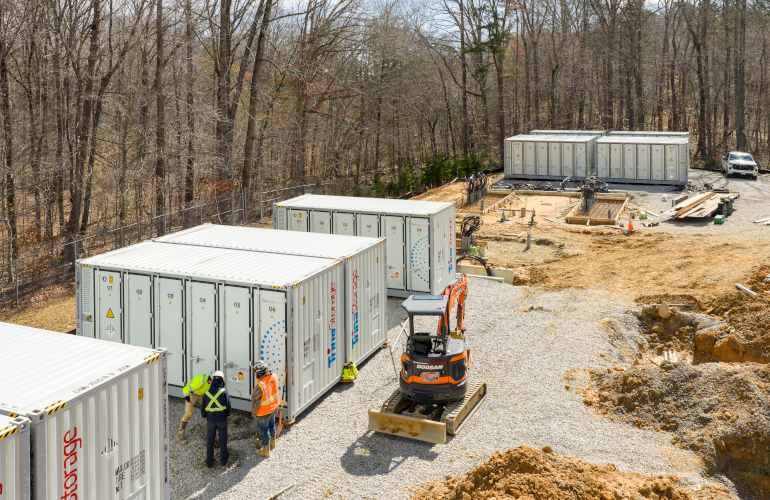
A Lightshift Energy BESS project under construction in Danville, Virginia. Credit: Lightshift Energy, Sanjay Suchak.
More than 610 GWh of energy storage is now expected to be installed by 2030, which is higher than previous projections.
“Energy storage’s remarkable first quarter only underscores the fundamental values of this technology: it’s insulated from fuel price shocks, keeps electricity costs down and strengthens grid reliability,” said Darren Van’t Hof, interim president and CEO of the SEIA. “While long-term forecasts are validating that the demand for this technology is rising as off-takers seek energy security, actions in Washington to stall permitting are threatening to slow that progress. Storage can help America meet rising energy demand and strengthen American energy independence, but only if Washington lets the solar and storage industry build.”
Data centers are driving storage demand, with Google, Meta and other tech companies announcing deals to procure tens-of-thousands of megawatt-hours of energy storage so far this year. According to SEIA analysis, 467 solar and storage projects have permits pending and are vulnerable to politically-motivated delays or cancellations.
“Energy storage is no longer just for backup, it’s critical energy security infrastructure,” said Shan Tomouk, BESS and energy lead at Benchmark Minerals. “A supportive policy landscape for BESS will be crucial to enabling the rollout of AI and data centers, while mitigating adverse cost impacts to regular consumers.”
Texas, Arizona and California led the nation in utility-scale battery storage capacity in Q1, maintaining their positions as the three largest energy storage markets in America. Seventy-one percent of all utility-scale energy storage capacity installed in Q1 was built in states won by President Donald Trump. Thirteen states now have explicit energy storage targets, and states like Georgia, Iowa and Mississippi installed a notable amount of energy storage in Q1.
In Q1, 7.8 GWh of utility-scale storage was installed in the United States, 648 MWh of commercial and industrial storage was installed and 515 MWh of residential storage was installed.
News item from the Solar Energy Industries Association