Media Release
Australia’s home battery market has entered a new era, and Anker SOLIX believes bigger is no longer always better. Following changes to the federal Cheaper Home Batteries Program on 1 May, the company has launched the new XE home battery system. Revealed during the Smart Energy Conference & Exhibition (SEC) and the exclusive “Anker SOLIX Day” event in Sydney, the XE has been purpose-built for Australia’s updated rebate structure.
Built around a modular 7 kWh design, the Anker SOLIX XE aims to maximise rebate value, simplify installations, and help homeowners get more out of their solar energy. The company says the system has been engineered specifically for Australian conditions and installer challenges, rather than adapted from overseas markets.
Australia’s battery market is at a turning point
Australia now has more than 4 million rooftop solar systems installed nationwide. Despite this, battery attachment rates remain low, sitting at just 5%. Speaking at the launch event, John Grimes highlighted the rapid growth of battery storage across Australia and the opportunities still ahead.
“It is heartening to see that there are now 380,000 cheaper home batteries installed, collectively delivering more than 10 gigawatt-hours. Anker SOLIX’s all-in-one system is very exciting. Looking ahead, we’ve got to unlock plug-in solar balcony storage systems in Australia. That is a massive opportunity for the country, and it is actively on our policy agenda at the Smart Energy Council.”
The Anker SOLIX XE launch comes as Australian households continue to face rising electricity prices and shrinking feed-in tariffs. That combination has many homeowners looking for ways to store more of their own solar energy instead of exporting it cheaply to the grid.
According to Anker SOLIX, the new rebate structure has also changed how batteries should be designed and sized.
Anker SOLIX XE: A battery built around the rebate structure
Rather than focusing on oversized systems, Anker SOLIX says the XE has been designed around what it calls the “rebate sweet spot”.
Under the new tiered rebate structure, the first 14 kWh of installed battery capacity attracts the highest subsidy level. The Anker SOLIX XE uses a modular 7 kWh architecture with 100% Depth of Discharge (DOD), meaning homeowners can use the full available capacity without hidden reserves.
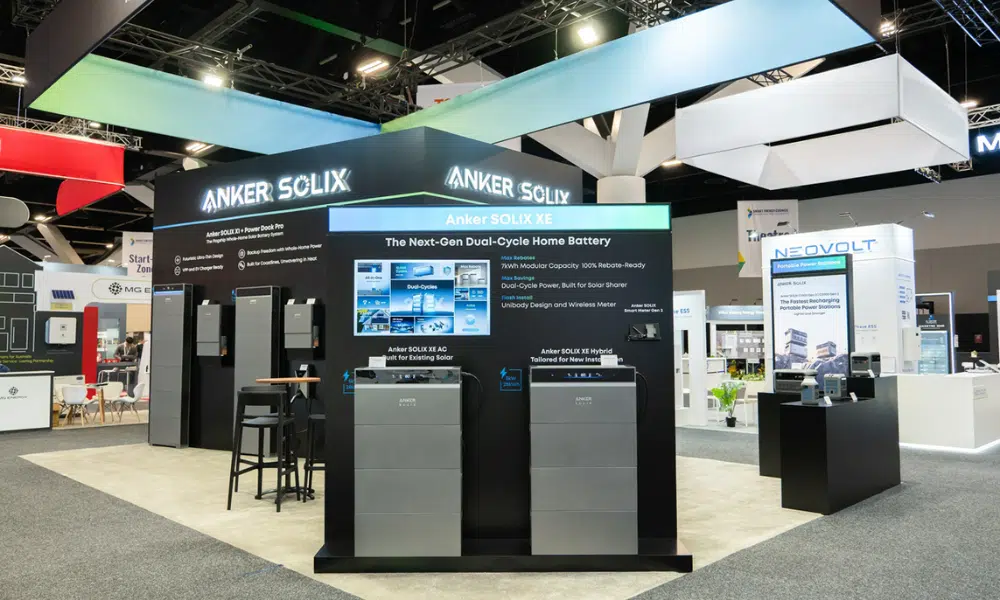
The company says its recommended 14 kWh battery paired with a 5 kW inverter aligns perfectly with the top rebate tier. Larger 28 kWh configurations are also available for homes with higher energy consumption.
14 kWh = 2 × 7 kWh
Symons Xie said the market needs a smarter approach to battery sizing.
“With soaring electricity bills and declining feed-in tariffs, households need smarter, not just bigger, storage,” stated Symons Xie, General Manager APAC. “Current products fail to maximise the new tiered subsidies, and complex installations drive up B2B costs. The XE’s ‘right-sized’ design rejects blind capacity-stacking, converting these challenges directly into margins for installers and ROI for homeowners.”
Dual-cycling aims to squeeze more value from solar
One of the XE’s biggest selling points is its support for dual daily charge and discharge cycles. The battery can charge and discharge twice per day instead of once. That allows homeowners to store excess daytime solar energy for evening use, while also potentially charging from cheaper overnight electricity rates.
Anker SOLIX claims this effectively doubles the daily usable output of a single 7 kWh module to 14 kWh. The company says the system uses premium 314 Ah utility-grade lithium iron phosphate (LFP) cells rated for 10,000 cycles. That is designed to support a 15-year lifespan, even under high-frequency cycling conditions.
The XE has also been designed to meet the heavy throughput demands of Virtual Power Plant (VPP) programs operating in states like Victoria and New South Wales.
Faster installations could reduce labour costs
Installation complexity remains a major pain point in Australia’s battery industry. Labour costs continue to rise, and installers often face lengthy commissioning processes.
Anker SOLIX says the XE addresses this with an integrated unibody design that combines the inverter and battery into a single compact unit. The system also features a wireless meter, removing the need for complex CT clamp wiring and external communication cabling.
According to the Anker SOLIX, this can reduce installation times from around four hours to just two hours. It also claims the simplified design cuts wiring errors by 90%, potentially allowing installers to complete two battery systems per day.
The XE will be available in both AC-coupled and hybrid configurations, making it suitable for new solar installations as well as retrofit battery projects.
Anker SOLIX XE Australian launch expected in August
The Anker SOLIX XE is currently undergoing Clean Energy Council (CEC) listing approval and is expected to hit Australian retail shelves in August. As Australia’s battery market evolves under the updated rebate framework, manufacturers appear to be shifting focus from raw battery size to smarter system design, installation efficiency, and daily usability.
For homeowners, that could mean batteries becoming less about sheer capacity and more about extracting maximum value from every kilowatt-hour. A bit like upgrading from a giant esky to a smarter fridge. Same job, but a whole lot more efficient.