

by Sophie Jenkins
London, UK (SPX) Apr 29, 2026
Reliable electricity supply is critical in desert environments, where cooling systems must function continuously during heatwaves to protect human health. Researchers at King Abdullah University of Science and Technology (KAUST) have demonstrated that explicitly accounting for extreme weather events during the design phase of community-scale renewable energy systems can prevent dangerous electricity shortfalls.
Growing interest in transitioning from fossil-fueled electricity to locally powered renewable grids has prompted communities such as the KAUST campus to explore fully renewable configurations. However, standard design approaches carry hidden risks. “Most existing designs for community-scale renewable energy systems in hot desert regions like Saudi Arabia optimize performance for average weather conditions,” said Farah Souayfane, a research scientist in Omar Knio’s lab who led the work. “This approach could lead to failures during rare but critical weather events,” she added.
Extreme weather days in hot desert regions combine very high temperatures, low wind speeds, and reduced solar irradiance from cloud cover. The result is a simultaneous spike in electricity demand for cooling and a drop in supply from wind and solar generation – a mismatch that can cause power failures in systems not designed for such conditions.
“We sought to explicitly account for extreme weather in renewable energy systems designed for hot desert communities and quantify the cost implications by designing a resilient renewable energy system for KAUST,” said Ricardo Lima, a research scientist in Knio’s group.
The team anchored their analysis on a 25-year historical record of hourly weather data for the KAUST site. “The system was first optimized for a single year of data, then simulated over the full 25-year period to identify failure events when supply did not meet demand,” Souayfane explained. Extreme conditions identified through that process were then progressively incorporated back into the design, with additional electricity storage and generation capacity added iteratively until the system could reliably cover all demand.
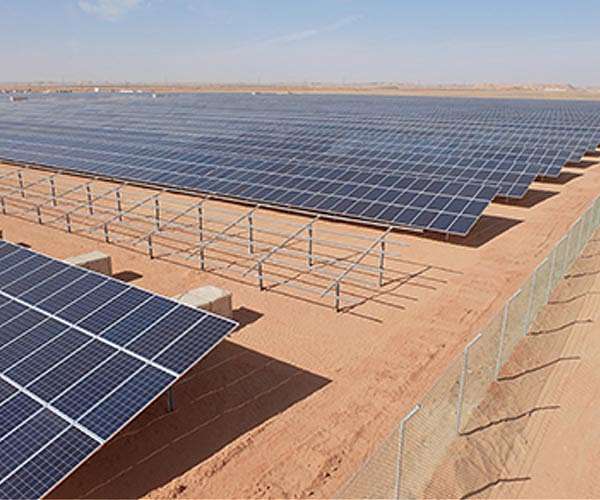
The resulting architecture combines concentrated solar power, photovoltaic panels, and wind turbines with both battery and thermal energy storage. Demand-side flexibility also plays a key role: the team used the KAUST desalination plant’s adjustable energy consumption to reduce stress on the grid during peak stress events. “The system balances cost and resilience by combining concentrated solar power, photovoltaic panels and wind turbines with battery and thermal storage,” Lima said. “Resilience was further improved by using the KAUST desalination plant’s flexible energy demand to reduce stress on the system during extreme events.”
When evaluated against the full 25-year historical weather record, the optimized system met KAUST’s electricity demand under all historical extreme conditions. It would also eliminate more than 330,000 tonnes of CO2 emissions annually relative to an equivalent fossil-fuel supply. The price of that reliability is not trivial, however. “Achieving this level of reliability requires additional investment, increasing system costs by 19 to 30 percent depending on configuration,” Lima noted.
Knio described the analysis as providing KAUST with a practical framework for designing a resilient, low-carbon power system at campus scale. For Saudi Arabia more broadly, the work offers a template for how renewable energy systems can support energy diversification and emissions reduction under harsh climatic conditions.
The research team is now extending the framework in two directions: integrating additional demand-side flexibility options such as district cooling operation and storage scheduling, and incorporating climate projections to account for future warming-driven shifts in both demand and extreme event frequency. “This will support long-term planning and improve resilience metrics for renewable energy systems,” Knio said.
Related Links
King Abdullah University of Science and Technology (KAUST)
All About Solar Energy at SolarDaily.com