


Solar panels are becoming an essential part of the lives of millions of people in India. And as the market for renewable energy is growing, technological advances in the renewable sector are no longer a surprise.
With new technologies such as HJT, TOPcon, and Bifacial modules, solar energy is the fastest-growing renewable energy.
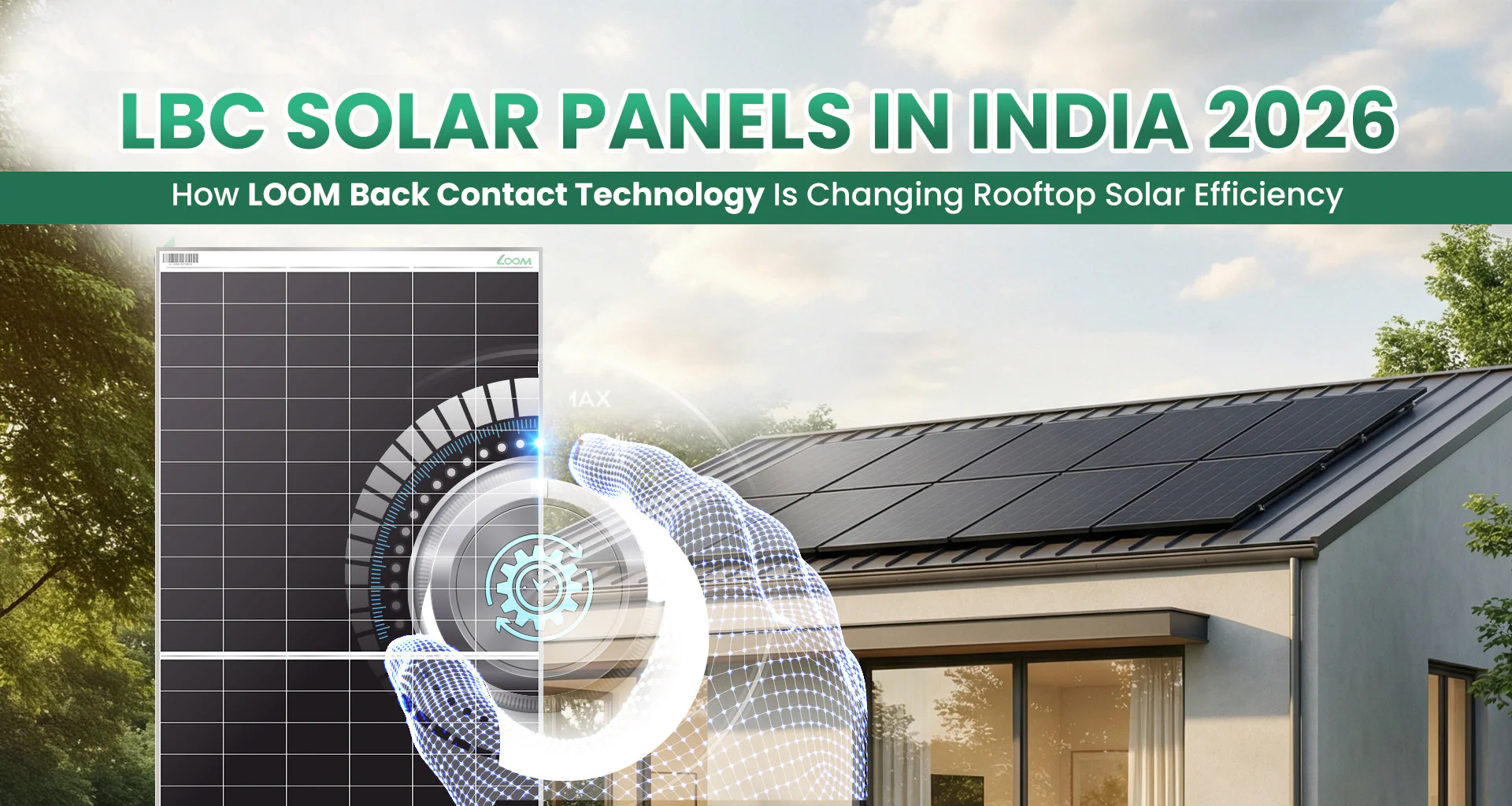
In this ever-evolving sector, Loom is now introducing its brand new LBC (Loom Back Contact) solar panels, which are more efficient and have less heat buildup. Read the full blog to know more about LBC panels.
SHARK–LBC 650 Wp is a premium rooftop solar panel built with LBC – Loom Solar Back Contact technology. In normal solar panels, there are thin metal lines (gridlines) that are placed on top of the solar cells of panels to capture sunlight, but these gridlines take up so much space on the top of the solar cells, acting as an obstacle for the solar cells.
In the LBC technology, these gridlines are placed at the back of the solar panels, which help the solar cells in capturing more sunlight and help the solar panels in generating more electricity without any obstacle. This increases its overall output.
LBC v/s Traditional panels
|
Features |
LBC panels |
Traditional Panels |
|
Cell Design. |
In LBC solar panels, the gridlines are on the back of the panel. |
In traditional solar panels, the gridlines are on the front of the panels. |
|
Efficiency. |
Due to more space available on the solar cells after shifting the gridlines at the back, the efficiency is higher. |
Gridlines occupy most of the space on the solar cells, due to which solar cells are not able to absorb much sunlight compared to the LBC panels, which leads to moderate efficiency. |
|
Appearance. |
The appearance of the LBC is aesthetically pleasing due to the lack of gridlines. |
The traditional panels appear to have gridlines on top of the solar cells. |
|
Power loss. |
Due to the lack of gridlines on the top of solar cells, more sunlight will be able to enter the panels on a cloudy day. |
Due to the gridlines on the top of solar cells, less sunlight will be able to enter the panels on a cloudy day. |
|
Space requirement. |
Due to generating more electricity with the same number of panels, less roof space is required. |
Due to generating less electricity with the same number of panels, more roof space is required. |
|
Performance. |
The performance during the low-light condition is much better than that of traditional panels. |
The performance of a traditional panel is standard during low-light conditions. |
Why does LBC perform better in Indian climates?
India is known for its unique and demanding environment. From the blazing plains of Rajasthan to the humid coastlines of Chennai and the dust- laden winters of Delhi, India’s diverse weather conditions include high temperatures, dust, humidity, and seasonal variation. LBC technology is better suited for these conditions.
|
Climate Condition. |
Traditional Panels |
LBC panels |
|
Extreme Heat (40°C+) |
Significant efficiency drop. |
Efficiency is higher. |
|
Partial shading (trees, AC units) |
A single shaded solar cell can affect the entire solar string, which may reduce efficiency and damage the panel over time. |
It is designed with better current distribution, which reduces the impact of partial shading. |
|
Dust accumulation |
Gridlines can trap some dust in front of the panels, which can block sunlight and decrease output efficiency. |
Due to the lack of grids at the front of the panels, the dust that settles on the panels is relatively less and easily cleanable, and it does not affect efficiency. |
|
diffuse/low light (monsoon, fog) |
Perform well in direct sunlight but struggle in diffuse light conditions. |
Maintain better generation even during diffuse light conditions. |
|
Limited roof space |
Requires more panels and more roof space for the same system size. |
LBC panels help you maximize solar generation without needing extra space. |
Key Benefits of LBC Panels.
LBC solar panels offer several benefits, which makes them a next-generation solar solution. These benefits are:
-
Increase Performance: LBC panels bring out higher overall energy output. The no front-side obstacle helps in absorbing more sunlight, which is then converted into electricity.
-
Less heat buildup: They are designed to handle higher temperatures better and with improved heat distribution & lower resistance losses. This makes the performance stable even during the peak summer hours.
-
Non-front gridlines: LBC panels are created with a specific design in which the gridlines of the solar panels are situated at the back of the panels; due to this, there is no internal design that acts as a shading for the solar panels, which also apparently makes it easier to clean the dust.
-
Improved light absorption: These are specifically designed to make the panels more efficient in light absorption. The gridlines at the back help the panels absorb as much sunlight as possible, which makes them more efficient even during cloudy days.
-
Aesthetically pleasing: LBC panels create an aesthetically pleasing look due to their non-front gridlines. Its sleek, full-black appearance blends with the modern rooftop, making it look premium.
Common Challenges.
While LBC technology is advanced, there are still some challenges. And understanding them helps both homeowners and installers to make informed decisions:
Here are some of the challenges faced:
-
Higher Initial Cost: LBC currently consists of a premium module as compared to the other models, like TOPcon and PERC. technology like laser patterning, back-side metallization, and advanced cell stringing, all these make the initial cost of manufacturing an LBC panel relatively higher.
-
Manufacturing complexity: Creating back contact cells requires precise and complex processes, as each connection should land exactly on the rear contact pads. This demands tighter quality control and more sophisticated factory equipment than conventional stringing.
-
Limited field history in India: While LBC technology has been commercially available since the early 2000s. But the development of a newer LBC variant is specifically designed for the Indian weather conditions to provide long-term performance; the only challenge now is to make it local.
-
Installer training and availability: LBC panels require careful handling during installation, as the rear contact structure can be sensitive to mechanical stress. Skilled installation network that is familiar with the back contact module remains limited outside India’s major metro areas.
But with time, these barriers will be overcome as the solar industry grows in India.
Future of LBC in India.
The future of LBC technology looks promising in India. At the current point, India is at a Turning point. According to the industry analysts, the country is currently mid-transition, moving from PERC to TOPcon. Meanwhile, China is already accelerating towards back contact as the next mainstream technology. So India is expected to follow as the country accelerates its transition towards clean and green energy.
With growing focus on:
-
Increasing renewable energy targets
-
Rising electricity costs across the residential sector.
-
Strong government support for rooftop solar and subsidies.
-
A clean shift towards a high-efficiency solar solution.
LBC panels are expected to move from premium to mainstream rooftop solar choice in the coming year.
Back contact solar technology is still evolving in India, but it will quickly become the standard for high-efficiency solar panels worldwide.
India is still in the early adoption phase of back contact technology, and many domestic manufacturers currently focus on mono PERC, TOPcon, Bifacial, and HJT.
However, companies like LOOM SOLAR are taking the initiative to introduce the back contact technology in the local market through their LBC (Loom Back Contact) solar panels and bringing their advanced technology to the rooftop of India.
Conclusion.
LBC (Loom Back Contact) solar technology marks a turning point in the solar journey of India by removing front-side gridlines, improving light absorption, and delivering higher efficiency during challenging weather conditions. These panels also address many of the limitations of traditional solar technologies by providing high performance in extreme heat & low light conditions.
While there are some challenges, such as high initial cost & limited awareness, these are expected to reduce as adoption increases & technology matures.
As India will continue its transition towards clean & sustainable energy, the demand for high efficiency & future-ready solar solutions will gradually increase with time.
At those points, technology like LBC plays a crucial role in shaping the next-generation solar solution. With its focus on advanced technology and customer-centric innovation, Loom Solar has positioned itself at the forefront of this transformation by bringing a smarter and more efficient solution for the household of India.









