


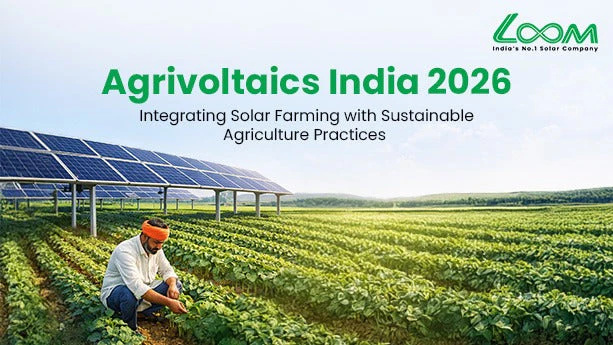
As India moves toward renewable energy, a powerful concept is emerging in both the agriculture and energy sectors—Agrivoltaics (Agri-PV). By combining solar power generation with farming, this approach enables dual land use, allowing crops to grow beneath elevated solar panels.
With increasing pressure on land, water, and climate resilience, agrivoltaics is emerging as a key solution for sustainable agriculture in 2026 and beyond.
What is Agrivoltaics?
Agrivoltaics refers to the combination of solar energy systems with agricultural practices. Unlike conventional solar farms, Agri-PV systems use elevated mounting structures that enable farming activities to continue underneath.
This dual-use model offers several advantages:
- Optimized land utilization
- Additional income opportunities for farmers
- Improved microclimatic conditions for crops
- Reduced conflict between food and energy production
Pilot projects in India, including installations in Maharashtra, have demonstrated that agrivoltaics can enhance crop productivity while simultaneously generating clean energy.
With the advancement of solar technologies by companies like Loom Solar, deploying efficient and compact solar systems in agricultural settings is becoming more accessible for Indian farmers.
Renewable Energy in Agriculture: A Growing Opportunity
The integration of renewable energy in agriculture is becoming increasingly important as energy demand rises in rural areas. Agrivoltaics allows farmers to:
- Generate electricity for on-farm use, such as irrigation
- Reduce reliance on grid power
- Contribute to decentralised energy production
Global studies indicate that agrivoltaics can improve land-use efficiency by up to 60–70%, making it one of the most effective models for combining energy and agriculture.
Indian solar innovators like Loom Solar are already working toward simplifying solar adoption through high-efficiency panels and farmer-friendly solutions, supporting this transition at the grassroots level.
Climate-Smart Farming and Water Efficiency
One of the most compelling advantages of agrivoltaics lies in its ability to support climate-smart farming practices. The partial shading created by solar panels helps regulate soil temperature and reduces direct exposure to harsh sunlight.
This has a direct impact on water conservation. Reduced evaporation leads to better moisture retention in the soil, which is particularly valuable in water-stressed regions. Indian pilot projects have demonstrated that such systems can meaningfully lower water loss while maintaining healthy crop growth, making agrivoltaics a practical solution for long-term agricultural sustainability.
Role of ALMM Approved Modules in Agri-PV
The effectiveness of agrivoltaics systems depends on the quality of solar components used. In India, the adoption of ALMM-approved modules is becoming increasingly important to ensure performance, reliability, and compliance with national standards.
Advanced technologies such as bifacial and N-type modules are particularly well-suited for agrivoltaic applications. Their ability to perform efficiently under varying light conditions makes them ideal for installations where sunlight is partially filtered through elevated structures.
Companies like Loom Solar are contributing to this space by offering advanced solar panel technologies designed for higher efficiency and durability, which are crucial for long-term agrivoltaic deployments.
Agrivoltaics and the Vision for 2026
As global discussions around sustainable agriculture intensify, agrivoltaics is gaining recognition as a scalable and future-ready solution. Industry platforms and policy discussions are increasingly focusing on integrating renewable energy into farming systems to improve resilience and productivity.
Agrivoltaics addresses multiple challenges simultaneously by supporting clean energy generation, improving farm efficiency, and promoting responsible resource use. This alignment makes it a key contributor to the broader vision of sustainable agriculture in 2026.
What Are The Possibilities In Future
India’s agrivoltaics journey is still in its early stages, but the direction is clear. With the right mix of policy support, technological innovation, and industry collaboration, Agri-PV has the potential to transform rural economies.
It offers farmers not just a way to reduce costs, but an opportunity to participate in the clean energy transition. At the same time, it supports national goals around renewable energy expansion and environmental sustainability.
With continued innovation from companies such as Loom Solar, the adoption of agrivoltaics is expected to become more practical, scalable, and farmer-friendly across India.
Conclusion
Agrivoltaics represents a strategic shift in how we think about land, energy, and agriculture. Enabling the coexistence of solar power and farming, it creates a more efficient and resilient system.
As India moves forward, the integration of solar farming with agriculture will play a critical role in shaping a future that is both energy-secure and environmentally sustainable. The farms of tomorrow will not only produce food—they will also generate clean energy, driving value on multiple fronts.