


The U.S. energy storage industry installed 57.6 GWh of new capacity in 2025, the largest single year of new battery capacity additions on record. Energy storage installations grew 30% from the previous record set in 2024, and are over four-times what the industry installed just three years ago.

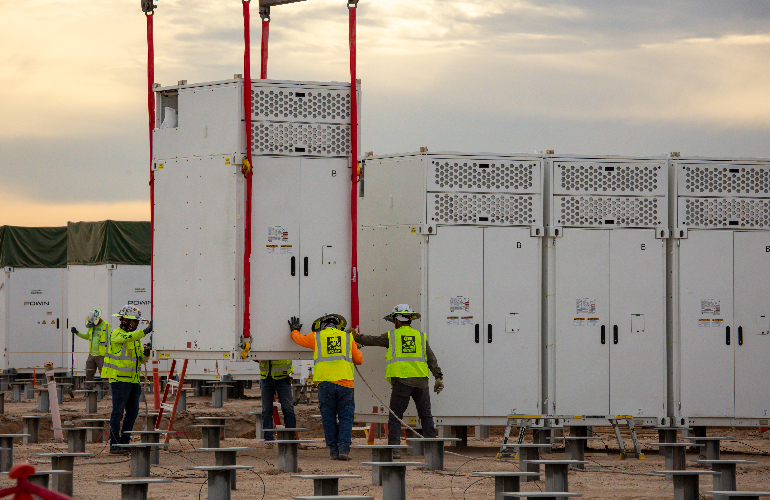
A solar + storage project in Arizona in the process of adding BESS. Credit: McCarthy Building Companies
According to the “U.S. Energy Storage Market Outlook Q1 2026 (ESMO)” released today by the Solar Energy Industries Association (SEIA) and Benchmark Mineral Intelligence, as of 2025, 137 GWh of utility-scale storage has been installed in the United States, 19 GWh of commercial
Over 600 GWh of energy storage is expected to be installed by 2030. Two-thirds of all utility-scale energy storage capacity installed in 2025 was built in states won by President Donald Trump, including nine of the top 15 states for new installations. Texas is set to overtake California in 2026 as the largest energy storage market in the country.
“This record-breaking year for energy storage is just the beginning of its rise as a cornerstone of America’s energy future,” said Darren Van’t Hof, Interim President and CEO of SEIA. “Whether it’s
Standalone storage made up nearly 30 GWh of new

Credit: SEIA/Benchmark Mineral Intelligence
In 2025, battery cell manufacturers pivoted from EV manufacturing toward dedicated energy storage production, converting existing lines and changing future plans. As of 2025, lithium-ion battery cell manufacturing for stationary electricity storage applications has risen to over 21 GWh according to SEIA’s Solar and Storage Supply Chain Dashboard, which is enough to power the city of Houston from sunset to sunrise. And American manufacturing facilities now have the capacity to manufacture 69.4 GWh of battery energy storage systems.
“The US energy storage market has entered a new phase of sustained, high volume-deployments,” said Iola Hughes, Head of Research at Benchmark Minerals. “As policy, manufacturing and market demand align, storage is playing a pivotal role in meeting peak demand, reducing price volatility and improving overall system resilience. At a time of rising electricity demand, driven in part by the growth of data centers and AI infrastructure, energy storage will be critical to ensuring the grid can scale reliably and efficiently.”
The quarterly ESMO report tracks
News item from SEIA