

If you are Googling “Tesla solar panels Australia launch date”, you are not alone. Right now, Tesla has not published an Australian launch date for its Solar Panels product. That uncertainty is frustrating, but it gives us the opportunity to see how they fare before hitting the Australian market. Aussies love Tesla gear, and we know how much they also love to match brands. If you already have a Tesla Powerwall, Tesla EV Charger, and a Tesla EV, then solar panels with the same logo sound like a winning combination.
While we wait to see if or when they will make landfall on Aussie soil, you can rest assured that the tech behind the fanfare already exists locally.
What Tesla sells overseas and the key specs
Here’s what Tesla lists for its Solar Panels product on its US site:
- Panel wattage: 420 W (per panel).
- Dimensions: 71.1 in x 44.7 in x 1.57 in.
- Dimensions: about 1806 mm x 1135 mm x 40 mm.
- Operating temperature: -40°C to +85°C.
- Materials: black anodised aluminium frame, black backsheet, glass, and solar cells.
- Certifications noted: IEC/UL 61730-1 and 61730-2, IEC 61215.
- Warranty: 25-year product and performance guarantee.
- Shade focus: Tesla claims “three times more power zones” than traditional panels.
On paper, it reads like a premium, modern residential panel. It also reads like several panels you can buy in Australia today.
Why there’s no Australian Tesla panel launch date
Tesla already has a strong energy presence in Australia via Powerwall. Solar panels are a different operational beast.
Panels need local distribution, installer coverage, warranty handling, and compliance pathways. Australia also demands strong after-sales support, because our weather does not muck around.
So, a missing launch date does not mean “never”. It means Tesla has not made a public commitment yet.

The Tesla tech story
Most “Tesla panel magic” comes down to three things:
- High power per panel (420 W).
- Better production under shade (more “power zones”).
- A clean, all-black look (black frame and backsheet).
None of that is exclusive to Tesla. Australian buyers can match those outcomes right now.
What “more power zones” really means, and how Australians already get it
When shade hits a panel, output can drop fast. So manufacturers fight shade losses in a few ways.
What Tesla highlights: more internal segmentation, so shade hurts less. In the broader industry, this usually overlaps with ideas like:
- Half-cut cells (more parallel pathways, better shade tolerance).
- More bypass diode segmentation (more sections, less total knockdown).
- Module and cell layout choices that reduce hotspot risk.
You can see this theme clearly in Australian premium ranges. For example, REC specifically calls out improved shaded performance via half-cut cell design.
If shade is your nemesis, you can also play defence at the system level. Microinverters and DC optimisers can limit how much one panel drags others down.
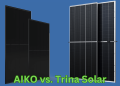
Partial-shade optimisation is AIKO solar panels’ bread and butter.
Australian alternatives that match Tesla’s talking points
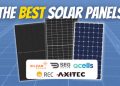
Energy Matters recommends several solar panel brands in Australia. A few line up nicely with Tesla’s headline features.
AIKO and the “shade plus sleek” angle
AIKO’s hero is ABC (All Back Contact) cell design. That moves conductors to the rear of the cell.
The result is a cleaner front look and a more active light-catching area. It also reduces some front-side shading losses from gridlines.
If you like the Tesla aesthetic, AIKO will feel familiar. It is the same “clean roofline” philosophy.
Explore AIKO solar panels.
LONGi and the back contact shift
LONGi has heavily leaned into back contact messaging, too.
Back contact designs aim for higher efficiency and better aesthetics. That again mirrors Tesla’s premium positioning.
Explore LONGi solar panels.
REC and the performance engineering approach
REC leans into measurable performance traits and reliability signals. That includes high power density models, strong warranties, and shade-aware design.
REC’s Alpha series also uses HJT (heterojunction) in key models. HJT often performs well in heat compared with older cell types.
That matters in Australia, because rooftops cook in the sun.
Explore REC solar panels.

Quick comparison table
| What people like about Tesla panels | What to look for in Australia | Energy Matters recommended examples |
|---|---|---|
| 420 W per panel | High wattage options in modern residential lines | AIKO (many models sit in the high 400 W to 500 W plus range) |
| Better shade tolerance | Half-cut cells, smart segmentation, and strong system design | REC (half-cut), plus microinverters like Enphase for system-level shade control |
| Clean, all-black look | Black frames, black backsheets, and back contact aesthetics | AIKO (ABC), LONGi (back contact direction, plus all-black options) |
| Long warranty confidence | Clear product and performance warranty terms, plus local support | REC (strong warranty programs), plus established local supply chains |
Should you wait for Tesla solar panels in Australia?
If you have a great roof, you lose savings every month you wait. That is the boring truth, and it bites.
Waiting can make sense in only a few cases:
- You are rebuilding soon and want one coordinated energy brand.
- You are determined to keep everything Tesla, no matter the delay.
- You want to pair with a specific future Tesla bundle or tariff.
Otherwise, Australia’s solar market is already mature. You can buy premium panels today, with local support and proven installers.
What to do instead if you want the “Tesla-style” outcome
If your goal is “Tesla, but on an Aussie roof”, aim for outcomes. Then pick hardware that delivers them.
- For shade-heavy roofs: Choose a shade-tolerant panel design and consider microinverters.
- For maximum roof aesthetics: Look at all-black modules and back contact options.
- For hot climates: Prioritise strong temperature performance and trusted warranties.
- For future batteries: Design the system for a battery from day one, even if you add it later.
Tesla or not, the winning move is a well-designed system. A good installer matters as much as the badge.
FAQ
Tesla sells Powerwall in Australia. Tesla Solar Panels do not have a confirmed Australian launch date.
Not automatically. The key features Tesla promotes already exist in premium Australian options.
If you want sleek looks, explore AIKO and LONGi back contact ranges. If you want engineered performance and warranty strength, look at REC.
If you have good solar conditions, buying now usually wins financially. Waiting only helps if you value the Tesla brand above savings.
Tesla solar panels = A big question mark
Tesla Solar Panels in Australia remain a question mark. But the technology story is not a mystery at all.
High wattage, shade resilience, and sleek all-black design are already here. So you can chase the Tesla vibe without waiting for a Tesla date. If you’re ready to add solar, let Energy Matters give you a head start. Get FREE Quotes from trusted installers in your area.