
No country has affected global solar panel supply chains more than the United States. Since the boom of solar in the early 2010s, the U.S. government has chased Chinese firms across the world, initiating tariffs on products as they’re “dumped” into the U.S. market at uncompetitive prices.

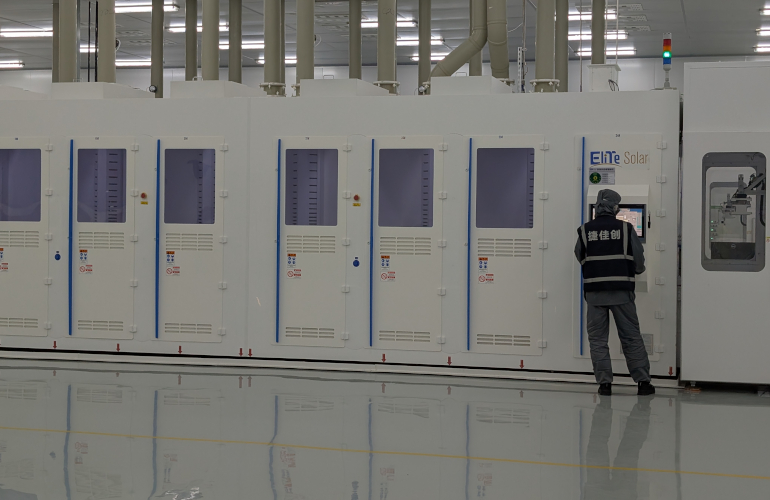
Elite Solar cell manufacturing plant in Egypt. Credit: Solar Power World
When the Dept. of Commerce first placed antidumping tariffs on Chinese solar panels in 2012, the manufacturers shifted production to Taiwan and then Southeast Asia. Regardless of China’s involvement, Southeast Asia became the core solar panel manufacturing spot until the United States put more tariffs on product from Cambodia, Malaysia, Thailand and Vietnam. Operations began moving again, and now the United States is looking at India, Indonesia and Laos for more antidumping measures.
One area that hasn’t seen intense supply chain scrutiny is the Middle East and Africa (MEA). The region is emerging as an ideal place to set up silicon solar panel manufacturing to avoid tariffs and supply the United States with much-needed solar product that complies with foreign entity of concern (FEOC) requirements.
This is the background of how an American solar journalist found herself in Egypt touring a solar cell and panel manufacturing complex.
Singapore-headquartered ELITE Solar formally commissioned its 3-GW panel, 2-GW cell manufacturing complex in Egypt’s Suez Canal Economic Zone (SCZone) earlier this month with a visit by Egyptian Prime Minister Mostafa Madbouly. U.S. partners and other guests were invited out a few weeks later.
The 450,310 ft² complex broke ground in December 2024 and incredibly began production in 12 months. ELITE Solar already has many supply agreements with U.S. project developers and signed a deal with a major U.S. developer at the grand opening last week.
rPlus Energies CEO Luigi Resta said that ELITE’s new Egypt facilities will benefit future generations as the world tackles climate change. He paraphrased a line from Deuteronomy, “We drink from wells we did not dig and sit in the shade of trees we did not plant.”
Factories in Egypt
ELITE Solar was founded in 2005 as ET Solar and has always had a special focus on supplying the U.S. market. In 2023, the company rebranded as ELITE Solar after splitting with its utility construction arm to focus entirely on panel manufacturing. ELITE also has cell and panel manufacturing operations in Indonesia and is establishing a solar wafer production facility in Vietnam with OCI Holdings, a long-time partner.
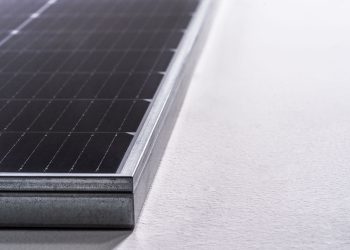
The company makes PERC and n-type solar panels using 182- and 210-mm wafers. The solar panels for the utility-scale market reach 630 to 725 W with efficiencies over 23.3%.
ELITE invested approximately $115 million on the combined manufacturing facilities in Egypt, with SCZone listing employment figures at 400 for the cell plant and 460 for the panel assembly side. During last week’s tour, the panel factory had more staff on the assembly floor while the cell operation was much more automated. Autonomous robots moved around the factory floor, positioning racks to move cells to their next production step. The automation at ELITE’s Egypt operations is far more advanced than anything seen at cell and panel manufacturing setups in the United States.
MEA popularity
Egypt is emerging as a clean energy manufacturing hub, and not just for solar panels. Within the SCZone, JA Solar recently announced it would make its own cell and module manufacturing complex, and Sungrow signed an agreement to make battery energy storage systems in the zone. GCL also intends to develop solar cells in Egypt, and more battery and transformer makers are looking at the country too.
The Middle East is growing in popularity, with Jinko and TCL looking at Saudi Arabia for operations, United Solar setting up polysilicon production in Oman and GameChange Solar operating tracker manufacturing in Saudi Arabia. A review of Customs and Border Protection (CBP) data shows an uptick in solar cells coming from Ethiopia after Toyo’s plant started production and Origin Solar shipped its first orders, likely for Canadian Solar. NE Solar/ZNShine just this week said it is now operating a cell factory in Nigeria, showing that solar manufacturing is expanding across Africa.
At ELITE Solar’s Egyptian grand opening, both ELITE Chairman Derek Liu and OCI Chairman Woo Hyun Lee wore cowboy hats that they said represented the “cowboy spirit” of what they’re doing together. Lee fashioned Liu as a “modern Genghis Khan” for ELITE’s early entry into the Egyptian market, leading the way for solar domination across the region.