


Maryland Gov. Wes Moore announced the Lower Bills and Local Power Act (LBLPA) as part of the Moore-Miller administration’s 2026 legislative agenda. The legislation introduces measures to secure financing for local clean energy projects, modernize the electric grid and provide additional direct energy bill rebates to Maryland families.

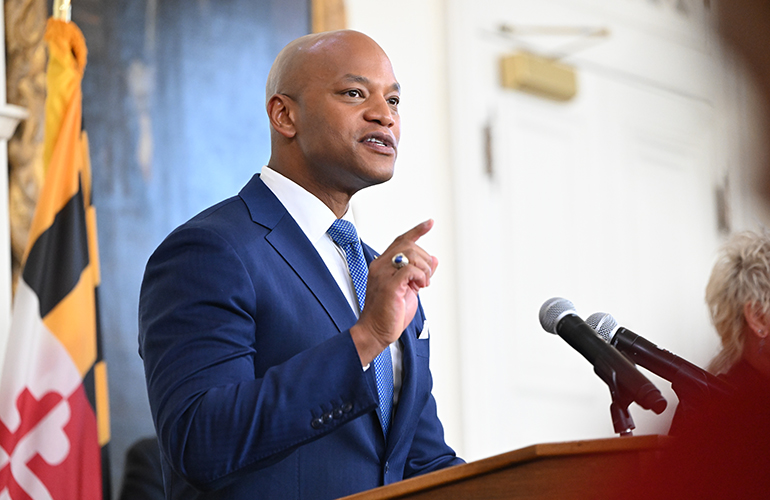
Maryland Gov. Wes Moore speaks at a press conference in January. Pat Siebert
“Energy policy is about more than megawatts and transmission corridors — it is about whether Maryland families can afford to live in their homes,” Moore said. “That’s why our administration is stepping up to deliver real relief, focusing on driving down the cost of utility bills for Marylanders, and investing in local projects that make energy more reliable and affordable.”
LBLPA allocates nearly $200 million from the state’s Strategic Energy Investment Fund — which reinvests Alternative Compliance Payments from utilities — to address rising energy costs impacting Maryland families.
Approximately $100 million will be directed to Maryland families for utility bill rebates. The rebates scheduled to start this fall are in addition to the $200 million in direct electricity bill rebates delivered by Moore and the Maryland General Assembly through the Next Generation Energy Act.
To promote local energy generation, the legislation establishes the Solar and Energy Storage Gap Financing Program. The program will invest $70 million to fund clean energy projects. The investment will spur local clean energy production.
“The Moore-Miller Administration is committed to moving as quickly as possible to a more affordable, reliable, clean energy system,” said Kelly Speakes Backman, director of the Maryland Energy Administration. “Gov. Moore’s legislation introduced today, his budget and the executive order issued in December all aim at addressing rising energy costs for working families, making sure the lights stay on, and moving us on a path to clean energy.”
To modernize Maryland’s transmission infrastructure, LBLPA makes utility companies responsible for prioritizing advanced transmission and grid-enhancing technologies when expanding grid capacity. Utilities trying to build new transmission lines must submit plans to implement these technologies without increasing ratepayer costs before receiving approval from the Maryland Public Service Commission.
LBLPA allocates $10 million for the Maryland Department of Transportation to identify opportunities for high-voltage transmission lines and battery storage projects along state and interstate highways. By using existing state-owned highway right-of-way, Maryland can bypass complex land acquisition and permitting processes.
“The Maryland Department of Transportation is a proud partner and supporter of the Moore-Miller Administration’s efforts to modernize the state’s energy grid and lower energy costs,” said Katie Thomson, acting secretary of the Maryland Department of Transportation. “With Gov. Moore’s Lower Bills and Local Power Act, I look forward to the continued collaboration with our state energy partners, doing what the Department does best—finding practical solutions that keep Maryland moving toward a more affordable, sustainable future.”
In addition to signing the Building an Affordable and Reliable Energy Future executive order and delivering $200 million in energy rebates, the governor invested more than $130 million into clean energy and modernization programs in 2025 alone, including funding for county government energy modernization and the Decarbonizing Public Schools Program.
News item from the Office of Governor Wes Moore