


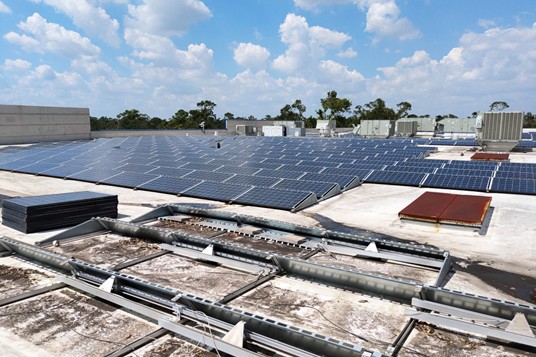

As solar power becomes the fastest growing source of energy in the United States, it has matured from a growth-first industry to one attempting to balance growth with full-lifecycle accountability. This year, several trends are converging to create a solar panel recycling landscape never seen before. How the industry, especially solar panel recyclers and those who want to recycle, responds now will determine if we move toward a true circular economy, or get pulled off-course.
Repowering hastens the tsunami of panels

Solar panels ready for decommissioning. Credit: Comstock Metals
To meet our nation’s growing demand for power, utility-scale and early commercial solar installations are entering large-scale repowering cycles. Higher-efficiency panels offer compelling performance gains, but also create a surge of retired modules.
Repowering decisions increasingly hinge on new project economics that shift as technologies advance and financial considerations change. Recent research by the National Laboratory of the Rockies has also found that decisions to repower are driven by repairs and system unreliability, not just project finance, meaning that any site can potentially be a candidate for repowering.
As a result, solar panels are coming off sites before originally planned, and not necessarily from regions where the first wave of solar sites congregated.
Potential EPA ruling promises turning point for the industry
The U.S. solar industry may soon reach a regulatory milestone. An anticipated EPA ruling to classify end-of-life solar panels as universal waste would provide long-needed federal clarity for how panels are handled, transported and processed at the end of their useful lives.
A universal waste designation would streamline handling and transport requirements while reducing compliance uncertainty for asset owners, developers and EPCs. Today’s patchwork of state-level regulations creates confusion and state-by-state standards. A federal framework would simplify obligations across state lines and create more predictable pathways for responsible recycling.
Just as importantly, the designation would signal formal federal recognition that solar panel waste is a distinct and growing category requiring tailored management. By creating economic incentives that discourage landfilling and encourage proper recycling, the rule could help scale recycling infrastructure nationwide and ensure valuable materials are reintroduced into the domestic supply chain.
Solar faces smelting, refining and the global standard issue

Smelting
As recycling volumes increase, industry stakeholders will need to become more familiar with two critical terms: smelting and refining.
Traditional metal recovery processes, particularly smelting and refining, often take place outside the United States, primarily in parts of Asia where labor costs are lower and environmental regulations are less stringent. Without meaningful innovation in domestic refining technologies, the United States risks continuing its reliance on overseas markets for critical material processing.
That dependence creates both environmental and geopolitical concerns. If the United States intends to set the global standard for solar panel recycling, it must invest in scalable, environmentally responsible processing technologies at home. Otherwise, end-of-life panels may simply shift responsibility for environmental impact offshore rather than truly closing the loop.
At the same time, the industry must remain vigilant. As more players enter the recycling market, not all processes will deliver the same environmental performance. Developers and asset owners will need to evaluate recycling partners carefully to ensure providers are committed to transparent, environmentally sound practices.
Bringing “recycling” closer to its true definition
This year, the industry is sharpening its definition of solar panel recycling. It no longer means recovering “most” materials or partially dismantling a module while sending residuals to landfill.
True recycling is defined by how effectively an operator converts end-of-life panels into materials that are safe and viable for reintroduction into the domestic supply chain while eliminating long-term liability for panel owners. Advances in processing technology have made this standard a reality, enabling higher recovery yields of critical materials such as copper, silicon and silver while preventing cross-contamination between material streams, making “zero-landfill” recycling a possibility.
With regulatory clarity and technological advancement comes heightened expectations. Important stakeholders, including investors and offtakers, are increasingly expecting verifiable proof related to environmental impact.
“True” recycling will be defined not by marketing language but by demonstrated results. It goes beyond integrating recovered materials into domestic supply chains, and includes the commitment to process panels in any condition, produce plastic-free and environmentally safe outputs, and eliminate downstream liability for panel providers.
The recyclers that can provide transparent data and scalable solutions will set the benchmark for the industry.
Claims are no longer enough. Chain-of-custody documentation, material recovery reporting and lifecycle data are becoming table stakes. The market is beginning to differentiate recyclers based on quality, accountability and verifiable outcomes.
Solar industry as a means to critical minerals reclamation, not just power

An example of polysilicon in the Imperial Star Solar booth at the RE+ 2025 tradeshow.
When done correctly, “true recycling” will contribute meaningfully to both ending the unreasonable disposal of critical materials through landfilling or offshoring and environmental protection for asset owners while supporting our nation’s domestic critical minerals policy and powering the solar supply chain.
Recovering aluminum, copper, silicon and rare or critical materials from retired modules supports U.S. clean-energy independence by creating domestic material inputs that would otherwise be unavailable or sourced from competitive foreign countries. This aligns directly with federal efforts to reshore manufacturing, reduce import reliance and strengthen industrial resilience.
As domestic manufacturing capacity expands, recycled materials can become part of a broader strategy to secure supply chains and stabilize input costs. In this context, true recycling is not simply an environmental consideration — it is of national economic and strategic priority.
The solar industry has built its reputation on delivering clean, affordable power at scale. Its long-term credibility, however, will depend largely on how it manages materials throughout the full lifecycle.
Developers, regulators and recyclers must now collaborate to ensure that the industry’s rapid growth is matched by equally committed end-of-life solutions. By doing so, solar can lead not only in clean energy generation but also in building a circular, resilient domestic materials economy for generations to come.
 Dr. Villamagna joined Comstock in 2023 and brings 40 years of experience in the energetic materials, hazardous materials, renewable energy, energy recovery, waste to energy, and medical as well as hazardous waste destruction industries in roles including research and development, engineering, product development, and executive management. His most recent work focused on developing and commercializing new technologies that redefine how emissions are controlled and avoided. Dr. Villamagna developed the proprietary process for recycling of end-of-life electrification products, which Comstock Metals is commercializing first in solar, and which prevents materials used in the electrification economy from being disposed of in landfills and enables the recovery of scarce and valuable metals from electrification products for reuse. Formerly, he was the CEO of Paragon Waste Solutions, LLC, a company he co-founded which advanced emission control processes he patented.