

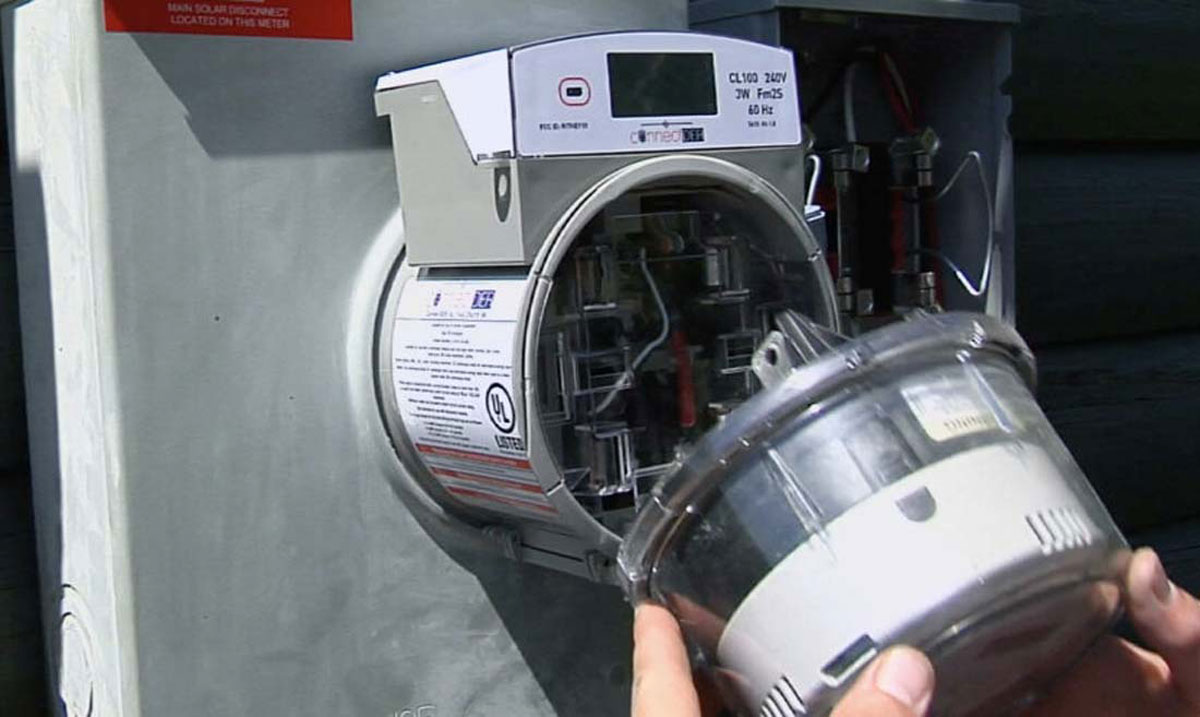
The bill, which is being considered in Senate committees after passing the state House, requires utilities to allow meter-mounted devices to connect between retail electric customer meters and meter sockets. These devices reduce complexity and installation time, ultimately saving homeowners money.
Washington state lawmakers are considering a bill that would require the state’s utilities to allow customer-owned meter-mounted devices that make solar easier to install.
These devices, commonly known as meter socket adapters (MSAs) or meter collar adapters (MCAs), allow solar inverters, EV chargers and battery backup systems to be connected to a home without complex wiring inside the home’s electrical panel.
HB 2296 would require all of the state’s utility companies to allow MSAs. The bill passed the state House on February 11, 2026, and is currently in the Senate Rules committee.
However, the version of HB 2296 that passed the House is significantly different from the bill’s original text, and advocates worry it could slow market adoption of MSAs.
The bill “leaves a lot of wiggle room for utilities that would rather not allow the technology to find ways to not do so,” said Jon Knauer, VP of policy and market strategy at MSA manufacturer ConnectDER, in a conversation with pv magazine USA.
Changes to HB 2296
The original version of HB 2296, prefiled on January 7, 2026, contained language to require devices accepted for use in the state to adhere to the National Electrical Code (NEC) and be certified/listed and approved by a nationally recognized testing laboratory. It also required all utilities to approve or disapprove within 90 days a request from a manufacturer to allow a device.
The substitute version of HB 2296 now under consideration in the Senate Rule Committee retains the provisions around the NEC and testing laboratories, but now requires only utilities that serve more than 25,000 customers to approve or disapprove within 90 days a request from a manufacturer to allow a device. Utilities that serve fewer than 25,000 customers would be allowed 180 days to approve or disapprove of MSA applications.
More controversially, the bill now includes language requiring MSAs to be “compatible with advanced metering infrastructure” and not “interfere with meter functions or communication networks.”
Industry response to the changes
In a statement provided to pv magazine USA, the Washington Solar Energy Industries Association (WASEIA) said the following
“While we support making simple, affordable technologies available to solar installers and homeowners, the current bill unduly empowers utilities to block these devices.
The original draft required meter-mounted devices to be approved if they met all applicable safety standards as verified by a nationally recognized testing laboratory. The amended bill adds vague requirements for ‘compatibility’ with AMI systems and for avoiding ‘interference’ with other utility operations, but it cites no standards and leaves those terms undefined — effectively letting utilities stack the deck.
That ambiguity leaves substantial discretion with utilities and could create uncertainty for manufacturers and installers, potentially slowing market adoption in Washington. The amended bill also provides no recourse for a meter-mounted device manufacturer to appeal an application denial by a utility.
Washington legislators should ensure that policy decisions are not driven solely by utility preferences, and instead establish clear, objective standards and an appeal process so consumers can access these affordable technologies.”
How MCAs work to speed solar installation and save money
As the name implies, MSAs like the kinds offered by ConnectDER, Enphase and Tesla (among others) connect directly into a home’s utility meter socket — between the socket and the utility meter — to allow for the two-way flow of electricity between the home and connected energy assets like those listed above.
In recent years, such devices have become a common tool used in many such installations around the country. Advocates say the use of an MSA in a solar installation can reduce the time it takes to install the system by several hours, reducing complexity for the installer, lowering costs for homeowners and enabling battery backup that can power all of a home’s circuits in an outage.
These benefits, combined with patient engagement and advocacy from the industry, have led utilities around the country to allow MSAs in residential solar installations.
ConnectDER now lists 50 utilities across 24 states on its page with information about utilities that have approved its products for use. Tesla, which calls its MSA the “Tesla Backup Switch,” offers a similarly long list of utilities.
Knauer said a regulatory — rather than legislative — approach has been more fruitful in the company’s efforts to get its products approved for use. He cited only three other states that have passed laws similar to Washington’s HB 2296: Colorado, Massachusetts and New Jersey.
States in which the regulatory approach has been more successful include Arizona, California, Connecticut, Illinois and Maryland. He said efforts in Delaware and the District of Columbia are both pending.
Knauer’s colleague, ConnectDER policy manager Emily Peck, called attention to a proceeding before the New York Public Service Commission (PSC) in which ConnectDER and Tesla have petitioned the Commission to establish a statewide process for MSA installations.
“The situation in New York is similar to Washington,” she wrote to pv magazine USA. “What began as a proposal for a streamlined process using NRTL testing and national standards as a baseline has turned into a convoluted proposal from the utilities.”
Peck noted that MSAs are not unknown technology in New York, with a few thousand ConnectDER devices having been installed between 2020 and 2022 under a program with ConEd and NYSERDA.
The New York PSC will accept public comments on the proceeding through April 17th, 2026.
This content is protected by copyright and may not be reused. If you want to cooperate with us and would like to reuse some of our content, please contact: editors@pv-magazine.com.
Popular content