


Approved vendor lists (AVLs) are a common business practice across industries, and their prominence in U.S. solar is growing. AVLs contain solar products that financiers funding projects have certified for construction.
Small-scale solar installers lost access to the 30% residential investment tax credit (25D) at the end of 2025 but can still qualify for the commercial credit (48E) if a homeowner’s solar project is third party owned (TPO) through leasing or a power purchase agreement.
“Leasing was never a big deal, but as soon as 25D went away, we’ve had to focus on 48E type applications for projects. That’s really where AVLs have come into play,” said Rob Gauchat, VP of sales and marketing for Buffalo, New York, PV contractor Solar Liberty.
TPO projects must use components from a financier’s AVL to be funded and to qualify for the tax credit. But this shift toward relying on AVLs has narrowed the number of products available to contractors building residential arrays.
Using AVLs to build for TPO
While 25D was active, residential solar contractors could build projects using components at their discretion and owners would still receive the tax credit. Unlike commercial and utility projects, residential arrays couldn’t qualify for a 10% additional tax credit for using domestically-produced solar components. These installers had the breadth of solar components available to them.

TPO projects can only be built using products on a financier’s approved vendor list. Solar Liberty
Residential solar contractors spent the latter half of 2025 rushing to complete solar projects before the tax credit ended. Now, tax credit-eligible residential solar projects are TPO and must use components only found on AVLs.
“For us, it’s like the guardrails of what we are allowed to sell, design, install and get paid for by a TPO provider,” said Will Brown, revenue operations director at installation company Civic Renewables. “That has especially been the case in the last six months and looking at 2026. Equipment availability is one of the biggest up-in-the-air questions we face right now, and being able to find equipment that is AVL-compatible and will be available in three months is a huge challenge — especially when we don’t have the capital to buy a container full of modules.”
Brown doesn’t question the quality of the products on AVLs — he said the resulting arrays are excellent — but having a select pool of components to choose from has made procurement more difficult. Options have narrowed further as tax credit qualification hinges on foreign entity of concern (FEOC) restrictions.
The One Big Beautiful Bill Act shortened the timelines on all federal solar tax credits and introduced FEOC requirements for solar components. To qualify for the intact tax credits, 40% of a solar project’s components must be manufactured by companies whose ownership isn’t affiliated with certain countries — namely China. This has especially been a pain point for solar modules.
“An AVL is a means of derisking a mass purchasing of equipment, basically,” Brown said. “For us, that means having to jump through hoops and build a procurement and sales strategy that’s compliant with those requirements.”
AVLs from a financier’s perspective
National installer Palmetto launched in 2024 its own solar lease and power purchase agreement (PPA) branch called LightReach. With its own TPO platform, Palmetto LightReach owns the projects it leases for 25 years.

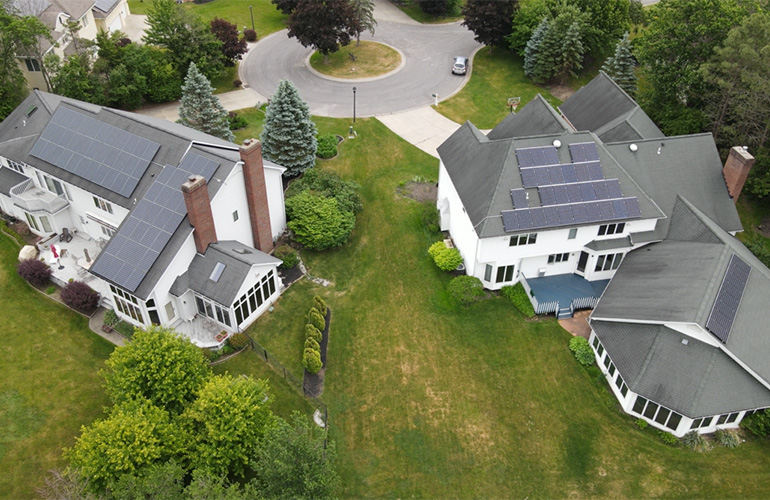
A solar project built on a residential rooftop. The residential market is shifting toward third party owned projects while the 48E tax credit is intact. Solar Liberty
“AVLs existed with cash and loan, but they were a little different in that the consumer was responsible for future maintenance of their systems,” said Sean Hayes, senior VP and GM of Palmetto. “Since we own it, the stakes of, ‘Is this equipment high quality?’ is much higher.”
In TPO scenarios, a company like Palmetto is responsible for fixing or replacing failing equipment, because lease contracts have performance guarantees. If a leased array doesn’t meet its expected performance, Palmetto cuts the customer a check for the difference in loss.
That’s why Palmetto scrutinizes the products on its AVL, Hayes said.
TPO financiers are also responsible for maintaining AVLs. Palmetto has a team of employees whose only job is to vet products for the list. These employees have experience in electrical engineering, financial analysis and worked at original equipment manufacturers.
They internally review products with information provided by manufacturers: data sheets, warranties, expected degradation, real-world performance and bankability. Palmetto also uses a third-party engineer for additional product reporting.
“If you’re not on the AVL, you can’t have your product used,” Hayes said.
Products that are on AVLs tend to also stay on the list for a while, he said, unless the manufacturer goes out of business or ends a specific product line. Palmetto doesn’t require domestic content for its projects, because procuring those products can ultimately make an array more expensive. The FEOC regulation has restricted the number of viable products available already.
“Yes, it is more restrictive, but there’s enough product and selection out there to ensure that installers have access and they’re not constricted from a supply chain side,” Hayes said. “The products are largely what they were installing to begin with. It just may be a different module now, or they can’t install an inverter that was a new-comer.”
AVLs and safe harboring
The 48E tax credit is still active for commercial and TPO residential solar projects through 2027. When the end of that year approaches, it will be possible to “safe harbor” solar projects to qualify for the 30% tax credit past 2027. This can be done by starting construction or incurring 5% of a project’s cost by the end of July 4, 2026, and coming online by the end of 2029.
Safe harboring residential TPO projects will require procuring a backstock of components on financiers’ AVLs. Current distribution bottlenecks could affect the effectiveness of safe harboring.
In the meantime, 48E is still active and residential solar contractors are incentivized to build projects for TPO providers. Prior to 2025, Solar Liberty hadn’t built a leased solar project since 2010. Civic Renewables’ subsidiaries Green Rack, FPM Solar & Roofing and Ipsun Solar have occasionally sold TPO projects but primarily worked as subcontractors and EPCs.
However, the U.S. residential market has shifted.
“Everybody who’s doing residential needs to be looking at TPO right now,” Civic Renewables’ Brown said.