


The U.S. energy storage market hit a record 18.9 GW of battery energy storage system (BESS) installations in 2025, a 52% increase over 2024, according to the latest “U.S. Energy Storage Monitor” report released today by the American Clean Power Association (ACP) and industry analyst Wood Mackenzie.

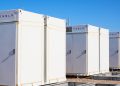
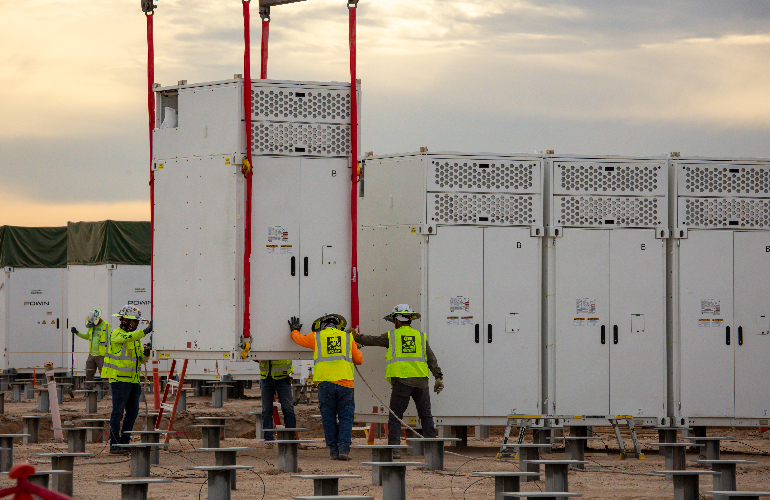
A solar + storage project in Arizona in the process of adding BESS. Credit: McCarthy Building Companies
In Q4 2025 alone, 5.8 GW was installed. Utility-scale installations accounted for 4.9 GW of that total, a 31% increase over the previous year. New activity was spread across 13 different states, showing a market increase outside of leading states California and Texas.
The U.S. residential storage market also hit a quarterly milestone in Q4 with 1 GWh installed as tax incentive expiration dates accelerated demand. The residential market installed a total of more than 800 MW in 2025, a 75% year-over-year increase. California led in growth, installing 700 MW more in 2025 than it did in 2024, driven by high retail electricity rates and a net billing tariff incentivizing battery discharge during peak energy usage hours. Puerto Rico, Texas, Arizona, and Illinois rounded out the top five markets for storage growth in 2025.
The community, commercial and industrial (C&I) market also saw record growth with 77 MW installed in Q4 2025 as state policies boosted deployments.
“The record-breaking energy storage growth seen in 2025 highlights how technology innovation is transforming America’s grid,” said John Hensley, senior VP of markets and policy analysis at ACP. “This momentum, driven by supportive policy and expanding market opportunities, demonstrates that large-scale storage is now a cornerstone of delivering affordable, reliable and American-made energy in communities nationwide. Continued collaboration across industry and government will be essential to building on this progress and meeting soaring energy demand.”
U.S. Installations to surpass 28 GW by 2031 across all segments
Wood Mackenzie expects this momentum in the BESS market will continue. The report predicts that the U.S. will install half a terawatt-hour of storage between 2026 to 2031, a 250% increase over the previous five-year period. Utility deployment is expected to lead that effort, which is predicted to double between 2025 and 2030 in gigawatt-hours installed.
A record-breaking number of projects started construction in 2025 to lock in the previous federal investment tax credit (ITC) requirements. Demand for residential storage rose in 2025 as consumers took advantage of the expiring Section 25D ITC, but the residential market is expected to contract by 2% in 2026 with the expiration of the tax credit, according to the report. Annual C&I storage installations are also expected to grow by 39% between 2025 and 2030 as system costs decline and possible policy support expand profitable business cases.
“2025 was a banner year for the energy storage market,” said Allison Feeney, research analyst at Wood Mackenzie. “Declining system costs, supportive policies and growing revenue opportunities have all contributed to the impressive growth over the last six years. We expect this momentum to continue as the technology becomes even more proven and widely adopted.”
Regulatory uncertainty and variable demand growth scenarios
Wood Mackenzie assessed high-case and low-case five-year outlook scenarios for BESS in the report. The high-case would result in approximately 36 GW of new BESS deployed in 2031, if higher demand growth, federal permitting relief and storage technologies retain access to tax credits and increase domestic system and cell supply in light of Foreign Entity of Concern requirements.
However, the low case results in 17% less capacity than the base case.
“The market trajectory is strongly upward, but large load buildout and federal policy will determine whether we reach the high case of 26 GW by 2031 or something more conservative,” said Allison Weis, global head of storage at Wood Mackenzie.
News item from Wood Mackenzie & ACP