

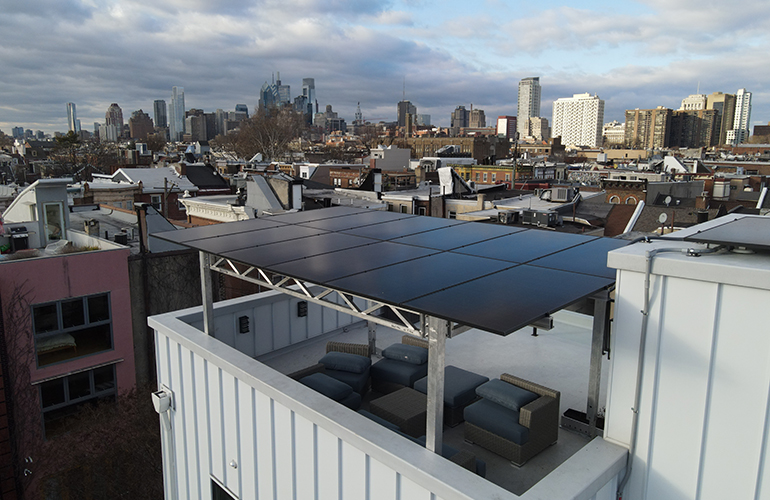

Flat roofs are traditionally sites for sprawling, low-built solar arrays meant to maximize energy output within the building’s footprint. However, some flat roofs may be better suited to smaller solar canopies that act as elevated shade structures on shared rooftops.

A solar canopy project built on a residential building in Philadelphia. Solar States
Rooftop canopies come with a whole different set of structural requirements to attach to buildings than ground-mounted carports and canopies. Instead of poured concrete columns for the foundations, solar canopies are typically attached to the parapet walls or structural beams on a roof.
Brooklyn SolarWorks, a PV contractor based in Brooklyn, New York, saw potential for solar canopies in a city where rooftop gathering spaces far outnumber grass lawns. New York City fire codes require a clear 6-ft path both front-to-back and side-to-side on residential buildings for firefighter access; and roof obstructions like hatches and vent pipes minimized sizing potential for roof-mounted solar projects.
“We knew if [a canopy] was 9-ft high it should meet the fire code requirements,” said Gaelen McKee, president and co-founder of Brooklyn SolarWorks. “We engaged with a design studio and an engineer, and we finally got this concept, and we brought it to a fabricator and made a prototype.”
The company iterated on that first solar canopy, making it lighter and faster to install, but still able to withstand the elements on New York City rooftops. Brooklyn SolarWorks was manufacturing aluminum canopy structures for its own projects, but other contractors around the country also wanted to build these arrays. So, Brooklyn SolarWorks started distributing them under the name Brooklyn Solar Canopy Co.
“It finally flipped so that we’re actually selling more canopies third-party than we are using ourselves,” McKee said.
Brooklyn Solar Canopy produces four different types of canopies and carports. Its A-Frame and Post-Truss structures can be installed on the ground or roof.
The A-Frame uses pairs of triangular supports attached at the top to trusses, and guiding rails hold the solar panels. Post-Truss uses upright columns for foundations, and supporting trusses run along the exterior and between column rows, with module-guiding rails atop.
Canopy components can be hoisted or, if there is enough space in the stairwell, carried by hand to the roof.
Installing a solar canopy requires reviewing building blueprints to determine what size rafters are under the roof surface, how far they’re spaced apart and their material. Base tracks on columns are positioned parallel to the top of a masonry/parapet wall or other roof surface so lag bolts can be driven perpendicularly into the rafters, which are often wooden. Attachment points should be spread across different rafters for proper load distribution.
“So, all the point loading is not on the masonry wall, but right inside of it, on the wood,” McKee said. “We will sometimes mount those structures to the actual parapet walls themselves, but because it’s New York, because its building stock is 150 to 200 years old, a lot of that brick is fairly degraded. You’re in a better position to fasten to the wood, just because the brick can be pretty crumbly and uneven.”

This solar project uses both the stairwell enclosure and a canopy structure as module attachment points. Solar States
In new construction projects where fresh concrete is poured, the canopy can be bolted directly into the concrete wall. Solar States, a residential and commercial PV contractor based in Philadelphia, has made solar canopy projects a regular part of its output, and many of those elevated arrays have been installed on new or recently built homes.
Many Philadelphians add shade structures to town- or rowhouses with roof access — locally known as “roof decks.” Solar States wanted solar canopies as an option for Philly roof decks, but the city initially considered them an “unknown use.” They weren’t traditional rooftop solar or a canopy. They were considered an auxiliary structure and required individual zoning variance with each project.
“If you look around Philadelphia, there’s tons of people that go to Home Depot and buy a backyard patio or pergola and just throw it up on the roof. That’s not permitted,” said Jared Pashko, director of sales and marketing at Solar States. “We need to do everything permitted, and in order to get it permitted, it needs to be structurally stamped.”
The company successfully advocated for a piece of legislation that codified solar canopies for rooftop construction within the city. Every city will have individual quirks for this type of solar project.
When building solar canopies in Philadelphia, Solar States isn’t covering the entire roof. These 5- to 8-kW arrays often occupy about one-third of the space, due to obstructions like stairwell enclosures on roofs.
There’s more material involved in building a solar canopy than a traditional rooftop solar project, but Pashko said the costs are comparable to having a non-PV shade structure built on a roof — except these ones are creating more living space in a home while increasing its property value and saving on energy costs.
“I think that being able to offer that to homeowners is great. Separately, for solar contractors, it opened up a new market segment for us,” he said. “We’re able to install high-profit-margin projects that customers are asking for where there’s not a lot of competition, and that’s a really great thing. It gives us more resources at our disposal to deploy solar and transition to a sustainable economy.”