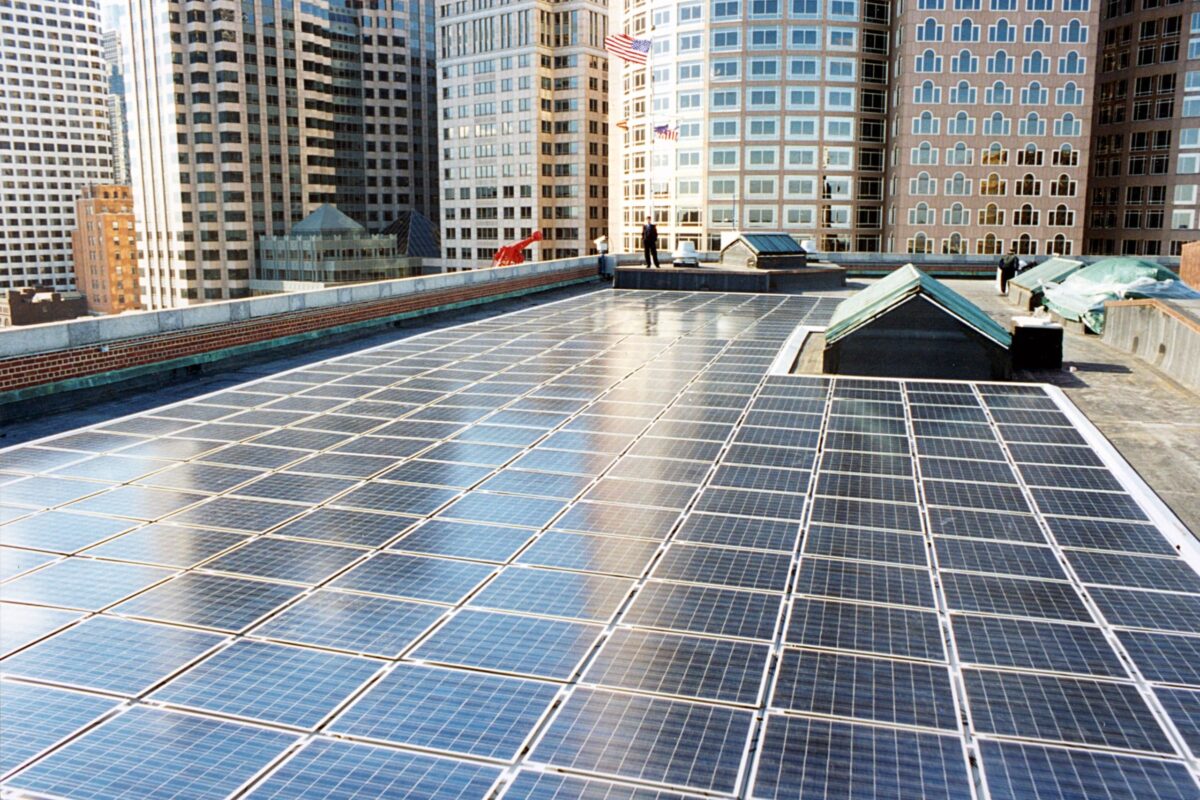


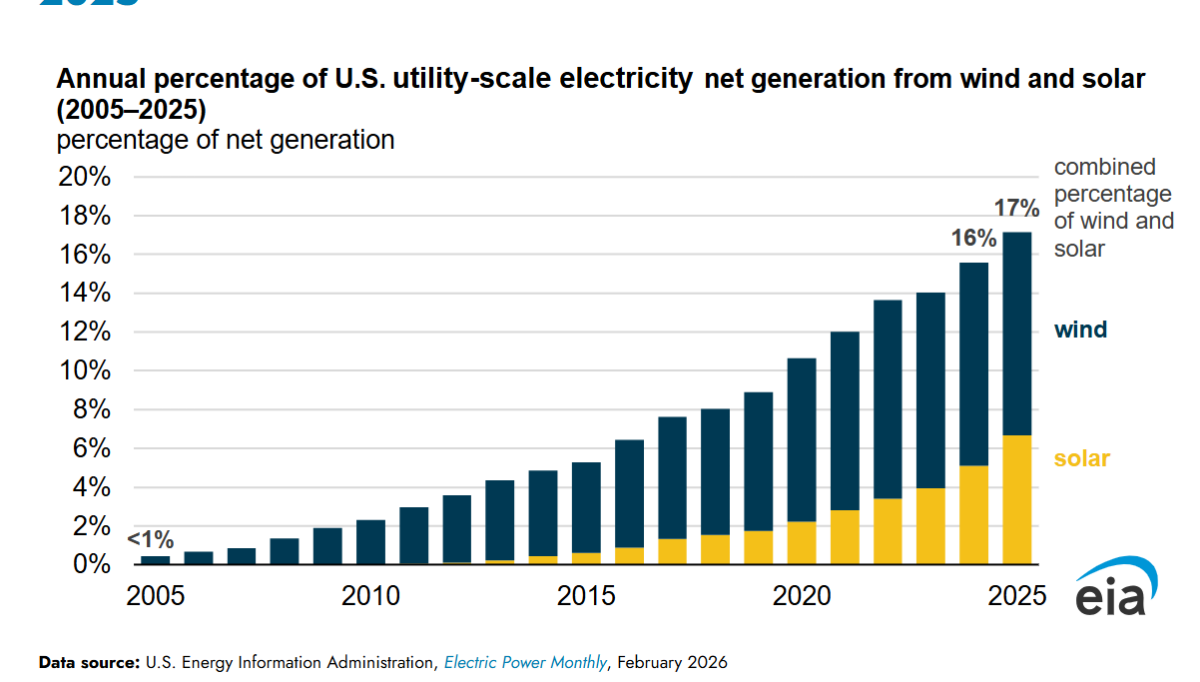
The combined output from wind and utility-scale solar reached a record 760,000 GWh last year, accounting for 17% of total U.S. electricity generation as the sector scales to meet intensifying load growth.
Combined generation from wind and utility-scale solar reached a record 17% of the U.S. electricity mix in 2025, a significant jump from less than 1% two decades ago.
According to the latest data from the U.S. Energy Information Administration’s (EIA) Electric Power Monthly, the two technologies produced a combined 760,000 GWh last year, an increase of 88,000 GWh over 2024 levels.
Utility-scale solar remains the primary engine of growth within the renewable sector. In 2025, solar generation totaled 296,000 GWh, marking a 34% year-over-year increase. This continues an unbroken streak of annual generation growth for the technology dating back to 2006.
When accounting for small-scale solar like residential rooftop installations, the contribution is even more pronounced. Small-scale solar generated an estimated 93,000 GWh in 2025, up 11% from the previous year. Factoring in these distributed assets brings the total combined share of wind and solar to 19% of total U.S. net generation.
While solar is expanding more rapidly in percentage terms, wind power remains the larger source of zero-carbon electrons by volume. Wind turbines generated 464,000 GWh in 2025, a 3% increase compared to 2024.
The steady rise of these “big two” renewables comes as U.S. electricity demand enters a new phase of intensification. After nearly 15 years of flat demand, “net energy for load” grew at an annual rate of 1.7% between 2020 and 2025. EIA analysts attribute much of this localized pressure to the rapid build-out of data centers and the expansion of industrial electrification, particularly in markets like Texas and the Mid-Atlantic.
The pace of future integration will likely depend on the industry’s ability to navigate persistent interconnection backlogs and the continued deployment of battery energy storage systems (BESS) to manage the variability of these record-breaking renewable volumes.
Project developers and utility operators are preparing for a historic expansion of the U.S. electric grid, with 86 GW of new utility-scale generating capacity slated to come online in 2026.
According to the February 2026 Electric Power Monthly report from the Energy Information Administration (EIA), the surge represents the largest single-year capacity addition in over two decades, nearly doubling the 53 GW installed in 2025.
The growth is overwhelmingly driven by “the big two” of the energy transition: solar and battery storage. Combined, these two technologies account for 79% of all planned additions for the year.
This content is protected by copyright and may not be reused. If you want to cooperate with us and would like to reuse some of our content, please contact: editors@pv-magazine.com.
Popular content