

by Riko Seibo
Tokyo, Japan (SPX) Jan 21, 2026
Osaka Metropolitan University scientists have developed a single organic molecule that naturally forms the internal p/n junctions needed for converting sunlight into electricity, offering a potential shortcut to more efficient organic thin film solar cells. The study shows how careful molecular design and self assembly can generate stable nanoscale p/n heterojunctions without the need to physically mix separate p type and n type materials.
Solar cells generate electricity when photons create charge carriers in a semiconductor and an internal electric field at a p/n junction drives those charges apart. In conventional devices, these junctions form at the interface between separate p type and n type materials, but small variations in processing can disrupt the interface, leading to inconsistent performance and reduced efficiency.
Organic thin film solar cells use carbon based semiconductors instead of silicon, making them lightweight, flexible and suitable for printing onto window films, building materials and even fabrics. Despite these advantages, their power conversion efficiency still trails that of silicon, in part because it is difficult to reproducibly engineer an optimal interface between p type and n type domains at the nanoscale. Researchers can tune the electronic properties and morphology of organic materials, but the required precision remains challenging in real devices.
To tackle this issue, the Osaka team explored a strategy that integrates both semiconductor types into a single molecular system that self assembles into nanoscale p/n heterojunctions. In such single component systems, subtle differences in solvent or temperature can drive the formation of competing aggregate structures, making it difficult to obtain well defined and functionally optimal junction architectures. The researchers therefore focused on controlling supramolecular assembly pathways to select a specific nanoscale structure with desirable electronic behavior.
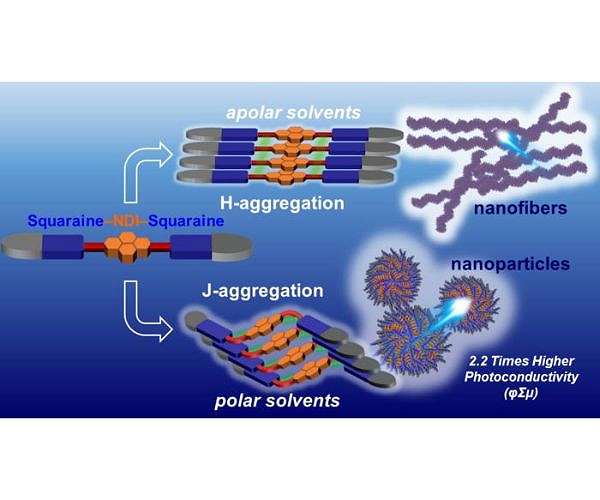
The team designed a donor acceptor donor molecule dubbed TISQ that combines a squaraine based p type segment with a naphthalene diimide n type segment in one molecular backbone. Amide linkages connect these segments and promote hydrogen bonding, enabling TISQ molecules to organize themselves into ordered aggregates. This architecture was intended to encourage the spontaneous formation of built in nanoscale p/n heterojunctions through self assembly alone, without external templating or complex processing.
Experiments revealed that TISQ can self assemble into two distinct types of supramolecular aggregates depending on the solvent environment. In polar solvents, TISQ forms nanoparticle like J type aggregates through a cooperative nucleation elongation process. In less polar solvents, the molecule instead assembles into fibrous H type aggregates via an isodesmic, stepwise mechanism in which each added molecule contributes similarly to the growing structure.
These different aggregate morphologies exhibit markedly different electronic behavior under illumination. Measurements showed that the J type aggregates produce nearly double the photocurrent response of the H type aggregates, highlighting how nanoscale packing and supramolecular architecture directly influence charge separation and transport. The results link solvent controlled self assembly to a measurable change in photoresponse in a single component organic material.
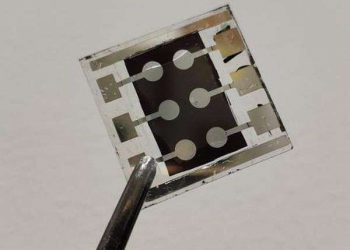
To assess device relevance, the researchers incorporated TISQ as the sole photoactive component in organic thin film solar cells. In these test devices, TISQ self assembled into nanoscale p/n heterojunctions, demonstrating that the molecular design can autonomously generate functional internal interfaces suitable for photovoltaic operation. The work provides a proof of concept that a single, carefully engineered molecule can supply both p type and n type functionality and organize itself into an electronically active junction.
The authors describe this as a bottom up approach to translating molecular level self organization into macroscale electronic function. By correlating specific supramolecular structures with photocurrent responses, the study offers a framework for using self assembly to systematically connect nanoscale p/n heterojunction architectures with device level performance. This concept could extend beyond solar cells to other organic optoelectronic devices, including photodetectors and light harvesting systems.
Although the power conversion efficiency of the prototype TISQ devices remains low and is not yet suitable for practical deployment, the work clarifies how subtle changes in nanoscale self assembly can strongly affect photocurrent in a single component organic system. The researchers aim to refine molecular design strategies and assembly control to improve both junction quality and charge transport, thereby expanding the design space of organic thin film solar cells and related optoelectronic materials. The findings are reported in Angewandte Chemie International Edition.
Related Links
Osaka Metropolitan University
All About Solar Energy at SolarDaily.com