

by Riko Seibo
Tokyo, Japan (SPX) Mar 30. 2026
As demand for renewable energy grows worldwide, engineers continue to wrestle with how to harvest the full solar spectrum efficiently using different conversion technologies in a single system. Photovoltaic cells operate best at relatively low temperatures, while photothermal and thermophotovoltaic systems require high temperatures, creating a thermal conflict that has limited hybrid solar designs.
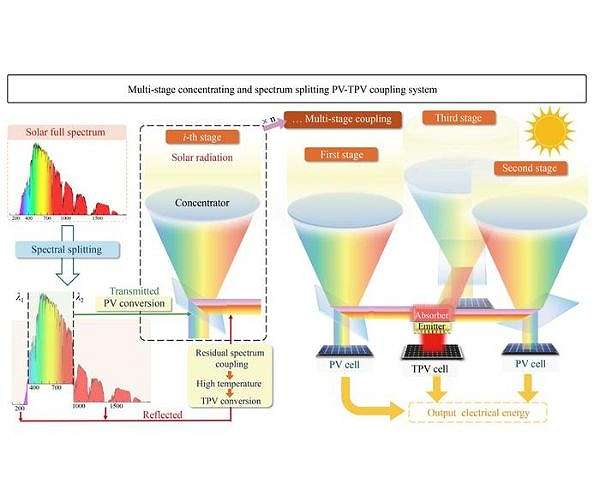
A research team from the State Key Laboratory of Clean Energy Utilization at Zhejiang University has now proposed a multi-stage concentrating and spectrum-splitting approach to overcome this conflict. In work reported in the journal ENGINEERING Energy, the team introduces a complementary photovoltaic-thermophotovoltaic conversion method that aims to use both visible and infrared light more effectively.
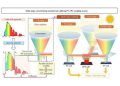
The core innovation is a multi-stage architecture that decouples the temperature and concentration requirements of the photovoltaic and thermophotovoltaic modules. In conventional spectrum-splitting systems, all components typically see the same solar concentration ratio, forcing designers to compromise between keeping photovoltaic cells cool and providing sufficient heat for thermophotovoltaic operation.
In the new concept, advanced spectrum-splitting filters, such as SiO2/TiO2 interference thin films, separate different portions of the solar spectrum before they reach each conversion stage. High-energy photons are directed to photovoltaic cells under lower concentration ratios to preserve electrical conversion efficiency, while lower-energy photons from residual spectra are coupled into a photothermal pathway to generate high-grade thermal energy for thermophotovoltaic conversion.
The researchers developed multi-stage thermophysical models based on thermodynamic analysis, coupling a Shockley-Queisser framework with external quantum efficiency behavior for different cell combinations. These models allow performance evaluation from idealized limits to more realistic operating conditions, taking into account bandgap selection and temperature coefficients.
Using this modeling approach, the team optimized a single-stage spectrum-splitting photovoltaic-thermophotovoltaic system as a baseline and then investigated how multi-stage spectrum coupling alters system performance. They found that low-bandgap cells with higher temperature coefficients can deliver superior performance at lower concentration ratios compared with high-bandgap cells that require higher concentration to reach similar outputs.
In particular, multi-stage configurations using Gallium Antimonide cells showed improved behavior over traditional single-stage hybrid designs, especially at modest initial concentration ratios. By separating the light-harvesting stages, the system can reach the high heat collection temperatures thermophotovoltaic devices need without overheating the photovoltaic components.
When the researchers incorporated a practical external quantum efficiency model, they identified additional advantages for low-bandgap cells. The analysis indicated that a maximum system efficiency of around 41.82 percent is achievable at a photovoltaic concentration ratio of 500 and a thermophotovoltaic concentration ratio of 300, under the specified modeling assumptions.
The multi-stage spectrum-splitting design also enables independent adjustment of spectrum allocation and concentration ratio, which can cut the overall system concentration requirement by more than half while maintaining high performance. This reduction in concentration eases the demands on concentrator optics and cooling, potentially simplifying device design and supporting practical deployment.
According to the team, full-spectrum solar utilization has long been constrained by the opposing thermal needs of different conversion technologies. They argue that the proposed multi-stage framework offers a flexible platform that can be tuned for various materials and geographic conditions, opening possibilities for new high-efficiency solar power plants that co-generate electricity and high-grade heat.
The study provides a theoretical foundation for integrating photovoltaic and thermophotovoltaic processes in decentralized energy systems and industrial facilities that need both electrical power and process heat. By clarifying how spectrum-splitting strategies, bandgap choices, and concentration ratios interact, the work points toward directions for future device development and experimental validation.
Related Links
State Key Laboratory of Clean Energy Utilization at Zhejiang University
All About Solar Energy at SolarDaily.com