


Monitoring advancements have made solar inverters into multi-faceted devices capable of engaging an increasing number of energy loads.
Gone are the days where solar system owners would discover their arrays were malfunctioning when they received an unexpected power bill. Now, major solar inverter manufacturers have granular monitoring measures in place to detect the slightest dip in array performance.
“There’s been a transition of monitoring being essential in the scope of a solar install,” said Brandon Davis, director of distribution sales, SMA America. “When it started, it was largely a desktop feature. Basically, every company has a monitoring platform now.”
Looking into every power load

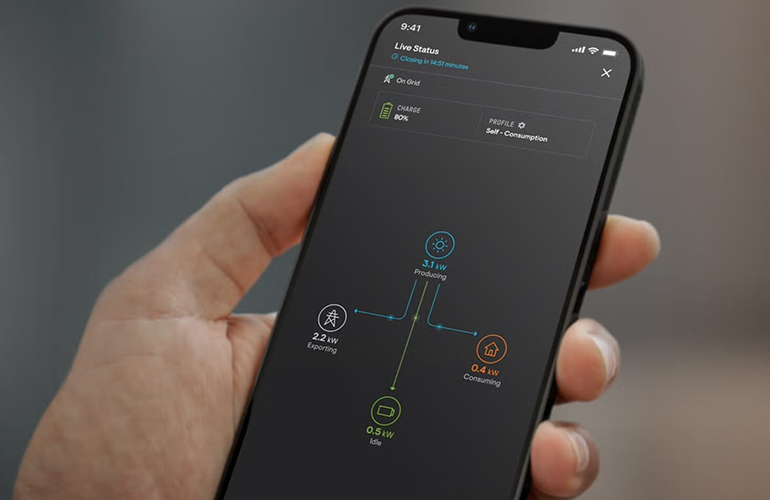
Enphase’s mobile solar inverter monitoring platform. Enphase Energy
In their original form, solar inverters provided the crucial conversion of direct current electricity from solar panels into usable alternating current electricity. While they still do, Raghu Belur, co-founder and chief products officer of Enphase Energy, now refers to inverters with their myriad capabilities as “power management platforms.”
“The reason why they have become extremely intelligent — and what the intelligence is for — is because the device is no longer simply connected to the grid,” Belur said.
Initially, inverter monitoring focused on the power levels coming from the solar panels, whether the inverters were properly functioning and ultimately if the array was meeting its quoted generation expectations. Those concerns remain today but have expanded in scope.
Enphase produces microinverters used in residential solar and the commercial space. Each microinverter is installed per panel on an array, which at the technology’s advent opened monitoring on a module-level basis.
Inverters can today monitor every source of energy they’re connected to — batteries and energy storage, electric vehicles and their chargers, where electricity is being used in a building and even the grid itself. They have advanced enough to monitor component temperatures, detect the sun’s irradiance and display even a single PV cell’s performance.
This level of monitoring has become advantageous for system owners facing grid outages and navigating specific time-of-use rates. The solar inverter can handle all these aspects to ensure a solar project is providing the most valuable result.
“[Inverter monitoring] becomes really important when you start to bring in storage and you’re trying to deal with things like NEM 3.0,” Davis said. “You want to keep all the energy in your battery to use at times of the day when energy costs are higher.”
Davis said he expects more states to adopt similar interconnection regimes like California’s NEM 3.0, so using solar + storage monitored by inverters could grow out of necessity.
Proactive and predictive maintenance
The data compiled by monitoring helps system owners and technicians make maintenance decisions. Inverters will flag underperforming arrays and attempt to diagnose the error, be it degrading modules or a faulty component, and manufacturers can dispatch a technician or order replacement parts to fix alerted issues.
“You can’t do this if you don’t have data,” Belur said. “You need detailed data, not just about your solar. You need data about all of the flexible resources that are behind the meter — and at the meter, if you have a meter collar.”
Inverter manufacturers are implementing artificial intelligence “agents” to parse the massive amounts of data generated by granular inverter monitoring. Belur said Enphase is gathering terabytes of project data daily.
Having these measures in place for predictive maintenance has increased solar system uptimes. A malfunctioning solar array is ultimately costing the system owner money, so maximizing performance and keeping systems online is paramount.
“The key part of monitoring is ensuring your customer is getting the financial returns that you guaranteed when you sold the system,” Davis said. “Peace of mind is the biggest thing.”
There are also opportunities to modernize solar arrays that were installed before inverter monitoring became the standard. SMA is pushing an initiative to replace legacy inverters with models that are monitoring-enabled. Repowering these projects can increase their longevity and help legacy components operate at new levels of efficiency.
Inverter monitoring is expected to progress further in expanding load management capabilities, namely within buildings. The original function of solar inverters remains the same, but they are not only converting electricity, but converting how solar power engages with the grid.