

by Riko Seibo
Tokyo, Japan (SPX) Dec 26, 2025
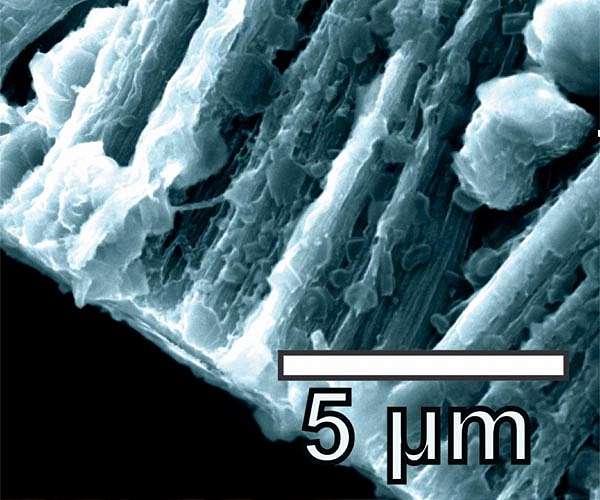
Researchers at Tohoku University have developed a covalently bridged fullerene framework that allows carbon-based lithium-ion battery anodes to store lithium in a more stable configuration while supporting fast charging. The new material, designated Mg4C60, connects fullerene (C60) molecules through covalent bridges, creating a layered structure that resists structural collapse and loss of active material during repeated cycling.
Conventional lithium-ion batteries typically use graphite anodes, which can limit fast-charging performance and create safety risks through lithium plating on the anode surface at high charge rates. By contrast, the Mg4C60 framework provides a different lithium storage mechanism within a carbon host that remains structurally robust, addressing both fast-charging limitations and degradation pathways that have hindered previous fullerene-based anodes.
The team reports that the layered Mg4C60 structure, confirmed by X-ray diffraction and electron microscopy, maintains integrity as lithium ions move in and out, avoiding the pulverization and loss of electrical contact that can occur in less stable architectures. Spectroscopic analysis, including carbon K-edge X-ray absorption, further characterizes the bonding environment and supports the proposed covalent-bridging scheme between fullerene units.
According to Distinguished Professor Hao Li of the Advanced Institute for Materials Research (WPI-AIMR), the group now plans to extend the covalent-bridging concept to a wider set of fullerene and carbon frameworks to build a family of stable, high-capacity anode materials designed for fast-charging batteries. “Our next steps are to expand this covalent-bridging strategy to a broader range of fullerene and carbon frameworks, with the goal of creating a family of stable, high-capacity anode materials suitable for fast-charging batteries,” says Distinguished Professor Hao Li (Advanced Institute for Materials Research (WPI-AIMR)).
Future work will also involve collaborations with industry to evaluate the scalability of Mg4C60-type materials and to integrate them into practical cell formats. The researchers emphasize that assessing manufacturability and performance under real-world conditions is essential for translating the laboratory results into battery technologies for electric vehicles, consumer electronics, and renewable-energy storage systems.
Research Report:Covalent Bridges Enabling Layered C60 as an Exceptionally Stable Anode in Lithium-Ion Batteries
Related Links
Tohoku University Advanced Institute for Materials Research
Powering The World in the 21st Century at Energy-Daily.com