


Depending on the jurisdiction, contractors can be limited in their installation locations for residential energy storage systems. Indoor setups may be preferred for accessibility and protection, but they must comply with clearance and safety requirements. It’s often easiest to install batteries outdoors, and most brands have outdoor-rated systems engineered to operate reliably under most environmental conditions. Now, residential battery suppliers are thinking even further ahead, anticipating evolving weather due to climate change and designing systems that will continue performing well into the future unknown.
Outdoor ratings
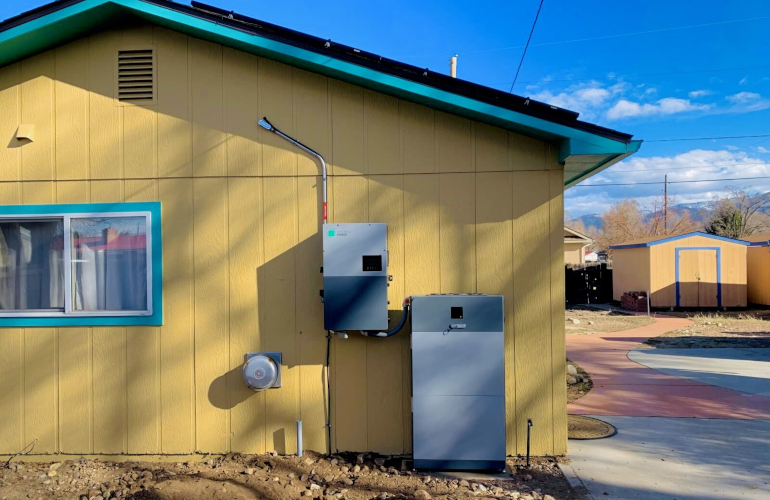
Despite product photos mostly showing interiors, residential energy storage systems are rarely installed indoors. Even garage setups can prove difficult.

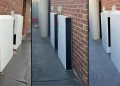
A Fortress Power installation by Colorado Mountain Solar.
“The majority of installations that we see are mounted outdoors on the wall,” said Sequoya Cross, VP of energy storage for Briggs & Stratton Energy Solutions. “Regulations for indoor installations are more restrictive as they need to be in a non-habitable space — usually a garage. There are additional limitations … somewhere where it cannot be impacted by a car and is far enough away from any ignition sources. This can be limiting for many homes that may not have space in a garage, or require installation of bollards to protect the batteries from impact. Due to these requirements, many batteries have become outdoor-rated so that they can endure the elements.”
As batteries have become more modular, all the electrical bits have been condensed into one enclosure, just like in Briggs & Stratton’s SimpliPHI system. When stacked, the SimpliPHI system is rated at IP65 — the common outdoor rating for the residential storage market. The International Electrotechnical Commission’s ingress protection (IP) rating scale consists of two numbers, with the first designating dust protection (on a scale of 0-6) and the second designating water protection (on a 0-9 scale). IP65-rated enclosures are dust-tight and have above-average water protection. IP65 systems are protected against water jets, which is well above the protection needed for falling waterdrops and spraying and splashing water.
FranklinWH has gone even further with its aPower 2 and aPower S systems. These 15-kWh batteries are rated at IP67 — still dust-tight but now also protected “against the effects of temporary immersion in water.” The FranklinWH systems should withstand temporary flooding conditions. The Tesla Powerwall variants also have an IP67 rating.
“Choosing IP67 wasn’t about chasing a spec; it was about resilience,” said Ke Bi, COO of FranklinWH. “From wind‑driven rain to standing water after a storm, higher protection helps the system ride through real‑world conditions and deliver reliable backup when the grid goes down.”
Temperature control
Along with ensuring outdoor elements can’t get inside the battery, making sure that battery can perform in a range of temperatures is equally important.

A Fortress Power install in California by Your Power.
The sun itself can be a concern, as has been noted in the inverter world. Anthony Pingicer, marketing director with Fortress Power, said that while the company uses Tier 1 battery cells that perform well in a range of conditions, it’s still good practice to not install any energy storage device in direct sunlight, like on a south-facing wall with no cover. Most residential energy storage systems have an operational temperature range between -4°F and 131°F, and continuous sun exposure along with regular charging and discharging can rapidly increase internal cell temperatures.
Fortress batteries have the highest operating temperature in the industry at 140°F — almost 10° beyond all competitors. Pingicer said that although extreme temperatures are not typical conditions, the growing frequency of record-breaking-heat days led Fortress to increase operating temperatures further.
“Higher ambient temperatures often correlate with increased electricity consumption and, consequently, higher energy costs. Our goal is to deliver a reliable and efficient energy storage system that not only mitigates the challenges of exceptionally hot summer days, but also helps reduce overall electricity expenses,” he said.
On the other extreme, most U.S. locations don’t reach -4°F, but even mildly cold weather can wreak havoc on a lithium battery’s performance.
“Cold weather starts to become a consideration as lithium batteries do not perform well in those environments,” said Cross with Briggs & Stratton. “If the area is cold, the batteries will need some form of heating and even protection from the elements.”
Companies usually include some type of heating element with their residential battery systems, including FranklinWH’s “heating blanket” and an integrated heater on EG4 units. Fortress Power systems also use a heater to ensure batteries aren’t impacted by below-freezing temperatures. When the internal cell temperature reaches 41°F — 9° above freezing — the heater turns on and warms the Fortress system to 50°F.

FranklinWH systems performing in snowy conditions.
With weather conditions varying across the country, Pingicer noted the importance of reviewing spec sheets and qualifications for every unique installation.
“Not every outdoor-rated battery will come equipped to mitigate climate changes,” he said. “Regardless of the installation location, it is essential that all ESS units carry UL 9540 and UL 9540A certifications to ensure compliance with established safety and performance standards.”