


As residential solar shifts toward leases and PPAs, installers are rapidly expanding into solar installer financing programs to stay competitive. But across the industry, a clear pattern is emerging: teams that were built to execute installs are now being forced to manage financing workflows that require a completely different level of precision, coordination, and operational control. The result is that financing is no longer just a sales lever, it’s becoming the primary operational constraint on growth.
The solar financing application process introduces strict requirements, fragmented workflows, and new operational risks that directly impact approvals, timelines, and cash flow. For many teams, this becomes the bottleneck that slows growth rather than enabling it.
Why Solar Financing Workflows Break at Scale
Most installers try to layer solar PPA application workflows and TPO processes onto systems designed for cash or loan deals. That mismatch creates friction at every stage.
This results in compounding operational failure.
- Data is captured inconsistently, then re-entered across systems
- Small errors trigger rejections and restart loops
- Field documentation fails to meet financing standards
- Teams rely on manual coordination across sales, ops, and field
This creates a “death by a thousand cuts” effect, where teams spend more time fixing issues than moving projects forward.
At higher volumes, the problem worsens. Every additional deal adds near one-to-one operational overhead without structured systems in place.
The Real Challenge: Operational Execution
Financing partners have extremely rigorous requirements, including:
- Structured, validated data at every step
- Strict documentation standards, especially post-install
- Consistent workflows across every project
Even a single missing photo or incorrect input can delay funding or trigger rejection.
This shifts solar from a project execution model to a finance-driven operational model, where precision and consistency determine revenue timing.
What It Takes to Streamline Solar Financing
To truly streamline solar financing submissions, workflows must do more than track tasks. They must enforce how work gets done.
That means:
- Capturing the right data once, at the source
- Validating inputs before projects progress
- Standardizing execution across teams
- Connecting every step into a single system
Without this, errors introduced early in the solar financing workflow automation process surface later when they are more expensive to fix.
The 4 Core Workflows Behind Scalable Solar TPO Application Management
High-performing teams do not treat financing as a single step. They structure the solar financing application process into connected workflows that enforce accuracy, consistency, and accountability at every stage.

1. Financing Intake and Qualification Workflow
Most financing failures originate at intake. Sales teams often qualify deals based on what closes, not what meets financing criteria. Without enforced validation, incomplete or ineligible projects move forward and fail later when more time and cost have already been invested.
That’s why a structured intake workflow that captures and validates all financing data is critical at the earliest stage of the project.
A sample workflow could include:
- Deal marked as “Financing Required” in your CRM
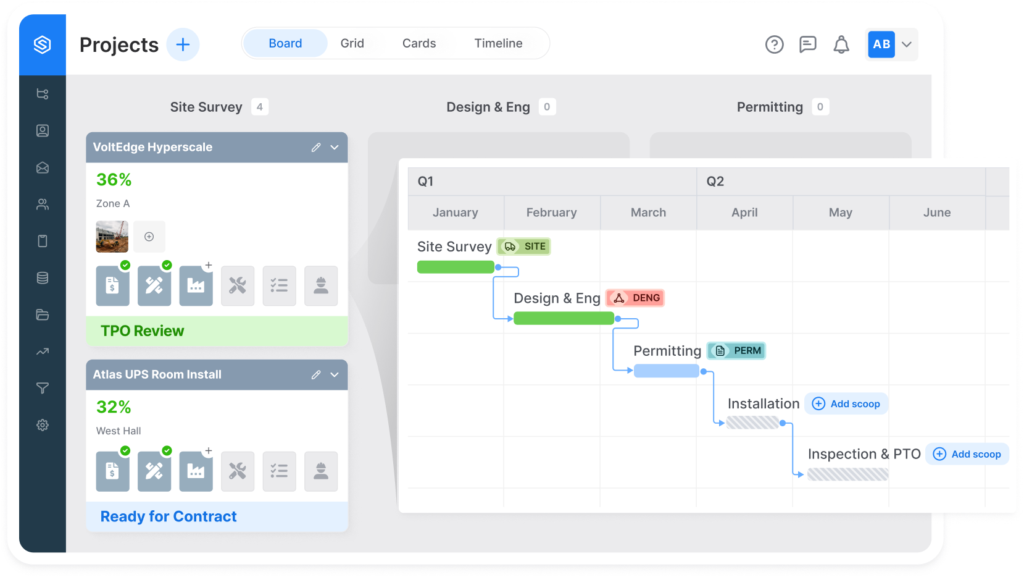
- Project is automatically created in Scoop with financing intake requirements
- Required fields enforced through structured forms
- System validates eligibility rules
- Conditional logic flags issues or blocks progression
- Only qualified deals move to project setup
Workflows like these help mitigate issues caused by PPAs being rejected weeks after submission because roof type or utility constraints do not meet lender requirements. By this point, commissions are paid, install capacity is scheduled, and the customer expects delivery.
A structured intake workflow would have validated those constraints upfront and stopped the deal before it entered the pipeline, avoiding margin loss and customer churn.
2. Project Setup and Validation Workflow
Once a deal passes intake, the next risk is data misalignment. The solar PPA application workflow often spans multiple systems, and even small inconsistencies can trigger rejections, delays, or resubmissions. Without a structured validation layer, teams rely on manual checks, which are inconsistent and difficult to scale.
That’s why a centralized validation workflow that ensures all project data is complete and aligned before execution is critical.
That workflow could look like:
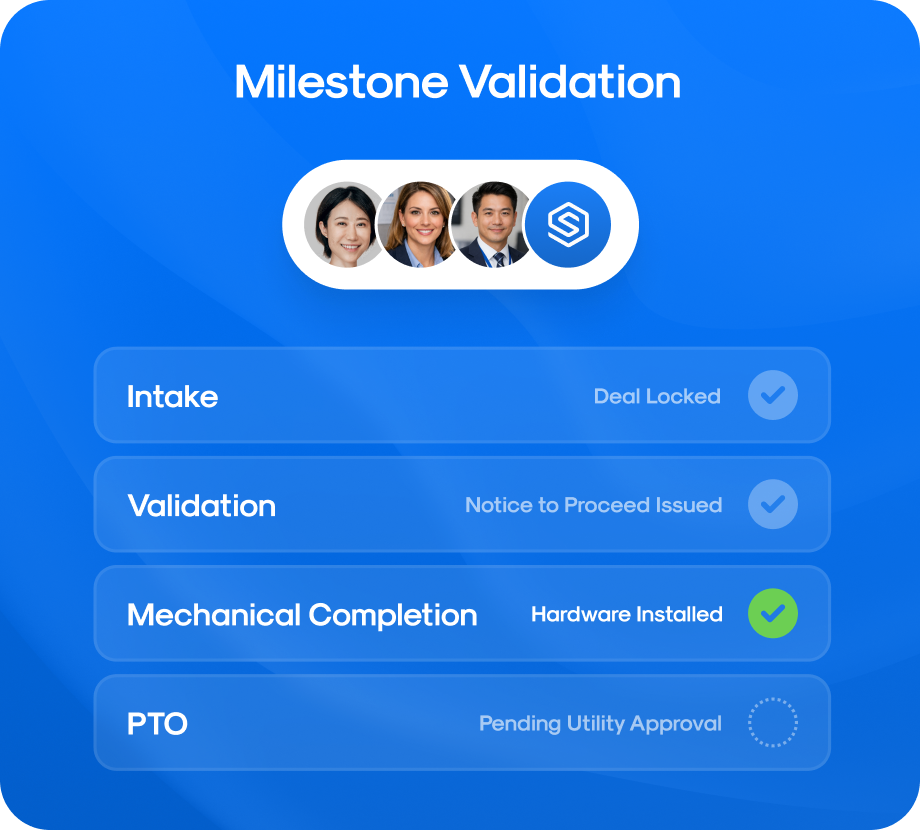
- Project enters a “Pre-Submission Validation” stage
- Data is automatically pulled from CRM, design tools, and financing inputs
- System runs validation checks across key fields
- Address, utility account, and customer details are standardized and verified
- Missing or inconsistent data is flagged automatically
- Tasks are assigned to sales or ops to resolve issues
- Project cannot progress until all validation rules are passed
Workflows like these help mitigate issues caused by financing submissions being rejected due to minor data mismatches, such as formatting inconsistencies between systems or incorrect utility information. These errors often trigger resubmission cycles that delay approvals and create unnecessary operational work.
A structured validation workflow ensures data is correct before submission, eliminating avoidable rework loops and keeping projects moving forward without delays.
3. Field Execution and Documentation Workflow
Field execution is one of the most common failure points in the solar financing application process. Financing providers require highly specific and structured documentation, but most field teams are not guided on exactly what to capture or how to capture it. This leads to inconsistent data, missing documentation, and costly rework.
That’s why a guided field workflow that standardizes how installation data and documentation are captured is critical.
This is what it looks like in practice:
- Project enters an “Installation and Documentation” stage
- Field crews receive mobile checklists tied to financing requirements
- Required photos and data points are clearly defined
- Step-by-step capture instructions guide the technician
- Photo types and counts are enforced before task completion
- Real-time validation flags missing or incorrect inputs
- All documentation syncs automatically to the project record
- Project cannot move forward until documentation is complete
Workflows like these help mitigate issues where an installation is technically complete, but financing approval is delayed because required photos, such as inverter labels or array shots, are missing or incorrectly captured. This often results in repeat site visits and added cost.
A structured field workflow ensures that all required documentation is captured correctly the first time, eliminating post-install chasing and preventing delays in approval and funding.
4. Submission and Approval Workflow
The final stage of the solar financing workflow automation process is where all upstream errors surface. When submission is handled manually, teams must gather documents from multiple systems, verify completeness, and format everything according to financing partner requirements. This introduces risk, delays, and inconsistency.
That’s why a structured submission workflow that compiles, validates, and prepares financing packages before submission is critical.
This workflow would include:
- Project enters a “Ready for Submission” stage
- System automatically compiles all required documentation
- Contracts, customer data, and installation records are aggregated
- Pre-submission validation checks confirm completeness
- Formatting and partner-specific requirements are enforced
- Ops reviews and approves the final package
- Submission is sent directly to the financing partner
- Status tracking updates automatically through approval stages
Workflows like these help mitigate issues where financing packages are rejected due to missing documents, inconsistent formatting, or incomplete data. These rejections often create multi-day or multi-week delays while teams track down and correct issues.
A structured submission workflow ensures everything is verified before submission, reducing revision cycles and accelerating approvals, which directly impacts how quickly revenue is realized.
Why Disconnected Tools Fail Solar Financing Workflows
Many teams attempt to solve these challenges with point solutions or integrations. That approach breaks down under TPO complexity.
Disconnected systems cannot support end-to-end data integrity, cross-team coordination, or embedded validation and process enforcement. The result is continued reliance on manual rework and coordination, which does not scale.
Using A Central Operations Hub for Solar Financing Workflow Automation
To support solar installer financing programs at scale, teams need a unified operational layer.
Scoop acts as a Central Operations Hub that connects all your systems, teams, and tools to manage projects and workflows as they progress.
Instead of managing disconnected tasks, teams operate within a single, continuous system where data is captured once and flows automatically, requirements are enforced at the right stage, and every team works from the same source of truth.
This removes the need for manual coordination and reduces variability across projects.

How Scoop Streamlines the Solar Financing Application Process
During the Financing Application
- Syncs data from CRM, design, and finance systems to reduce manual entry
- Automates document generation and form population
- Enforces early validation rules to prevent bad projects from progressing
During Project Execution
- Standardizes field documentation with guided workflows
- Ensures all financing requirements are met before submission
- Eliminates missing or inconsistent data at the source
At Submission and Approval
- Verifies completeness automatically
- Generates structured, submission-ready outputs
- Reduces approval timelines and revision cycles
The outcome is predictable, scalable solar financing workflows. With the right system in place, teams move from reactive operations to predictable execution. Instead of financing becoming a constraint, it becomes a growth driver.